
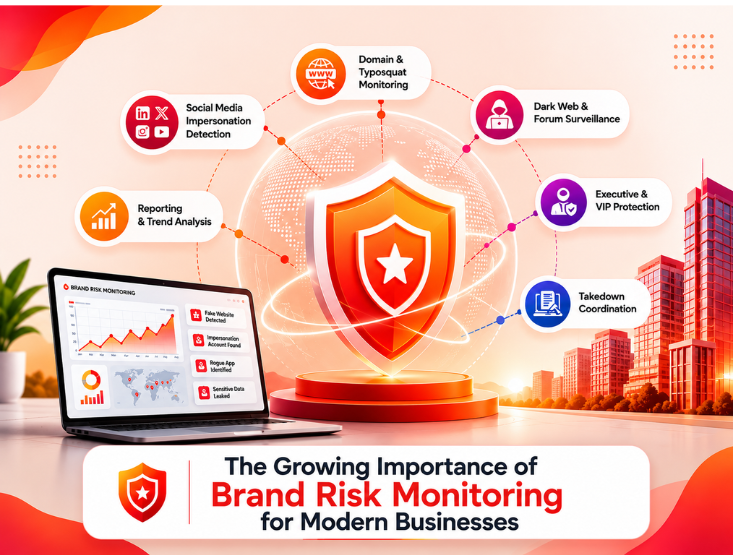
A brand rarely gets attacked at its core infrastructure first. It gets attacked at its edges, in the places a security team doesn’t own outright. A cloned website, a fake support handle on social media, an app in an unofficial store carrying the company logo. None of these sit inside a firewall, yet each one can do more damage to customer trust than a technical breach ever would.
This is the space Brand Risk Monitoring, or BRM, is built for. BRM tracks how a brand’s name, logo and digital identity are being used across the open web, social platforms, marketplaces and even parts of the internet that don’t show up in a standard search. When something is being misused, whether that’s a lookalike domain or an impersonation account collecting customer credentials, BRM is what surfaces before the damage compounds. This post looks at why brand risk has grown into its own category of exposure and what a working BRM programme actually covers.
Why Brand Impersonation Moves Faster Than Most Defences
Registering a lookalike domain takes minutes. Building a convincing clone of a login page takes an afternoon. Setting up a fake customer support account on social media takes even less time than that. None of this requires breaching a network, which is exactly why brand impersonation has become such an efficient attack path.
Apple has been the most impersonated brand in financial phishing campaigns, accounting for close to 60% of financial phishing attacks that targeted online shoppers, with Amazon a distant second. The pattern holds well beyond retail. Banks, insurers and fintech platforms in India face the same exposure, particularly during festive sale periods and tax filing windows when customers are primed to click without checking the sender closely.
What BRM Actually Watches For
This kind of programme doesn’t try to protect everything a company owns. It focuses on the surfaces attackers use to borrow a brand’s credibility. That includes domain registrations that mimic a company’s name, executive profiles cloned on social platforms and mobile apps published under a brand’s identity without authorisation. It also extends into spaces that are harder to see directly, including forums and marketplaces where stolen credentials or counterfeit goods carrying a brand’s name get traded.
The common thread across all of this is speed. A fake domain sitting unused for a week does limited harm. The same domain sending phishing emails to a bank’s customer base for a week can cause measurable financial loss and a longer reputational hangover. This works by shortening that window, not by trying to prevent the domain from being registered in the first place, which is largely outside anyone’s control.
Where BRM Coverage Typically Sits
Most organisations think of brand risk narrowly, usually as a website cloning problem. In practice it spans several distinct surfaces that need to be watched together rather than in isolation.

- Domain and DNS monitoring: Tracking lookalike and typo-squatted domains as they get registered
- Social media impersonation: Fake profiles, cloned pages and impersonation of executives or support handles
- App store monitoring: Unauthorised or malicious apps published under a brand’s name
- Dark web and forum tracking: Leaked credentials, brand mentions and counterfeit goods being traded
- Phishing and email spoofing: Domains and infrastructure built to impersonate a brand’s communications
- Marketplace abuse: Counterfeit listings and unauthorised sellers trading under a company’s name
Each of these surfaces produces its own type of alert, and the value here comes from correlating them rather than treating each as a separate feed to check manually.
The Financial Services Angle in India
Banks and NBFCs carry a particular kind of brand exposure because customers trust the brand name enough to act on instructions carrying it, whether that’s a payment request or an urgent account update. RBI has flagged phishing and impersonation as a persistent channel risk for regulated entities, and SEBI’s cyber resilience expectations increasingly look at how firms monitor their external digital footprint, not just their internal network perimeter.
This shifts brand monitoring from being a marketing concern into something closer to a compliance and fraud prevention function. A takedown that happens within hours rather than days can be the difference between an isolated phishing attempt and a wave of fraud that reaches thousands of customers before anyone notices the source.
Building BRM Into an Ongoing Security Function
Point-in-time brand checks miss the threats that matter because impersonation infrastructure gets built and torn down quickly. A domain used for one phishing wave might be abandoned within days, only for a fresh one to appear under a slightly different spelling.
A working setup runs continuously rather than as a periodic sweep. It combines automated detection across domains, social platforms and marketplaces with a validation step, since not every lookalike domain is malicious and false positives waste response time. Once something is confirmed, the process moves into takedown coordination with registrars, hosting providers and platform trust and safety teams, which is usually where in-house teams without prior experience lose the most time.
Conclusion
Brand impersonation has become a routine part of the threat landscape rather than an occasional nuisance, and it moves in places most security tools were never built to watch. BRM closes that gap by giving organisations continuous visibility into domains, social platforms, app stores and dark web activity connected to their brand, along with a faster path to takedown once something is confirmed.
CyberNX’s Brand Risk Monitoring service is built around exactly this kind of continuous coverage, paired with validation and takedown support so alerts turn into resolved incidents rather than an ever-growing list. If your organisation needs clearer visibility into how its brand is being used outside its own infrastructure, connect with their experts to see how it fits your environment.
