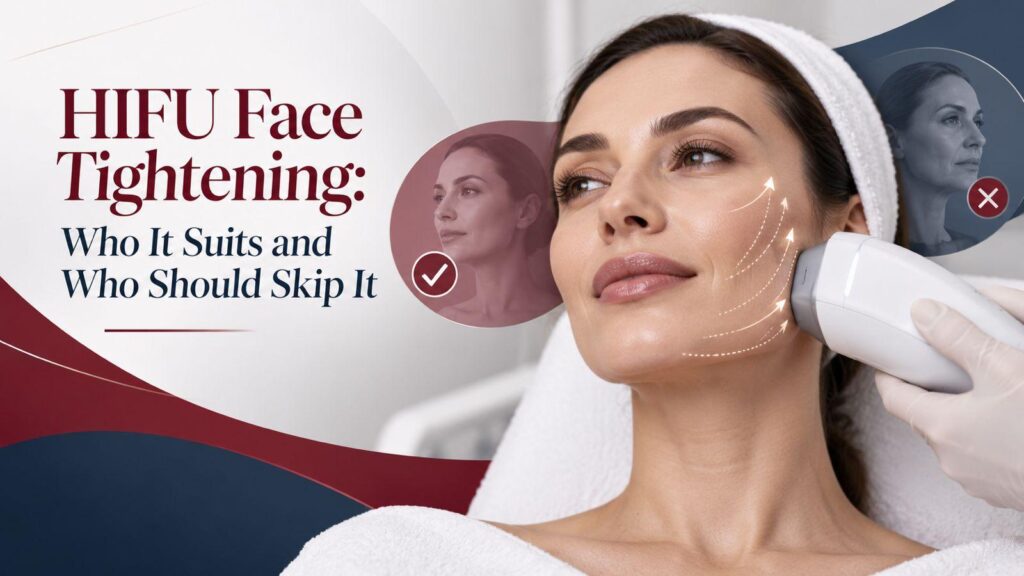
High-intensity focused ultrasound, usually shortened to HIFU, firms facial skin by heating tissue deep below the surface, without cutting or removing anything. It belongs to the wider group of facial skin tightening devices that promise a sharper jawline, a lifted brow and smoother skin without surgery or recovery time. The honest starting point is simple: HIFU rewards the right candidate and disappoints the wrong one. It performs best on mild to moderate skin laxity, and it does not stand in for a surgical facelift once sagging is advanced.
That single distinction settles most of the confusion around face tightening and face lifting with ultrasound. Knowing where your skin sits on that scale, and what a realistic result looks like, matters far more than the brand name on the machine.
How HIFU tightens the face
HIFU concentrates ultrasound energy at fixed points beneath the skin, commonly at depths around 1.5, 3.0 and 4.5 millimetres. The deepest of these reaches the superficial musculoaponeurotic system, the SMAS, the same supportive layer a surgeon repositions during a facelift. At the focal point the tissue heats to roughly 60 to 70 degrees Celsius, which creates tiny zones of controlled thermal injury while the surface skin is spared.
Two things follow. Heated collagen contracts straight away, giving a small immediate tightening. Then, over the following weeks, the body repairs those points by building new collagen and elastin. This is why face rejuvenation with ultrasound is gradual: the visible change keeps developing for about three to six months and the remodeling can continue for up to a year. The best-studied version, microfocused ultrasound with visualization (marketed as Ultherapy), is cleared by the US FDA for lifting the brow, the neck and the area under the chin, and for improving lines on the chest.
Who tends to get the best results
The strongest candidates share a pattern rather than a single trait. Skin laxity is early to moderate, the face still has reasonable structure, and the goal is refinement rather than reversal. In practice this often means people from their thirties into their fifties who notice softening along the jaw, a heavier brow or mild looseness under the chin, and who would rather maintain and delay than undergo surgery.
- Mild to moderate looseness of the cheeks, jawline, brow or under-chin area, not deep folds or heavy hanging skin.
- A lean to average build in the face, since a lower body-mass index is linked with better response.
- Realistic expectations: a subtle firming and a small lift, not the dramatic change of a facelift.
- Willingness to wait, because the result builds slowly and is judged at three to six months, not on the day.
The measured effect is genuine but modest. Studies report brow lifts on the order of half a millimetre to under two millimetres and reductions in under-chin looseness measured in tens of square millimetres. In pooled data about nine in ten patients showed some improvement at three months, yet most of that improvement fell in the mild band rather than the moderate or marked one. For the right person that quiet, natural firming is exactly the appeal.
Who should skip HIFU or choose something else
HIFU is a poor match when the problem is bulk and gravity rather than mild slackness. Two limits show up consistently in the research, so they are worth weighing honestly.
- Advanced skin laxity. When sagging is significant, with heavy jowls or loose folds of skin, results drop off sharply. Excess laxity is a common reason people are excluded from treatment, and a surgical lift is the more honest option for them.
- A higher body-mass index or a full, fatty face. Response tends to weaken above a body-mass index of about 30, and extra facial fat is linked with less tightening. In one study only three of eleven people with a body-mass index over 30 improved.
- Anyone expecting facelift-level change. If the goal is to erase years or remove substantial loose skin, HIFU will underdeliver and the money is better spent elsewhere.
A few practical cautions round this out. Almost all of the published evidence is in women, so results in men are less certain. Clinicians generally avoid treating over active skin infections, open or irritated lesions, or directly over permanent implants and fillers in the exact treatment area, and treatment is usually postponed during pregnancy because it has not been studied in that group. Because this touches on health, a qualified practitioner should assess your skin and history before anything is booked.
Good fit or not: a quick comparison
| Leans toward a good candidate | Leans toward skipping or surgery |
| Early to moderate laxity | Heavy jowls and advanced sagging |
| Lean to average facial volume | Full, fatty face or body-mass index over 30 |
| Wants subtle firming and prevention | Wants a dramatic, facelift-level change |
| Comfortable with gradual results over months | Wants a visible change immediately |
Comfort, side effects and downtime
The treatment is usually described as moderately uncomfortable, a deep prickling or heat that tracks the ultrasound pulses, and numbing cream is common. Afterward, temporary redness and some swelling are normal, and occasional bruising can appear. More significant effects are uncommon, reported in around two percent of cases: patches of numbness or heightened sensitivity, stinging, and, rarely, small burns along the jaw or minor skin marks. These generally settle within a few days to about two weeks, and most people return to normal activity the same day.
Making the decision
Think of HIFU as a maintenance and early-intervention tool rather than a rescue for advanced aging. If your skin is starting to lose crispness along the jaw or brow, your expectations are calibrated to a subtle lift, and you can wait a few months to judge it, you are the kind of candidate the technology serves well. If the sagging is heavy, the face is full, or you are hoping for the effect of a surgical lift, the wiser move is to skip HIFU and discuss other options with a qualified provider.