
|
Article Title |
The Role of Livestock Scales in Modern Farming |
|
Meta Description |
Discover how livestock scales improve modern farming through accurate animal weighing, better herd management, and increased farm productivity. |
Ask any farmer who has been in the business for thirty years how they used to judge an animal's weight, and you'll probably get a grin. "By eye," they'll say, "and by gut." Some of them were remarkably good at it. But even the best eye drifts by ten or fifteen percent, and on a herd of two hundred head, that drift adds up to real money.
Farming has changed since then, and the margins have changed with it. Feed costs swing, buyers expect consistency, and regulations ask for records that a gut feeling can't supply. That is where livestock scales stopped being a nice extra and became a core piece of equipment.
Weight is the number everything else depends on
Almost every important decision on a livestock farm comes back to weight. How much feed should this pen get? Is that calf growing the way it should? Has the sow recovered after farrowing? Is the lamb ready for market, or will another two weeks pay off?
Without a reliable weight, you are guessing at all of these. With one, you have a baseline, and a baseline is what lets you notice change. A steer that gains 1.1 kg a day on Monday and 0.6 kg a day a month later is telling you something. Maybe the pasture has thinned out, maybe there's a hidden health issue, maybe the feed mix has slipped. You'd never catch that by looking across a fence.
Feeding smarter, not just feeding more
Feed is usually the biggest expense in any livestock operation, often more than half of total costs. Overfeeding wastes it, and underfeeding costs you growth and condition. Regular weighing lets you adjust rations to what the animals actually need instead of what they needed last season.
Farmers who weigh on a schedule, say every three or four weeks, tend to learn their feed conversion numbers surprisingly fast. Once you know how many kilos of feed it takes to put on a kilo of body weight, you can compare batches, breeds and suppliers with real evidence. That kind of knowledge quietly saves thousands over a year.
Spotting health problems early
Animals hide illness well. It's an instinct, since a sick animal in the wild is a target. By the time a cow looks unwell to the human eye, she has often been struggling for days.
Weight tells the story earlier. A flat growth curve, or a sudden drop, is frequently the first sign of parasites, respiratory trouble or nutritional deficiency. Catching it at the scale rather than at the vet's emergency call-out is cheaper for the farm and kinder for the animal.
Dosing medication properly
Here is a point that doesn't get discussed enough: many treatments, from dewormers to antibiotics, are dosed by body weight. Estimate low and you risk under-treating, which can encourage resistance. Estimate high and you waste product or push toward unsafe levels. An accurate scale takes the guesswork out of every injection and drench, and that matters more with each passing year as antimicrobial stewardship gets stricter.
Selling with confidence
At sale time, weight decides the price. Farmers who sell by live weight know that a few kilos per animal can swing the cheque noticeably. Having your own accurate figures also puts you on better footing in a negotiation. You aren't relying solely on the buyer's scale or the market's, because you've been tracking the animals yourself and you know what they should weigh.
There's also breeding to think about. Replacement heifers and breeding stock are often chosen partly on growth performance. Without records, those decisions lean on memory and impression. With records, you can say with a straight face which bloodlines grow best on your land.
It isn’t only about the animals
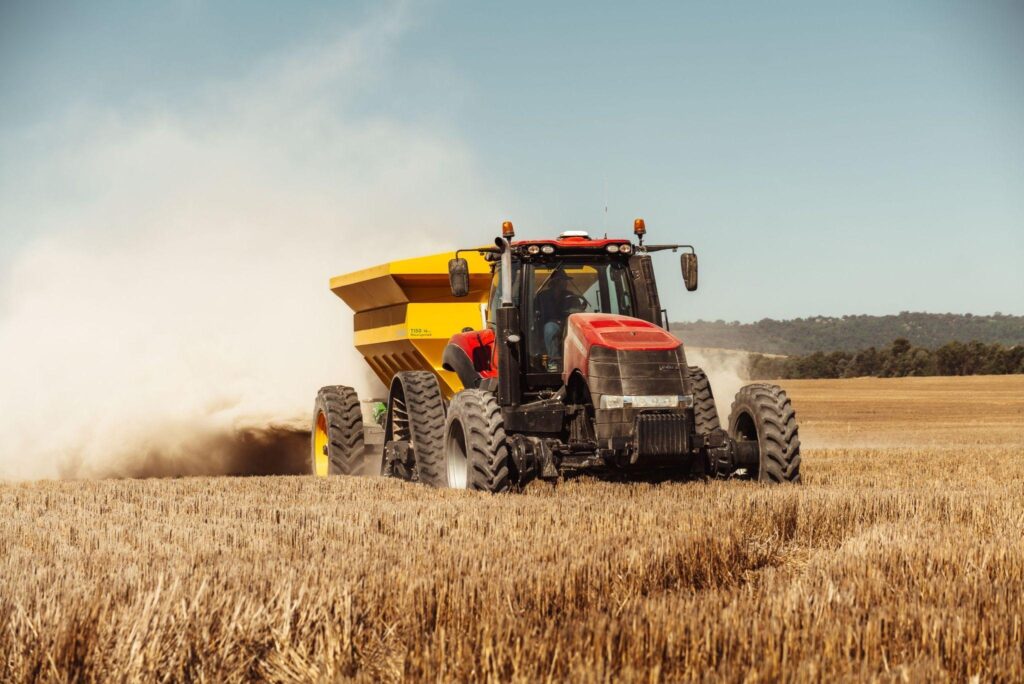
The same thinking applies to the ground they graze. Healthy pasture feeds healthy stock, and fertiliser is a major part of keeping it that way. Spread too little and the grass underperforms, spread too much and you waste money and risk runoff into waterways. A fertiliser spreader scale lets you check exactly how much product is going on per hectare, so your spreader settings are based on measurement rather than habit. Farmers who calibrate this way often find their old settings were off by a surprising margin.
What to look for in a livestock scale
Not every scale suits every farm. A few things are worth thinking through before you buy:
Capacity and size. A platform that works for sheep will not take a bull, so match the scale to your largest animal, with some headroom.
Durability. Farm conditions are rough: mud, moisture, dung, kicks and weather. Sturdy construction and sealed electronics matter far more than a long feature list.
Accuracy and stability. Animals move, shift and sometimes panic. Good indicators can average readings so you get a steady figure even when the animal won't stand still.
Data handling. The ability to store weights, link them to animal IDs and export records saves hours of paperwork, and it makes trends visible.
Portability. If you run several paddocks or share equipment between sites, a scale you can move without a crane is a real advantage.
Choosing a supplier who understands the work
Equipment is only half the picture. The other half is whether the people behind it understand how farms actually operate. This is where specialists like Meltrons come in, offering weighing equipment shaped by the practical demands of livestock handling rather than generic industrial design. When you're comparing Livestock Weighing Solutions, it helps to ask about calibration support, spare parts and after-sales service, because a scale that can't be maintained will eventually become an expensive gate-stop.
A small tool with a long reach
It's easy to think of a scale as a simple device: an animal steps on, a number appears. But that number feeds into nutrition, health, breeding, compliance and profit all at once. Farms that weigh regularly tend to run tighter, calmer operations, because they're working from facts instead of hunches.
Modern farming rarely rewards the people who guess well. It rewards the people who measure well. A good livestock scale is one of the cheapest ways to move from the first group into the second, and most farmers who make the switch say the same thing afterwards: they wish they'd done it years sooner.
