
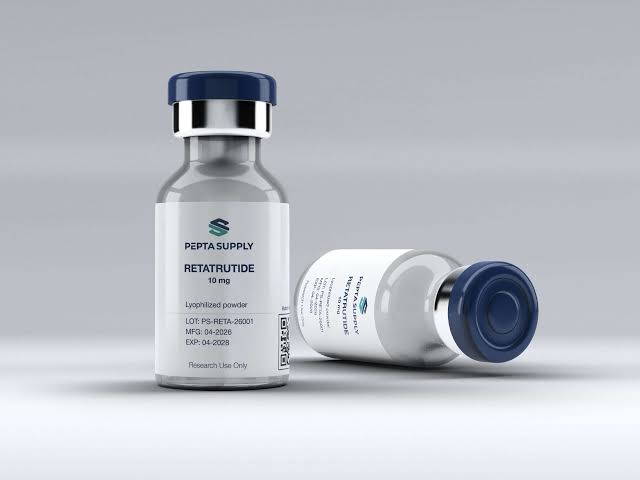
Retatrutide has become the most requested compound in the research-peptide market in a remarkably short time. An investigational triple agonist of the GLP-1, GIP and glucagon receptors developed by Eli Lilly, it produced substantial mean weight reduction in phase 2 trials and is now being evaluated in the large phase 3 TRIUMPH programme. That combination of striking early data and an unfinished approval process has created enormous demand among researchers who want to study the molecule, and an equally large supply of vendors happy to sell them something labelled with its name.
Not all of those vendors are equal, and for a compound as expensive and analytically demanding as Retatrutide the difference between a good supplier and a bad one is not a matter of a few percentage points of purity. It can be the difference between receiving the correct molecule at the labelled mass and receiving an unidentified powder with a printed label. The questions below are designed to be asked, in order, before any order for Retatrutide peptide is placed. They apply to any supplier, domestic or foreign, and to any researcher, whether at an institution or a well-equipped home bench.
A note on scope before beginning. Retatrutide is not approved by Health Canada, the FDA or any other regulator for human use. It is sold solely as a research reagent, and nothing in this article is medical advice or guidance for self-administration. The questions here are about sourcing and documentation; they assume the buyer is conducting legitimate laboratory work and is responsible for compliance with applicable law.
1. Is the Product Explicitly Sold for Research Use Only?
The first question is also the quickest filter. Look at how the supplier describes the product. A legitimate listing for Retatrutide states plainly that the compound is for laboratory research only, is not for human or veterinary use, and carries no regulatory approval. It does not include dosing schedules, before-and-after imagery, testimonials about weight loss, or language implying that the customer will experience the outcomes reported in clinical trials.
This is not merely a compliance formality. A supplier that markets an investigational compound with implied human benefits is either ignorant of the regulatory position or willing to disregard it, and neither trait inspires confidence in the rest of their operation. A supplier that states the research-only status clearly, as NOX Peptides Canada does on its Retatrutide 30 mg listing, is demonstrating that it understands what it is selling and to whom. Treat the absence of this language as a warning rather than a convenience.
2. Is There a Batch-Specific Certificate of Analysis, and Who Issued It?
A certificate of analysis is only as useful as its specificity. Ask three things: does the COA correspond to the exact lot you will receive, does it come from a laboratory independent of the seller, and does it show the raw data rather than just summary figures?
Batch specificity matters because peptide synthesis is a batch process and quality varies between runs. A COA from a lot produced eighteen months ago says nothing about the vial being shipped today. Independence matters because in-house testing is an obvious conflict of interest; a third-party laboratory has no stake in the result. Raw data matters because a stated figure of 99.1 percent purity cannot be checked, whereas an HPLC chromatogram and a mass spectrum can be read by anyone with the training to do so. A supplier that publishes all three for each lot, and makes the document available on the product page before purchase, has answered this question fully. One that offers a generic COA on request, or none at all, has not.
3. What Analytical Methods Were Used, and Are the Results Consistent?
Once a COA is in hand, read it critically. The two core methods for a research peptide are HPLC for purity and mass spectrometry for identity. For Retatrutide specifically, mass confirmation is important because the molecule carries a lipid side chain and non-standard residues; a synthesis error in those modifications produces a compound that may look acceptable on HPLC but has the wrong molecular weight and cannot be assumed to have the same receptor activity.
Check that the measured mass on the spectrum matches the theoretical value for the full modified sequence, not for a truncated or unmodified variant. Check that the HPLC trace shows a single dominant peak with a clean baseline rather than a cluster of shoulders. Check that the purity percentage stated in the summary agrees with the peak areas on the chromatogram. Inconsistencies between the summary and the data are a serious sign, and a supplier who cannot explain them should not receive the order. Additional tests such as endotoxin (LAL), residual solvent or net peptide content are marks of a more thorough supplier and are worth asking about.
4. How Is the Labelled Mass Defined?
A vial labelled “Retatrutide 30 mg” can mean two different things. It may mean 30 mg of gross lyophilised powder, of which some proportion is water, counter-ions and residual salts. Or it may mean 30 mg of net peptide, with correspondingly more total powder in the vial. The difference can be 10 to 30 percent of the peptide content, which for an expensive compound is a significant sum and, for any quantitative experiment, a significant source of error.
Ask the supplier directly which convention applies and whether net peptide content has been measured for the lot. If the answer is that the label refers to gross weight and net content is unknown, the buyer should factor that uncertainty into any concentration calculation. If the answer is that the label refers to net peptide content confirmed by amino acid analysis, the product is worth more than a nominally identical vial from a supplier who cannot say. This question separates suppliers who understand their own product from those who resell it.
5. How Is the Product Stored Before Shipping, and How Is It Shipped?
Lyophilised Retatrutide is reasonably stable when kept cold and dry, but it is not indestructible. Prolonged exposure to heat degrades it, and moisture ingress through a compromised seal ruins it. A supplier should be able to say how inventory is stored (frozen or refrigerated, protected from light), how vials are packaged for transit, and how long a typical shipment takes to arrive.
For Canadian buyers, domestic shipping is the practical answer to most cold-chain concerns. An order shipped within Canada by a supplier such as NOX Peptides Canada spends days rather than weeks in transit and does not pass through a customs facility where it may sit at ambient temperature for an unknown period. Overseas shipments, by contrast, are exposed to long and unpredictable routes, and a vial that arrives with a collapsed or discoloured cake has probably been through one. Ask about transit time and packaging before the order, and inspect the vial on arrival.
6. Where Is the Supplier Located, and What Law Governs the Transaction?
Jurisdiction is easy to overlook and hard to fix afterwards. A supplier with a Canadian business address, a Canadian phone number and a physical presence within the country operates under Canadian consumer-protection and commercial law. A buyer who has a dispute with such a supplier has recourse. A supplier that is an anonymous storefront routing orders through an overseas fulfilment centre offers none of that, whatever the website looks like.
Jurisdiction also affects the parcel itself. Retatrutide imported into Canada by an individual may be examined and seized by the Canada Border Services Agency, and there is no refund from the seller and no appeal that is likely to succeed. A domestic supplier avoids the border entirely. When comparing a lower overseas price against a domestic one, the buyer should price in the probability of seizure, the cost of a lost shipment and the absence of any legal recourse; the overseas option is rarely cheaper once those are included.
7. What Does the Supplier Refuse to Do?
This question sounds counterintuitive, but it is one of the most revealing. A reputable research-peptide supplier refuses to provide human dosing instructions, refuses to describe expected results, refuses to sell the product as a weight-loss aid, and refuses to answer questions about self-administration. It does so because the compound is not approved for any of those purposes and because offering such guidance would be both illegal and irresponsible.
A supplier that happily tells a customer how much to take and what to expect is not being helpful; it is demonstrating that it either does not understand or does not care about the product’s regulatory status. The same supplier is unlikely to be rigorous about testing, storage or anything else. Ask a borderline question and pay attention to the answer. The right response from a research supplier is a polite refusal and a reminder that the product is for laboratory use only.
8. What Is the Vial Size, and Does It Match the Research Plan?
Retatrutide is offered in a range of vial sizes across the market, and the appropriate one depends on the experiment. A larger vial such as 30 mg offers a lower cost per milligram and reduces the number of separate lots a study depends on, which improves consistency. A smaller vial reduces waste if only a small quantity is needed and limits the loss if a single vial is compromised.
The arithmetic of reconstitution is worth considering here as a laboratory matter. A 30 mg vial reconstituted with 3 mL of bacteriostatic water gives a 10 mg per mL solution; with 1.5 mL it gives 20 mg per mL. Higher concentrations use less diluent but leave less margin for measurement error when small volumes are drawn. A researcher should decide the working concentration before ordering and choose the vial size that supports it with minimal waste, bearing in mind that reconstituted solutions have a shorter shelf life than lyophilised powder and that a vial should not be reconstituted until it is needed.
9. What Do Other Researchers Say, and Where Do They Say It?
Reputation in this market is easy to manufacture and hard to verify, so the source of any review matters as much as its content. Testimonials on the supplier’s own website are worthless as evidence. Discussion in independent research forums, comments from buyers who have posted their own third-party test results, and the supplier’s longevity and consistency over time are more informative.
Look for specific, checkable claims rather than enthusiasm. A reviewer who reports that a vial was sent to an independent laboratory and returned a result consistent with the supplier’s COA has provided real information. A reviewer who reports that the “product works great” has not, and in the context of a research-only compound has said something that should not be said at all. Pay particular attention to how a supplier handles problems: a company that replaces a damaged shipment promptly and explains a discrepancy in a COA is showing the kind of accountability that matters more than any single review.
10. Does the Price Make Sense?
Retatrutide is a large, heavily modified molecule that is expensive to synthesise correctly. Its price across the research market reflects that, and a listing far below the prevailing range should prompt suspicion rather than excitement. The likely explanations for a very low price are underfilled vials, low net peptide content, poor purity, or a product that is not Retatrutide at all. None of these represent a saving.
Compare price on a per-milligram basis, adjusted for net peptide content where known, and include shipping, currency conversion and, for overseas orders, the risk of seizure. Then weigh the total against what the supplier provides in documentation, storage and accountability. A domestic supplier such as NOX Peptides Canada that publishes batch-specific third-party COAs, stores product cold and ships within Canada is delivering considerably more than a bare vial, and its pricing should be read in that context. The cheapest Retatrutide is the one that is what it claims to be; anything else is a waste of money at any price.
Frequently Asked Questions
What is the current clinical status of Retatrutide?
Retatrutide is an investigational compound developed by Eli Lilly. Phase 2 trials in adults with obesity reported substantial mean weight reduction over the study period, and the compound is now in the phase 3 TRIUMPH programme, which is evaluating it across several populations. It has no regulatory approval for any indication and is not available as a medicine anywhere in the world.
Can Retatrutide be legally purchased for research in Canada?
Research-chemical suppliers sell Retatrutide for laboratory use, and the compound is labelled accordingly. It cannot be sold or marketed for human consumption. Buyers are responsible for ensuring their own compliance with applicable law; this article is not legal advice, and anyone uncertain should consult a qualified professional.
How should a research vial of Retatrutide be stored?
Lyophilised powder should be kept frozen, typically at minus 20 degrees Celsius, protected from light and moisture. Once reconstituted, the solution should be refrigerated and used within the period specified by the supplier, since aqueous peptide solutions degrade far faster than the dry form. Repeated freeze-thaw cycles of a reconstituted solution should be avoided.
Why is third-party testing so important for this compound specifically?
Retatrutide is expensive, in high demand, and analytically complex. Those three factors together make it an attractive target for substitution, underfilling and mislabelling. Independent HPLC and mass spectrometry are the only practical way for a buyer to confirm that the vial contains the correct molecule at the stated purity, and a supplier that publishes such results for each batch is offering the buyer a verifiable product rather than a promise.
Final Thoughts
The ten questions above share a single underlying principle: a research reagent should be verifiable at every step, from the supplier’s identity to the molecule’s mass. Retatrutide’s popularity has made it the compound where that principle is tested most severely, and where the consequences of skipping the questions are most costly. A buyer who asks each one, and declines to order until the answers are satisfactory, will avoid the great majority of problems in this market.
For Canadian researchers, the practical shape of a satisfactory answer is a domestic supplier that labels the product for research use only, publishes a batch-specific third-party COA with the raw data visible, defines the labelled mass clearly, stores and ships cold within Canada, and refuses to offer any guidance on human use. NOX Peptides Canada lists its Retatrutide 30 mg research vial on exactly those terms. Whichever supplier a researcher chooses, the compound remains investigational, unapproved and for laboratory use only, and no purchase decision should be mistaken for medical advice.
