
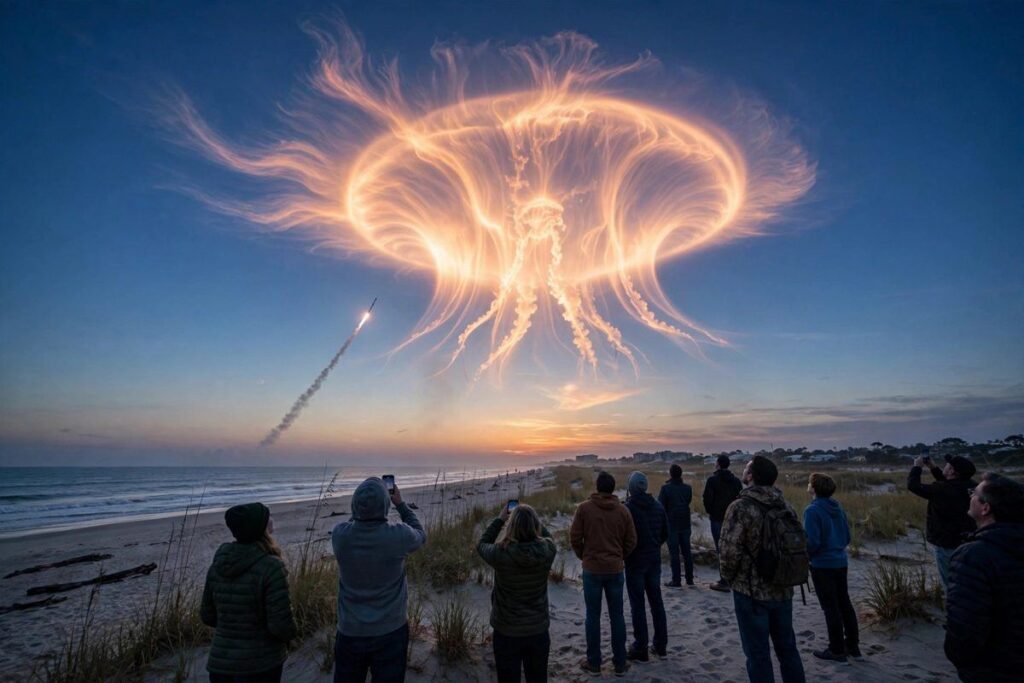
Space tourism’s first era sold a single product: a few weightless minutes for the very rich, delivered with maximum publicity. Its second era looks less like a stunt and more like an industry — diversified across price points, booked years ahead, and increasingly integrated with research and hospitality businesses that make the economics sturdier. Our business desk has been following the money as it moves from spectacle to structure.
The market is stratifying. At the top, orbital flights and planned commercial stations sell weeks, not minutes, to private astronauts and national programmes alike. Below them, suborbital operators are standardising operations — the unglamorous work of maintenance cycles and insurance that turns a demonstration into a service. And a surprise tier has emerged beneath both: stratospheric balloon capsules offering a day-long, gentle ascent to the edge of space at a fraction of rocket prices, marketed to people who want the view without the G-forces.
The Supporting Economy Is the Story
As with gold rushes, the durable businesses sell shovels. Training centres, medical screening firms, specialised insurers, spacesuit and life-support suppliers, and the spaceports competing to host them all take revenue whether any single operator thrives. Industry analyses — among them the FAA’s commercial space transportation licensing data — show launch cadence and licensed activity climbing steadily, the boring statistics underneath the spectacular headlines.
When Does It Reach Everyone Else?
The Customers Are Changing Too
The passenger manifest is diversifying in a way that changes the business. Alongside wealthy individuals now fly researchers whose experiments justify the ticket, artists and educators sponsored for outreach, and — most significantly for the economics — national astronauts from countries buying capability rather than building it. Each category pays differently and complains differently, and operators are learning to run what is effectively a space airline with several classes of service and one unforgiving safety standard.
Safety, indeed, is the industry’s shared balance sheet: a serious accident at any operator resets public and regulatory tolerance for all. That interdependence has produced an unusual amount of cooperation among competitors on standards, transparency and incident data — the behaviour of an industry that understands its licence is collective. Tourism was supposed to be spaceflight’s frivolous phase. It is turning out to be the phase that professionalised it for everyone.
Honest answer: not soon, and prices that fall to airline levels require vehicle reusability economics that remain unproven at passenger scale. But the trajectory resembles early aviation more than critics admit — a luxury that subsidises the infrastructure of an eventual mass market. Space tourism’s business plan no longer depends on any single billionaire’s hobby. It is becoming an industry with suppliers, regulators and waiting lists. That is what growing up looks like.
