
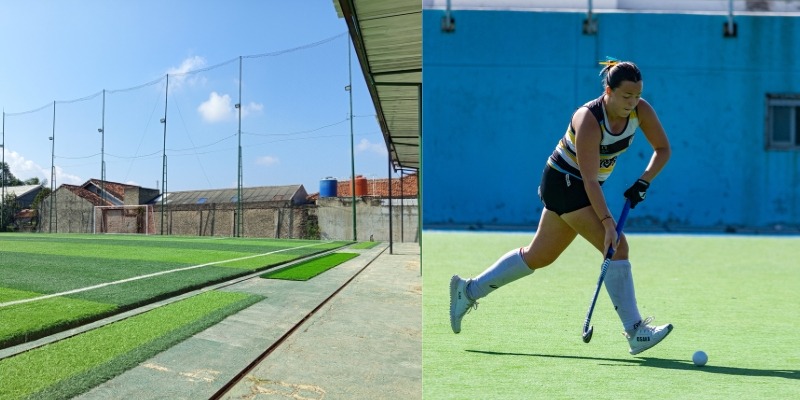
Indian hockey was built for decades around close control, stick skill, short passing, and the ability to manipulate the ball on natural grass. That style produced long periods of success because grass slowed the ball, created uneven movement, and rewarded players who could maintain possession through technique. The arrival of artificial turf changed the sport by changing the surface beneath every tactical decision.
Fans may encounter the tower rush app link while moving between sports coverage and other forms of online entertainment, but for hockey players the move to synthetic surfaces was a technical and physical transformation. The ball traveled faster, movement became more demanding, and teams that adapted quickly gained an advantage. Indian players had to preserve their skill while learning a style based on speed, structure, and repeated high-intensity actions.
Ball Speed Reduced the Value of Prolonged Dribbling
Natural grass often slowed the ball and made long passes less reliable. This gave players more reason to carry possession and beat opponents through stick work.
Artificial turf changed the calculation.
The ball could travel across the pitch with less resistance and greater consistency. A pass became a faster method of progression than a long dribble.
Indian players therefore had to release the ball earlier. Carrying possession for several seconds could allow the defense to reorganize, while a quick pass could exploit space before it closed.
Dribbling did not disappear, but its role changed. Instead of trying to beat several opponents, players increasingly used short elimination moves to create one passing angle.
First Touch Became More Important
A faster surface increased the speed at which passes reached the receiver.
This placed greater pressure on the first touch.
On grass, a player could sometimes use several contacts to control a difficult pass because the ball slowed naturally. On synthetic turf, a poor first touch could move the ball several metres away or directly toward an opponent.
Players therefore needed better body positioning before receiving.
They had to scan earlier, open their stance, and decide whether the next action would be a pass, carry, or turn.
Control became less about stopping the ball completely and more about directing it into the space required for the next action.
Fitness Became Part of Technical Performance
Artificial turf increased the speed of the game, but faster ball movement also required faster player movement.
Players had to cover more ground to support passing lanes, press opponents, recover after turnovers, and maintain defensive structure.
This changed physical preparation.
Endurance remained important, but repeated sprint ability, acceleration, recovery, and strength became central to performance. A player could possess strong stick skills and still struggle if unable to reach the correct position quickly enough.
For Indian hockey, this represented a major adjustment. Technique could no longer compensate for differences in physical output as effectively as it had on slower surfaces.
Fitness became part of tactical execution.
Passing Networks Replaced Some Individual Creation
Artificial turf encouraged teams to create space collectively.
Because the ball moved quickly, three or four connected passes could move the defense farther than one player’s dribble. Teams began using switches, triangles, and diagonal circulation to move opponents across the pitch.
Indian players had to become comfortable playing within these structures.
The emphasis shifted from asking whether one player could escape pressure to asking whether the team could create the next free receiver.
This made off-ball movement more important. Players without possession had to create angles, stretch defensive lines, and arrive in space at the right moment.
A successful attack became the product of several coordinated movements rather than one long individual action.
Pressing Became More Effective
Synthetic turf also made defensive pressing easier to organize.
Defenders could move quickly and predict how the ball would travel. Teams could close the ball carrier while blocking nearby passing options.
This reduced the time available to Indian players who had previously relied on close control to escape pressure.
The response required faster decisions.
A player receiving with the back to pressure had to know where the next pass was before the ball arrived. Holding possession while searching for an option became risky.
Press resistance therefore became less about dribbling through contact and more about scanning, positioning, and one-touch combinations.
Defensive Structure Had to Become More Compact
The speed of synthetic surfaces increased the danger of turnovers.
Losing possession in midfield could allow the opponent to move the ball into the attacking circle within seconds. Teams therefore needed better protection behind their attacks.
Indian players had to become more disciplined about spacing.
Defenders could no longer remain disconnected from midfielders while attackers committed numbers forward. The team needed a structure that allowed immediate pressure after losing the ball.
This led to greater emphasis on compactness, recovery runs, and controlling central channels.
Defensive work became the responsibility of the entire side rather than only the back line.
Long Passing Became a Tactical Weapon
Artificial turf made long passes more reliable.
A player could switch the point of attack quickly or find a teammate through a line that would have been difficult to use on grass.
This changed how Indian teams attacked.
Instead of progressing only through short combinations, they could move the ball from one side to another and exploit defenders who had shifted too far.
Long passing also increased the importance of receiving technique because the receiver had to control a faster ball while often under immediate pressure.
The ability to combine short and long distribution became part of modern midfield play.
Tackling Technique Had to Adapt
Defending on artificial turf created different timing demands.
Because attackers and the ball moved faster, defenders had less time to recover after committing to a tackle.
Poor timing became more expensive.
Indian defenders had to improve footwork, body angle, and patience. Diving into a challenge could allow the attacker to eliminate the defender and enter open space.
Channeling became more important. Instead of attempting to win the ball immediately, defenders often guided attackers toward areas where support was available.
This made defense more positional and less dependent on isolated tackle attempts.
Penalty Corners Became More Specialized
Artificial turf also contributed to the growing importance of penalty corners.
The predictable surface allowed teams to execute injection, trapping, and shooting routines with greater speed and precision.
This encouraged specialization.
Players trained specific roles, including injection, stopping, drag-flicking, rebound positioning, and defensive running.
For Indian hockey, set-piece efficiency became a major competitive factor because penalty corners could decide matches where open-play chances were limited.
A team could no longer depend only on creative attack. It needed repeatable set-piece production.
Training Methods Had to Change
The move to synthetic turf affected development from youth level upward.
Players needed more access to the surface to learn its pace and movement. Training on grass and competing internationally on turf created a gap that could not be solved through technique alone.
Coaches had to emphasize passing speed, receiving under pressure, transition play, pressing, and repeated movement.
Training sessions also became more game-specific.
Small-sided drills could reproduce the limited time and space players faced in competition. Fitness work became integrated with tactical tasks rather than treated as a separate activity.
The surface changed not only matches but also how players were prepared.
Traditional Skill Had to Be Reinterpreted
Artificial turf did not make India’s traditional technical strengths irrelevant.
Close control, deception, hand speed, and dribbling still matter. The difference is that those skills now need to produce an outcome more quickly.
A player may use a short drag to escape one defender and immediately release the ball. A change of direction may create a passing lane rather than begin a long solo run.
Individual skill remains useful when it serves the team structure.
This is the main adjustment Indian players had to make: preserve technical creativity while reducing unnecessary possession time.
Artificial Turf Changed the Logic of the Game
The transition from grass to artificial turf did more than increase speed. It changed which decisions were rewarded.
Passing became more efficient, pressing became harder to escape, fitness became inseparable from tactics, and defensive mistakes became more costly.
Indian hockey had to move from a style built around prolonged individual control toward one based on rapid execution and collective movement.
The strongest modern Indian players still reflect the country’s technical tradition. They control the ball well, improvise, and use stick skill in tight spaces. But they now operate inside a game that demands faster choices.
Artificial turf did not remove India’s hockey identity. It forced that identity to evolve. The challenge became learning how to use traditional skill at modern speed.
