
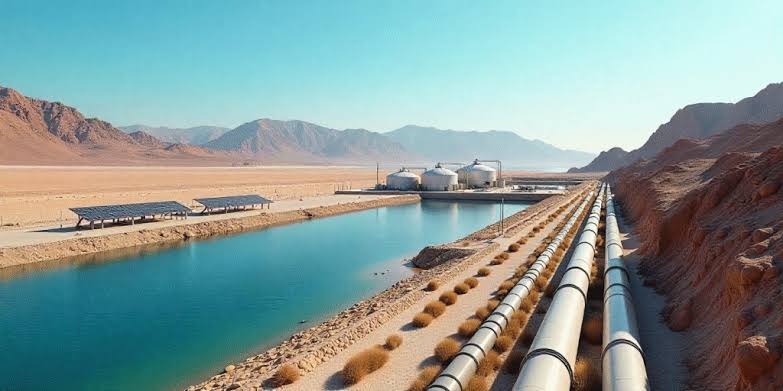
Jordan is moving ahead with one of its largest water infrastructure projects as pressure on freshwater resources continues to grow. At the center of the strategy is the Aqaba-Amman Water Desalination and Conveyance Project, also known as the National Water Carrier.
The project is designed to desalinate seawater from the Red Sea at the Gulf of Aqaba and transport it north toward Amman and other governorates. Once operational, it is expected to provide around 300 million cubic metres of potable water annually. Jordanian authorities describe the project as a major component of the country’s efforts to strengthen national water security.
The push toward desalination reflects a broader challenge facing Jordan and other countries across the Middle East: freshwater supplies are under increasing pressure from population growth, climate change, groundwater depletion, and rising demand.
Why Water Security Is a Growing Concern in Jordan
Jordan is among the world’s most water-scarce countries. The country’s renewable freshwater resources are far below commonly used thresholds for water scarcity, while demand continues to place pressure on available supplies. The World Bank’s MIGA has cited annual renewable water resources of less than 61 cubic metres per person and reported that groundwater is being used faster than it can naturally replenish.
Water availability is also affected by changing climate conditions and population pressures.
For households, scarcity can mean intermittent municipal supply and greater reliance on storage tanks and water tankers. For agriculture, industry, and cities, limited water availability creates additional pressure on economic activity.
Jordan’s National Water Strategy 2023–2040 therefore places emphasis on increasing available supplies while improving efficiency, infrastructure, data management, wastewater reuse, and water-resource management.
Desalination is emerging as one part of that wider strategy.
The Aqaba-Amman National Water Carrier
The National Water Carrier is designed to bring seawater from the Gulf of Aqaba to a large desalination facility before transporting the treated water through a long-distance pipeline network.
The project includes a desalination plant in Aqaba and a pipeline extending roughly 438 kilometres toward Amman. It also incorporates renewable-energy infrastructure, including a solar photovoltaic facility of approximately 280 megawatts to supply part of the project’s energy requirements.
The scale is significant.
Jordan’s government expects the project to produce approximately 300 million cubic metres of desalinated water each year. The water would serve Amman and Aqaba while also supporting communities and governorates along the conveyance route.
In April 2026, King Abdullah II reviewed government preparations for the project and emphasized the importance of completing technical, financial, and legal preparations while keeping the project’s implementation timeline on track.
International Financing Supports the Project
The National Water Carrier has attracted substantial international financial and institutional support.
In March 2026, Jordan’s Cabinet approved a $203 million U.S. grant for the Aqaba-Amman Water Desalination and Conveyance Project. The government said the project was being advanced through implementation phases with the objective of completion within four years.
The project has also received support from European institutions and international development organizations.
In 2025, Jordan signed a €31 million agreement with the Netherlands to support the project. Jordan’s Ministry of Planning and International Cooperation described desalination as an important additional source of water that could reduce pressure on groundwater and surface-water resources.
The International Finance Corporation has also been involved in structuring the project, which is being developed as a public-private partnership. Its project documentation identifies Meridiam and Suez as sponsors of the National Carrier Project Company.
Desalination Offers a New Source of Freshwater
Traditional water sources are limited by geography and climate. Desalination offers a fundamentally different approach because seawater is abundant compared with conventional freshwater resources.
The process removes salts and other dissolved substances from seawater, producing water suitable for drinking and other uses after appropriate treatment.
For Jordan, this is particularly significant because the country has limited freshwater resources and does not have extensive coastal access. The Gulf of Aqaba provides a connection to the Red Sea, allowing seawater desalination to become part of the national water-supply system.
The challenge is that producing freshwater from seawater requires substantial infrastructure and energy.
That makes energy efficiency and renewable power important parts of Jordan’s desalination strategy.
Renewable Energy Could Help Reduce Energy Pressure
Desalination is an energy-intensive process, particularly when large volumes of seawater are processed.
Jordan’s project incorporates renewable-energy generation as part of its infrastructure. The IFC describes a solar photovoltaic facility of approximately 280 megawatts intended to cover part of the project’s energy needs.
This approach connects two strategic priorities: water security and energy transition.
Using renewable electricity for part of the desalination process could help reduce exposure to fossil-fuel energy costs while supporting Jordan’s broader efforts to expand renewable energy.
However, the overall environmental and financial performance of the project will depend on how effectively the desalination plant, solar generation, pumping infrastructure, and distribution network operate together.
Moving Water Across the Country Is Another Challenge
Producing desalinated water is only one part of the National Water Carrier.
The water must also travel hundreds of kilometres from Aqaba toward population centres in the north.
Long-distance water conveyance requires large pipelines, pumping stations, storage facilities, maintenance systems, and reliable electricity.
The project therefore represents a combination of desalination infrastructure and national water-transport infrastructure rather than simply the construction of a desalination plant.
The World Bank’s project documentation identifies a roughly 438-kilometre conveyance pipeline as a central component of the project.
This infrastructure could also influence how Jordan manages water distribution across different governorates.
Desalination Is Not the Only Solution
Although desalination is receiving considerable attention, Jordan’s water strategy involves several other measures.
The country’s government is also working on reducing water losses, improving distribution networks, expanding wastewater treatment and reuse, developing rainwater harvesting, improving dams, and strengthening water-resource management.
Jordan’s 2026–2029 Economic Modernisation Vision executive programme includes the National Water Carrier alongside projects for water harvesting, network improvements, wastewater services, renewable energy, and reductions in non-revenue water.
This is important because increasing supply alone does not solve every water-management problem.
Water lost through aging or inefficient infrastructure can represent a substantial resource-management challenge. Improving the efficiency of existing networks can therefore complement the additional water produced through desalination.
Groundwater Pressure Remains an Issue
Jordan has historically relied heavily on groundwater, but overuse has placed pressure on aquifers.
MIGA reports that groundwater is being used at approximately twice the rate at which it can naturally replenish. It also estimates that groundwater currently meets only around two-thirds of national water demand.
Increasing desalinated-water supplies could provide an alternative source for municipal consumption and reduce some pressure on groundwater resources.
Jordanian officials have also emphasized diversification of water sources, including desalination, groundwater management, water harvesting, and treated-water reuse.
The broader objective is therefore to create a more diversified water system rather than depend on a single source.
Environmental Considerations
Large-scale desalination also presents environmental questions.
Seawater intake systems need to be designed to reduce impacts on marine ecosystems, while the concentrated saltwater produced during desalination must be managed carefully.
The project has been classified as a Category A development under IFC environmental and social standards, reflecting the scale and potential environmental and social impacts that require assessment and management.
The European Investment Bank says the project includes measures intended to reduce environmental impacts, including the design of seawater intake systems and wastewater treatment associated with the desalination facility.
Careful environmental monitoring will remain important as the project moves from planning and financing toward construction and operation.
A Regional Shift Toward Water Resilience
Jordan’s desalination strategy is part of a wider regional conversation about water resilience.
Countries across the Middle East and North Africa face different combinations of water scarcity, population growth, climate pressures, and increasing urban demand. Desalination has already become an important source of municipal water in several Gulf countries.
Jordan’s situation is distinctive because it combines severe water scarcity with limited coastal access. Its National Water Carrier therefore requires both desalination technology and a major inland conveyance system.
The project demonstrates how countries without abundant freshwater resources can use infrastructure, renewable energy, international financing, and water-management reforms to expand available supplies.
What the National Water Carrier Could Mean for Jordan
If completed as planned, the National Water Carrier would add approximately 300 million cubic metres of desalinated water to Jordan’s annual supply.
That would represent a significant addition to the country’s water system and could improve the reliability of municipal supplies.
The project is also expected to reduce pressure on existing water resources and contribute to longer-term water security. The Green Climate Fund estimates that the project could provide about 40% of Jordan’s municipal water needs by 2030 and 45% by 2040.
Its success, however, will depend on more than desalination capacity. Financing, construction, energy costs, pipeline management, distribution efficiency, environmental safeguards, and long-term water demand will all influence its performance.
The Future of Water Security in Jordan
Jordan’s move toward desalination illustrates a broader transformation in how water-scarce countries approach resource security.
The country is not abandoning groundwater, wastewater reuse, rainwater harvesting, conservation, or network improvements. Instead, desalination is being added to a larger portfolio of water-supply and efficiency measures.
The National Water Carrier is particularly significant because it links seawater desalination with renewable energy and long-distance water transportation.
As climate pressures and regional water demand continue to shape the Middle East, reliable water infrastructure is becoming increasingly important for households, agriculture, economic development, and public services.
For Jordan, turning seawater into a dependable source of freshwater could become an important part of that infrastructure strategy. The next challenge will be translating the project’s large-scale plans into an efficient, financially sustainable, and environmentally responsible water system.
