
Japan has long been associated with robotics. From industrial automation to advanced research projects, Japanese companies have played a major role in developing robots for factories, healthcare, logistics, and everyday life.
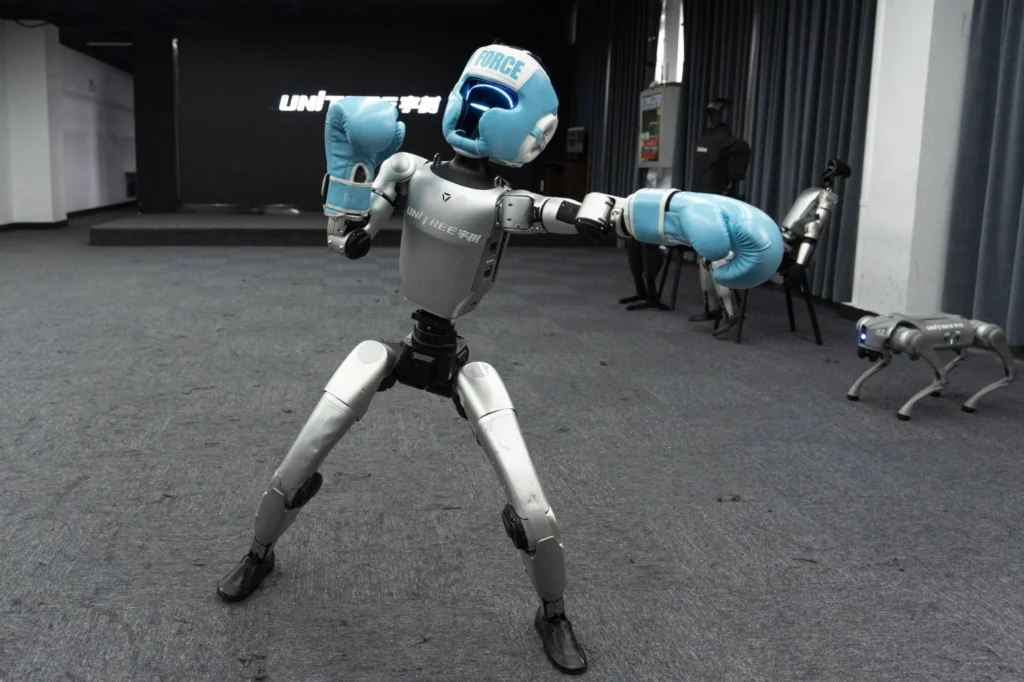
Now, Japan’s position in the humanoid robot industry is facing growing competition from China.
Chinese robotics companies are rapidly developing humanoid robots designed for industrial, commercial, and potentially consumer applications. Faster development cycles, expanding manufacturing capacity, and strong investment in artificial intelligence are changing the competitive landscape.
For Japan, the rise of China’s humanoid robot industry creates a new challenge: maintaining its technological leadership while competing in a market that is developing at remarkable speed.
China’s Humanoid Robot Industry Is Growing Quickly
China has become one of the world’s largest robotics markets, particularly in industrial automation.
The country is now expanding its focus toward humanoid robots. Companies are developing machines capable of walking, carrying objects, manipulating tools, and performing increasingly complex tasks.
Government support is also encouraging investment in humanoid robotics. Chinese technology and manufacturing companies are combining artificial intelligence, advanced sensors, electric motors, batteries, and precision components to develop increasingly capable machines.
The result is a rapidly expanding ecosystem surrounding humanoid robots.
Why Humanoid Robots Matter
Humanoid robots are designed around the basic shape and movement of the human body.
Two legs allow robots to operate in environments designed for people. Arms and hands can potentially allow them to use existing tools, equipment, and workspaces without requiring major changes to infrastructure.
This makes humanoid robots potentially useful in factories, warehouses, logistics centers, healthcare environments, and other workplaces.
However, building a robot that can reliably operate in unpredictable human environments remains a major engineering challenge.
Japan Has Deep Robotics Expertise
Japan has decades of experience in robotics.
Japanese manufacturers have developed industrial robots used in automotive production, electronics manufacturing, assembly, inspection, and other applications.
The country also has extensive expertise in precision machinery, sensors, motors, actuators, and automation.
Japan’s aging population has created another reason to invest in robotics. Robots have been explored as tools for addressing labor shortages and supporting industries such as manufacturing, healthcare, and logistics.
This gives Japan a strong foundation for humanoid robot development.
China Brings Manufacturing Scale
One major difference between the two countries is manufacturing scale.
China has an enormous industrial supply chain capable of producing electronics, batteries, motors, mechanical components, and other hardware at large volumes.
That ecosystem could help Chinese humanoid robot companies reduce production costs as the technology matures.
Lower manufacturing costs could become increasingly important if humanoid robots move from research laboratories into large-scale commercial deployment.
The ability to manufacture thousands or eventually millions of machines could become as important as developing advanced robot software.
Artificial Intelligence Is Changing Robotics
Modern humanoid robots are increasingly connected to advances in artificial intelligence.
Traditional robots often perform carefully programmed tasks in controlled environments. Newer systems are being developed to understand visual information, recognize objects, interpret instructions, and adapt their actions.
Generative AI and machine learning could make robots more flexible.
Instead of programming every movement individually, developers can train robotic systems using large amounts of data and demonstrations.
This creates a new competition involving both robotics and AI.
China’s growing AI industry therefore gives its robotics companies another technological resource to draw upon.
Japan Faces Competition Beyond Hardware
The competition is not only about building better mechanical systems.
Humanoid robots require several technologies to work together:
- Artificial intelligence
- Computer vision
- Sensors
- Actuators
- Batteries
- Motors
- Robotics software
- Advanced processors
- Connectivity
- Precision manufacturing
Japan remains strong in many hardware categories, but the increasing importance of AI software means competition is becoming broader.
Companies that successfully combine hardware and AI may have an advantage as humanoid robots become more capable.
Cost Could Become a Major Factor
Humanoid robots are currently expensive and technically complex.
As production increases, manufacturers will look for ways to reduce costs.
China’s large manufacturing ecosystem could make cost reduction an important competitive factor.
If Chinese companies can produce capable humanoid robots at lower prices, adoption could expand across factories, warehouses, and other commercial environments.
Japanese companies may therefore need to compete not only on reliability and engineering quality but also on production efficiency and scalability.
Japan Still Has Important Advantages
China’s rapid progress does not mean Japan has lost its position in robotics.
Japan continues to have major strengths in industrial automation, precision engineering, robotics components, manufacturing technology, and research.
Japanese companies also have long-standing relationships with global manufacturers.
These capabilities could become valuable as humanoid robots move into real-world industrial applications.
Japan’s experience in designing robots for demanding manufacturing environments could help companies develop systems that prioritize reliability and safety.
The Real Competition May Be Industrial Adoption
The humanoid robot race will not be decided solely by demonstrations or impressive prototypes.
The bigger question is whether companies can deploy robots reliably and economically.
A commercially successful humanoid robot needs to perform useful tasks repeatedly, operate safely around people, require manageable maintenance, and justify its cost.
Factories and warehouses will ultimately judge robots based on productivity and operating costs.
This could make industrial deployment one of the most important stages of the competition between Japanese and Chinese robotics companies.
Labor Shortages Could Accelerate Demand
Labor shortages are becoming an important economic issue in several countries.
Japan faces significant demographic challenges, while China is also experiencing changes in its working-age population.
Humanoid robots could eventually help companies automate tasks where recruiting enough workers is difficult.
Potential applications include material handling, assembly, inspection, warehouse operations, and other repetitive activities.
However, widespread adoption will depend on whether robots become reliable and affordable enough for businesses.
What the Future Could Look Like
The global humanoid robot industry is still in its early stages.
Japan has decades of robotics expertise, while China has rapidly expanding manufacturing capabilities and significant investment in AI and automation.
Other countries, including the United States and South Korea, are also developing humanoid robotics technologies.
This means the industry is likely to become increasingly competitive.
Future success may depend on a combination of artificial intelligence, mechanical engineering, manufacturing scale, energy efficiency, software, and access to supply chains.
Conclusion
Japan’s robotics industry has a strong technological foundation, but China’s rapid progress in humanoid robots is creating a new competitive environment.
China’s manufacturing scale, investment in artificial intelligence, and expanding robotics ecosystem could accelerate the development and commercialization of humanoid machines.
Japan, meanwhile, retains significant expertise in robotics, precision engineering, industrial automation, and advanced manufacturing.
The next phase of the humanoid robot industry will show which companies can move beyond impressive prototypes and deliver reliable, affordable robots at commercial scale.
For Japan, the challenge is no longer simply developing advanced robots. It is competing in a global market where manufacturing scale, artificial intelligence, cost, and speed of innovation are becoming increasingly important.
