
Meta Title: Build Smarter Games Using AI Without Writing Code
Meta Description: Learn how to build smarter games using AI and no-code tools, focusing on deliberate design, faster iteration, and better playtesting.
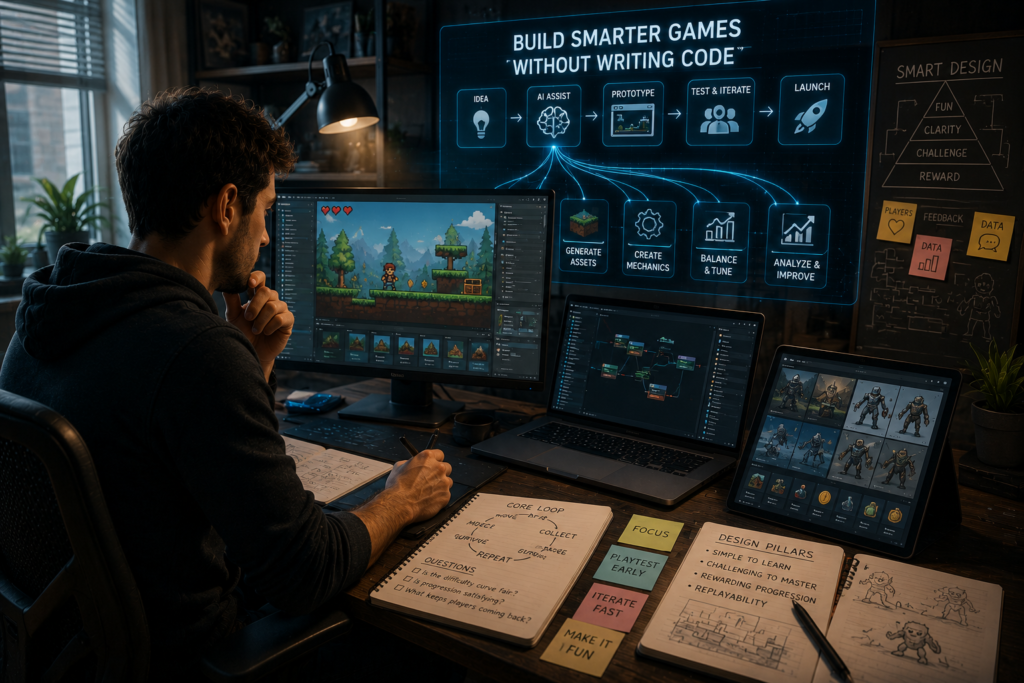
The word “smarter” gets thrown around a lot in game devopment discussions, usually attached to complicated systems, elaborate AI opponents, or deep procedural generation. Building a smarter game doesn’t actually require any of that. It requires a tighter, more deliberate design process, and it turns out AI tools are just as useful for that as they are for handling technical implementation.
If you’ve assumed that skipping code means settling for something simpler or less thoughtful, that assumption doesn’t hold up anymore. Here’s how to actually build something smart, not just something quick.
What “Smarter” Actually Means in Game Design
A smarter game isn’t necessarily more complex. It’s one where every system serves a clear purpose, where difficulty scales intentionally, and where the core loop was refined through real iteration rather than shipped as a first draft. Complexity and intelligence aren’t the same thing. Plenty of overengineered games feel dumb to play, while plenty of simple ones feel remarkably well-considered.
Building smarter, in this sense, is about the quality of decision-making behind the game, not the amount of code or systems layered into it.
Why No-Code Tools Support Smarter Design, Not Just Faster Design
More Iterations Mean Better Decisions
The biggest lever for building something smart is how many times you get to test and refine an idea before shipping it. Game maker online platforms make each iteration cheap enough that testing five variations of a mechanic before choosing one becomes realistic, instead of committing to the first version because rebuilding it manually would cost too much time.
Removing Technical Distraction From Design Thinking
When implementation requires deep technical focus, design decisions often get made reactively, whatever is easiest to code, rather than deliberately, whatever actually serves the game best. Removing that technical friction lets design decisions get made on their own merits instead of being shaped by what’s convenient to implement.
Faster Feedback Exposes Weak Decisions Sooner
A smart design process depends on catching bad decisions early, before they’re expensive to fix. Because no-code tools shrink the time between an idea and a testable version of it, weak design choices surface almost immediately instead of after weeks of investment, when changing course feels far more costly.
Practical Ways to Build Smarter Without Code
Start With Constraints, Not Features
Rather than listing everything you want the game to include, define what the game explicitly won’t do. Constraints force sharper decisions about what actually matters, and a tightly constrained design almost always feels more intentional than one built by adding features until it feels complete.
Design the Difficulty Curve Deliberately
Difficulty shouldn’t just increase. It should escalate in a way that teaches, tests, and occasionally gives players a breather. Games like Dig to Fill show this kind of deliberate pacing well, the challenge builds in a way that feels considered rather than just progressively harder for its own sake.
Playtest With a Specific Question Each Time
Instead of vague playtesting sessions, go in asking one specific thing: does this difficulty spike feel fair? Does this new mechanic get understood without explanation? Smart design comes from answering focused questions repeatedly, not from general impressions gathered occasionally.
Cut Anything That Doesn’t Serve the Core Loop
Every system in the game should support the central mechanic in some way. If a feature doesn’t reinforce what makes the core loop satisfying, it’s likely diluting the experience rather than adding to it, regardless of how interesting it seemed during brainstorming.
Where AI Assistance Fits Into Smarter Development
Rapid Testing of Design Hypotheses
Treat every design idea as a hypothesis to test, not a decision to commit to immediately. AI-assisted prototyping makes testing those hypotheses fast enough that you can validate or reject ideas based on actual play, rather than intuition alone.
Generating Variations for Comparison
Rather than manually building multiple versions of a mechanic to compare, AI tools let you generate variations quickly enough to actually compare them side by side. Direct comparison tends to produce better decisions than evaluating a single version in isolation and guessing how alternatives might have felt.
Freeing Time for the Judgment Calls That Matter
The time saved on implementation should go toward the decisions that actually require human judgment: whether something feels fair, whether pacing holds up, whether a mechanic is genuinely fun. Smarter games come from spending more time on these judgment calls, not less, and AI-assisted workflows make that reallocation possible.
Common Mistakes That Undermine “Smart” Design
Confusing More Systems With Better Design
Adding mechanics doesn’t automatically make a game smarter. It often just makes it more cluttered. A tightly designed game with one excellent mechanic usually feels smarter than one with five mediocre ones competing for attention.
Skipping Playtesting Because Prototyping Is Fast
Fast prototyping is only valuable if it’s paired with real testing. Building quickly and shipping without playtesting just means arriving at a weak decision faster, not a better one.
Treating the First AI-Generated Version as Final
The initial output from any AI-assisted tool is a starting point, not a finished product. Smart design still requires refining that starting point based on how it actually plays, not accepting it as-is because it was fast to produce.
A Practical Framework for Building Smarter
- Define constraints before features. Know what the game won’t do before deciding everything it will.
- Prototype fast, but playtest with intention. Speed only helps if it’s paired with focused, specific testing.
- Compare variations directly. Generate more than one version of key mechanics and evaluate them side by side.
- Cut anything that doesn’t serve the core loop. Every system should earn its place.
- Reinvest saved time into judgment, not just speed. Use the time AI saves to think harder about design, not just to ship faster.
Final Thoughts
Building a smarter game without code isn’t about lowering the bar for what counts as thoughtful design. It’s about using tools that remove technical friction so more of your time and attention can go toward the decisions that actually make a game good: pacing, fairness, feel, and restraint.
The smartest games rarely come from the most complex systems. They come from deliberate, well-tested decisions made repeatedly throughout development. No-code and AI-assisted tools don’t replace that process. They just make it possible to go through it more times before you ship.
