
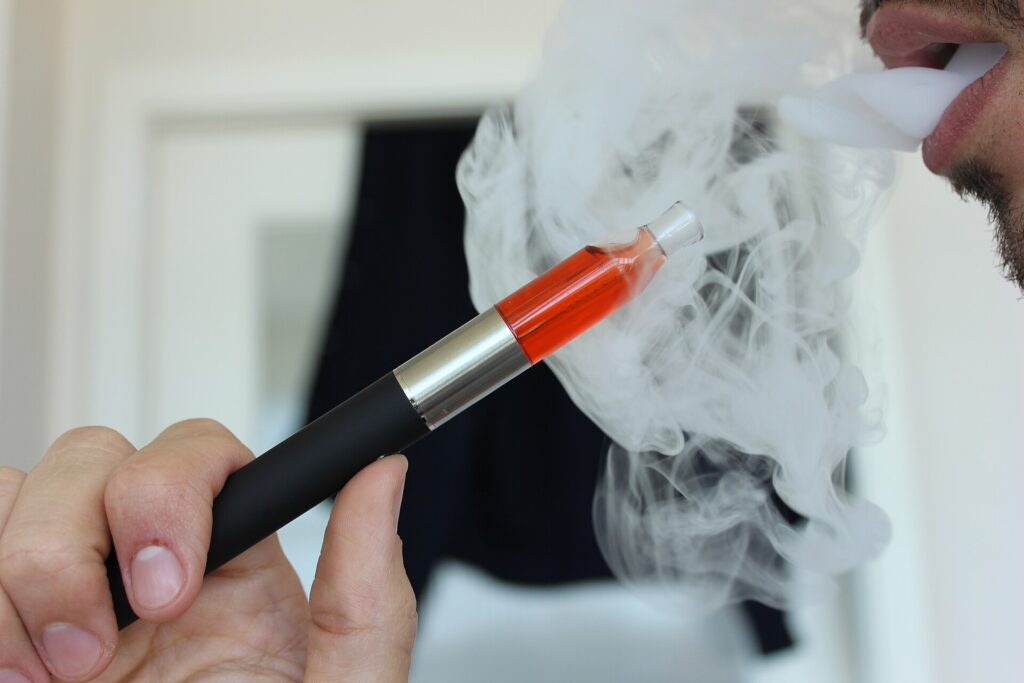
Smoking cessation is a major public health success story, but it has produced a follow-up question that health pages are asked constantly: if someone quits cigarettes by moving to an electronic cigarette, what happens to their lung cancer risk? This article sets out the established facts, the reasonable inferences and the genuine unknowns, in that order.
Fact one is not in dispute. Cigarette smoking is the leading cause of lung cancer, responsible for the large majority of cases, and stopping at any age reduces risk compared with continuing. Fact two is also solid: e-cigarette aerosol exposes users to far fewer carcinogens, at far lower levels, than cigarette smoke. Everything beyond those points involves some degree of scientific judgement.
The established facts about exposure
Tobacco smoke contains more than seven thousand chemicals, and health authorities including the National Cancer Institute identify dozens of them as proven causes of cancer. Most are products of combustion. E-cigarettes, which heat a liquid rather than burn a leaf, do not generate that same mixture, and comparative testing consistently finds carcinogen levels in vapers’ bodies that are dramatically lower than in smokers’ bodies.
Lower, however, is a relative term. Aerosol from e-cigarettes can still contain formaldehyde under some device settings, nitrosamines at low levels, and flavouring chemicals whose long-term inhalation safety is untested; food-safe, after all, does not automatically mean lung-safe. The Centers for Disease Control and Prevention accordingly states that e-cigarettes are not safe for youth, pregnant women or adults who do not currently use tobacco products.
What can reasonably be inferred
Because cancer risk tracks cumulative exposure to carcinogens, researchers infer that a complete and permanent switch from smoking to vaping should carry a substantially lower lung cancer risk than continued smoking. Supporting that inference, studies of ex-smokers who vape show lung function stabilising or improving modestly, chronic bronchitis symptoms easing in many cases, and exposure biomarkers close to those of people using licensed nicotine replacement therapy.
The inference has limits. Nobody can yet attach a trustworthy number to it, such as a percentage reduction in lifetime risk, because the necessary decades of observation have not passed. Animal and cell studies showing DNA damage from aerosol exposure are the main reason scientists resist declaring the question closed: they suggest the risk is unlikely to be zero, without showing how large it might be.
Known unknowns and risky patterns
The clearest unknown is time. A person who vapes for two years after quitting and then stops has minimal theoretical exposure; a person who vapes intensively for thirty years is, scientifically speaking, part of an experiment still in progress. Device evolution adds another variable, since modern high-power products deliver aerosol very differently from the early models used in older studies.
Meanwhile, one risky pattern is well documented rather than hypothetical: continuing to smoke while vaping. Dual users keep almost the entire carcinogen load of smoking, so from a cancer perspective they have changed very little. Relapse carries the same lesson in reverse, which is why cessation services usually treat any return to regular smoking as the outcome to prevent first.
The bottom line for ex-smokers
Summarised fairly, the facts support three conclusions. Quitting smoking transforms lung cancer risk more than any other single decision. Replacing cigarettes completely with vaping cuts exposure to the relevant chemicals by a wide margin, based on everything measurable today. And vaping itself cannot yet be certified harmless, so the healthiest finishing line is to be free of both, with professional support and screening advice from a clinician for anyone whose smoking history was long or heavy.
One further fact deserves emphasis, because it is often lost in online arguments: risk is not a switch that flips between safe and dangerous. It is a gradient built from dose and duration. That is why scientists can consistently hold two thoughts at once, that complete switching very likely cuts a smoker’s cancer risk substantially, and that the only exposure with no open questions attached is no exposure at all.
Our health section has also covered a recent medical study in this report, and readers can return to the Update Article homepage for the latest additions.
