
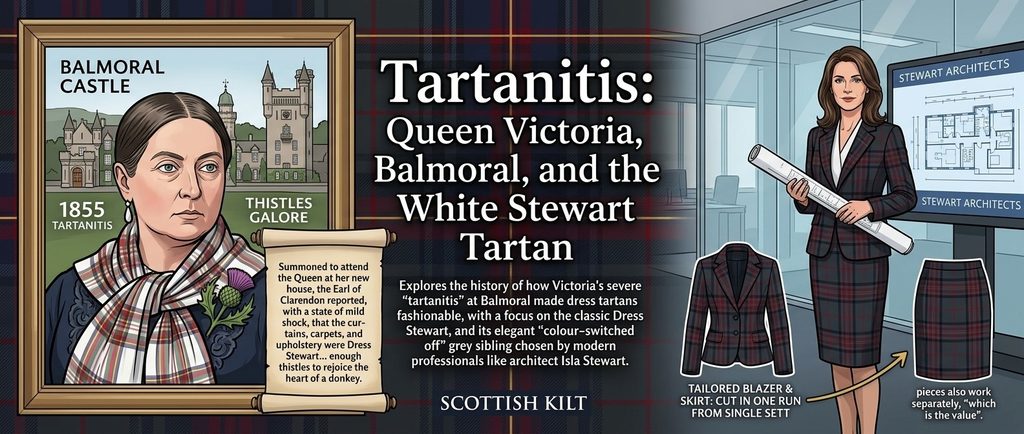
In the autumn of 1855 the Earl of Clarendon, Her Majesty’s Foreign Secretary, was summoned to attend the Queen at her new house in the Scottish Highlands. He was a polished, sardonic man who had served in the embassies of Europe, and he wrote home afterwards in a state of mild shock.
It was not the cold, though it was cold. It was not the remoteness, though Balmoral was a day’s journey from anywhere. It was the decoration. The carpets were tartan. The curtains were tartan. The chairs and sofas were covered in tartan. There was tartan on the floors of the corridors and tartan linoleum in the servants’ quarters. Where there was no tartan, there were thistles: carved into the woodwork, woven into the chintzes, printed on the wallpaper. There were enough thistles, Clarendon reported, to “rejoice the heart of a donkey.” The Stewart name, already woven into the royal family’s Highland imagery, would soon become closely associated with the elegant dress variation now known as Stewart Dress tartan.
Later writers gave the condition a name. They called it tartanitis, and the Queen had a severe case.
A love affair with a country
Victoria first saw Scotland in 1842, when she was twenty-three. She had been Queen for five years and married for two, and she was already tired of London, of politicians, and of being stared at. In the Highlands nobody stared. The air was clean, the hills were empty, and the people, she noted with delight, spoke to her directly and without fuss.
She and Albert came back in 1844 and again in 1847. In 1848 they took a lease, sight unseen, on a small castle on Deeside. They loved it at once, bought the estate, pulled the old house down and built a new one in white granite to Albert’s own designs. It was finished in 1856. It was the first home the two of them had ever made for themselves, and they furnished it as newly married couples do, according to their enthusiasms.
Albert designed a tartan, the Balmoral, in grey with black and red, which is still reserved for the royal family. Victoria is credited with another, a white-ground variation on the Stewart that carries her name. And for the principal rooms they chose the tartans of the royal house itself. By the usual account the carpets were the scarlet Royal Stewart and the green Hunting Stewart, and the curtains and upholstery were Dress Stewart.
The courtiers winced. But the Queen’s taste, however much her ministers laughed at it, changed the world’s. Where Victoria led, the middle classes followed. Tartan poured into drawing rooms, wardrobes and nurseries across Britain, Europe and America. The Highland holiday was invented. And the white-ground dress tartans, which had been a minor branch of the weaver’s trade, became the height of fashion for women.
Why the ground is white
Dress tartans have their own history, and it is a women’s history.
In the old Highlands the dark, heavy plaid was a man’s garment. Women wore the earasaid, a long wrap reaching from the neck to the ankles, belted at the waist and pinned at the breast with a brooch. Travellers who described it, from the sixteenth century onwards, agreed on one thing. It was white. Martin Martin, who toured the Western Isles around 1700, wrote of women in a “white plaid, having a few small stripes of black, blue and red.”
When the tartan trade organised itself in the early nineteenth century, weavers began producing dress versions of the great setts by taking one broad band of the pattern and turning it white. The result was lighter, brighter and more formal, and the convention is generally held to descend from that women’s cloth.
The Dress Stewart is the classic example. It is simply the Royal Stewart, the most famous tartan in the world, with its broad scarlet ground replaced by white. All the rest is there: the blocks of green and navy, the fine lines of yellow, black and red. A specimen from about 1819, preserved in the Smith Institute in Stirling, shows it being woven by the great Bannockburn firm of William Wilson & Sons well before Victoria was born. Her enthusiasm made it a classic. It is cheerful, clean and unmistakable, and Highland dancers the world over compete in it.
It also has a quieter relation. Take the Dress Stewart and drain the colour out of it, so that the ground becomes a pale silver grey and the greens and blues become charcoal and black, and leave only a single line of red. The trade calls the result Grey Stewart, and the tartan archives file it among the dress setts. It keeps the structure and the elegance of the original and loses all the sugar. Retailers who carry Stewart Dress tartan in its grey colouring offer it alongside the white and the scarlet, made to order as kilts, skirts, scarves and sashes, or by the yard. Prince Albert, who had chosen grey, black and red for his own Balmoral tartan, would have recognised the idea immediately.
Glasgow, a Thursday evening in November
Isla Stewart is forty-four and runs a small architecture practice in the Merchant City. Tonight is the opening of an exhibition she has spent a year designing, and she is wearing a suit.
It is a skirt suit: a sharply cut single-breasted blazer and a straight knee-length skirt, in a tartan of silver grey, charcoal and black with one fine line of red. Under it she has a black silk T-shirt. Black opaque tights, black block-heeled boots, a slash of red lipstick that picks up the line in the cloth. Nothing else.
She had thought for years that tartan tailoring was not for her. She associated it with two things: her grandmother’s Royal Stewart travelling rug, and tourists on the Royal Mile. What she had not understood was how much depends on the colouring. The scarlet Royal Stewart in a full suit is a costume. The white Dress Stewart in a full suit is a great deal of pattern, best kept to a jacket or a skirt worn on its own. But the grey, she realised when she saw a swatch, is essentially a Prince of Wales check with better bones. It is graphic, neutral and very slightly dangerous. It is an architect’s tartan.
Finding someone to make it was the difficulty. Most of what the high street sells as woman plaid suiting is printed check in a generic pattern, on cloth too thin to hold a line. She wanted her own family’s tartan, properly woven. She found it at Scottish Kilt, a made-to-measure outfitter working in more than five thousand setts, whose women’s tartan suits come as a blazer with trousers or a skirt, both cut in one run from a single length of cloth so that the shades match and the grid lines up across the seams. She sent her measurements and chose the skirt.
What she had not anticipated was how much use she would get out of the two halves apart. The site’s description says the pieces also work separately, “which is the value,” and she has come to think of that as the most honest sentence in retail. The blazer goes over black trousers for client meetings, and over a black dress for dinner. The skirt goes with a charcoal roll-neck and flat boots for site visits. She has worn one or other of them most weeks since it arrived.
She applies the rules she applies to buildings. One strong idea. Everything else plain. No second pattern anywhere near it. Let the grid do the work.
At the opening, a retired professor of design history corners her by the drinks table. He is wearing a Royal Stewart tie, badly knotted.
“Is that a Stewart? It looks like a Stewart with the colour switched off.”
“That’s exactly what it is. Dress Stewart, in grey.”
“Ha. Do you know about Balmoral? The whole house, floor to ceiling. Lord Clarendon said there were enough thistles to please a donkey. The court thought she’d lost her mind.”
“And then everybody copied her,” says Isla.
“And then everybody copied her,” he agrees. “Including, I notice, you. Though you’ve shown rather more restraint than Her Majesty.”
The Queen was right
It is easy to laugh at Balmoral, and people have been laughing at it since 1855. A young couple with unlimited money and a new passion went too far, as young couples do. But Victoria saw something in tartan that her sophisticated courtiers missed. She saw that a grid of coloured lines is one of the most satisfying patterns ever devised, that it can be grand or homely, loud or quiet, depending entirely on how you colour it and how much of it you use.
The white Dress Stewart she loved is still dancing at every Highland games on earth. Its grey sibling has walked into boardrooms and gallery openings on the backs of women who would never dream of carpeting a castle in it. The Queen had tartanitis. The rest of us have learned to take it in moderation, in a well-cut jacket, with everything else kept plain.
