
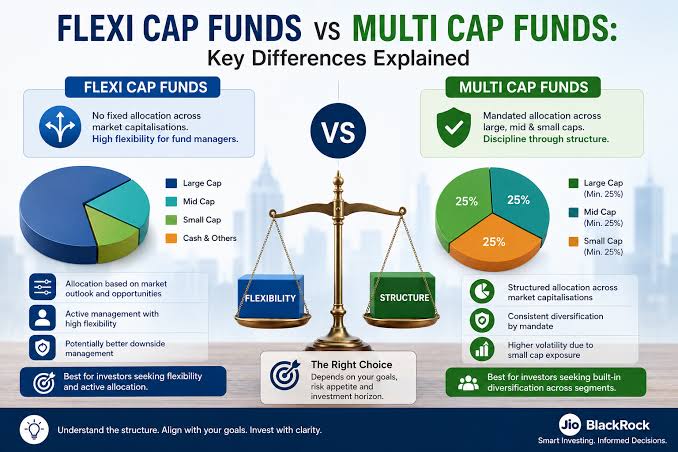
Flexi cap and multi cap funds both invest across large cap, mid cap and small cap companies. Their allocation rules, however, differ and can influence portfolio composition, risk and performance. Understanding the mandates of a flexi cap fund and a multi cap fund makes it easier to assess which approach may fit an investor’s goals and existing portfolio.
What is a flexi cap fund?
Under SEBI’s February 2026 scheme categorisation framework, a flexi cap fund is an open-ended dynamic equity scheme investing across large cap, mid cap and small cap stocks. It must invest at least 65% of its total assets in equity and equity-related instruments.
There is no prescribed minimum for each segment. The manager can change large, mid or small cap exposure based on the scheme’s strategy, valuations and market outlook.
Two flexi cap schemes can therefore look quite different. One may favour large cap companies, while another takes more mid and small cap exposure. The actual portfolio matters as much as the category label.
What is a multi cap fund?
A multi cap fund is an open-ended equity scheme investing across large cap, mid cap and small cap stocks. SEBI requires it to invest at least 75% of total assets in equity and equity-related instruments, with a minimum of 25% each in large cap, mid cap and small cap companies.
These minimums maintain exposure to all three segments. The fund cannot move substantially away from mid and small cap stocks when conditions become difficult.
The structure provides market-cap diversification alongside meaningful exposure to segments that may be more volatile and less liquid than large cap stocks.
Flexi cap fund vs multi cap fund
The central difference lies in how much freedom the fund manager has when allocating across company sizes:
| Point of comparison | Flexi cap fund | Multi cap fund |
| Minimum equity allocation | 65% of total assets | 75% of total assets |
| Market-cap requirement | No prescribed minimum for each segment | At least 25% each in large, mid and small cap companies |
| Allocation style | Dynamic across market caps | Structured exposure to all three segments |
| Ability to reduce mid or small cap exposure | Greater flexibility | Limited by the minimum allocations |
| Portfolio character | Depends heavily on fund-manager decisions | Maintains meaningful exposure across company sizes |
Both offer diversified equity exposure, but neither protects against market losses.
How the allocation difference affects risk
A flexi cap fund can increase large cap exposure when the manager prefers established companies or finds fewer opportunities elsewhere. This may moderate fluctuations but is not compulsory.
A multi cap fund must maintain at least half its assets across mid and small cap companies combined. Their shares can be more volatile and less liquid, leading to sharper movements during unsettled markets.
Flexi cap allocation depends more heavily on fund-manager judgement, and decisions can prove mistimed. A multi cap scheme’s market-cap structure is more predictable, although individual holdings change.
How to compare performance
Compare returns over matching periods using suitable total return benchmarks and the same plan type. A strong one-year result may reflect a favourable phase for one market-cap segment.
Review rising and falling markets. Rolling returns, drawdowns and recovery periods offer more context than one point-to-point figure. Results should also be consistent with the fund’s allocation and process.
Past performance may or may not be sustained in future
Costs and portfolio overlap
Compare expense ratios within the same category and plan type. Direct and regular plans hold the same portfolio but have different costs. An exit load may apply to early redemptions.
Review existing holdings before adding either category. Separate large, mid or small cap funds may already provide similar exposure. Monthly portfolios can reveal overlapping companies and unintended concentration.
Which category may suit an investor?
A flexi cap fund may suit an investor who prefers the manager to adjust market-cap exposure and accepts that positioning may change. Review the actual allocation periodically.
A multi cap fund may suit someone seeking sustained exposure to all three segments through one scheme and able to accept fluctuations from its compulsory mid and small cap allocations.
Neither category is universally more suitable. The decision depends on the investment horizon, risk tolerance, existing asset allocation and preference for a flexible or structured approach.
Conclusion
The key difference between a flexi cap fund and a multi cap fund is allocation freedom. A flexi cap scheme can move dynamically across company sizes, while a multi cap scheme must maintain at least 25% each in large, mid and small cap companies.
Both can support long-term equity exposure, but they produce different portfolio experiences. Reviewing the mandate, current allocation, investment process, costs and overlap with existing funds can help clarify which structure fits the intended role. Mutual Fund investments are subject to market risks, read all scheme related documents carefully.
