Just picture it. You’ve had one of those weeks. Again, the boss emailed you at 9pm, the train was delayed twice, and your group chat is somehow more stressful than your actual job. You come home, you sit on the couch and you just stare at the wall. Sound familiar?
The thing is, most of us deal with stress in the same boring way. We scroll our phones until our eyes are tired, we eat something we’ll regret, or we tell ourselves we’ll “go for a run tomorrow” (we won’t). None of it really gets the stress out of our bodies. It just sits, quietly accumulating, until one day you snap at someone for no reason.
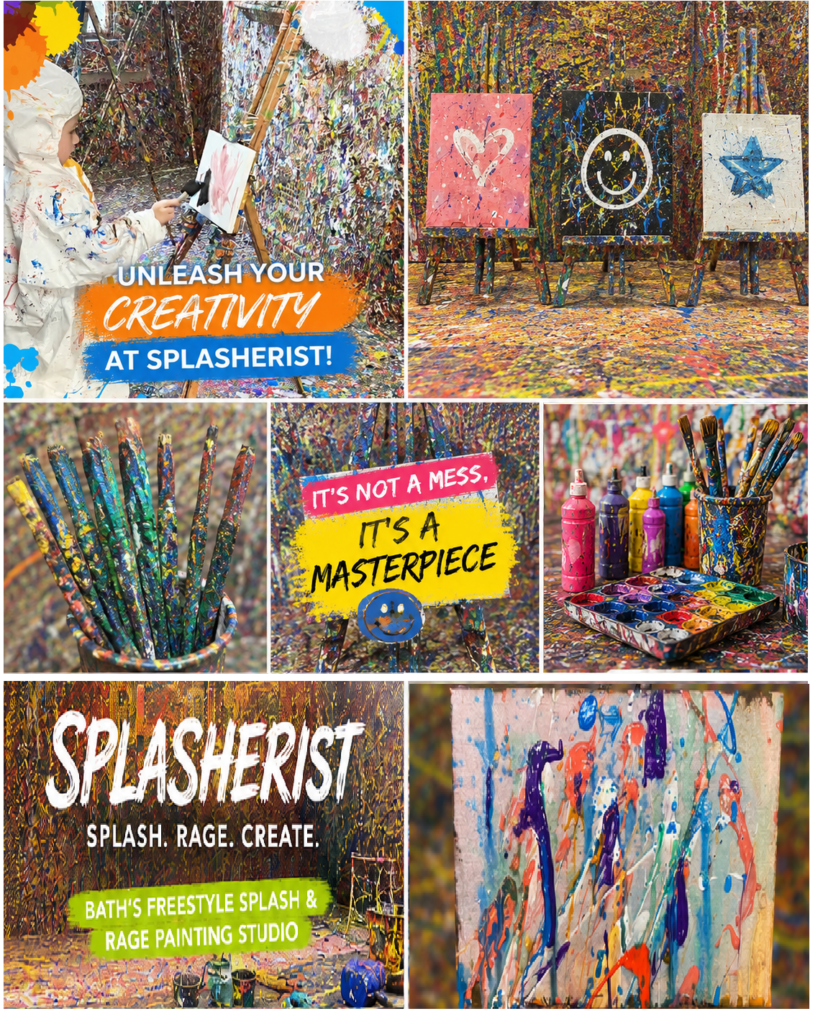
That’s where rage painting Worcester comes in. And no, it’s not a gimmick or a passing TikTok trend. All over the UK people are booking sessions where you’re handed a paintbrush, a bucket of paint and full permission to throw, splat and fling colour at a canvas with no rules. There’s no “right” way. No judging. Just you, some music and a wall of paint waiting to be destroyed in the best possible way.
Rage painting studios in Bristol, rage painting in Bath, rage painting in Worcester, rage painting in London, they’re cropping up because people frankly need this. We’re over-working, over-stimulating, and most of us haven’t done anything just for fun – with no goal, no productivity angle, no “self-improvement” spin in months. Rage painting gives that back to you.
Let’s explore why this is happening now, what really happens in one of these sessions, and why it may be exactly the reset your nervous system has been begging for.
We’re all a little too keyed up.
Stress in the UK is not a new story, but it has got louder lately. Work doesn’t switch off like it used to – your phone buzzes with emails at all hours, and there’s this unspoken pressure to always be “on.” Add in the cost of living, the never-ending news cycle and the general feeling that everything is a little bit too much and you have a population that is chronically tense without really knowing it.
The catch is that most of us don’t feel “stressed” in the dramatic, movie-style. We feel it in smaller ways: clenched jaws, shallow breathing, snapping at our partner over the dishes, lying awake at 1am replaying a conversation from three days ago. It’s stress in disguise, and it builds up because we rarely provide it a place to go.
The old advice is meditate, journal or do yoga. And hey, those things do really help a lot of people. But they need stillness, and stillness is exactly what an overstimulated brain finds hard to do. Ever try to just relax and your mind races faster? This is because stress is often physical – it’s adrenaline and cortisol sitting in your muscles with nowhere to go. Breathing slowly and sitting cross-legged doesn’t always do the trick when your body is pretty much vibrating with pent-up tension.
What really helps in such moments is movement. Large, physical, full of expression. Which is precisely what rage painting provides you.
So What Exactly Goes Down in a Rage Painting Session?
In case you’ve never heard of it, the idea is refreshingly simple. You show up at a studio, get kitted out in a protective suit (boiler suit, goggles, gloves – the works) and you’re given a private space with a blank canvas and pots of paint. Then for about 45 to 50 minutes you just . . . go for it.
Splattered paint. splatter it, pour it out. If you feel like it, smear it with your hand. Step on it. Some places even allow you to bring your own music so you can fling paint to your favourite playlist, totally free to make as much noise and mess as you want. No instructor hovering over you saying you are “doing it wrong” since there is no wrong. the whole idea is there are no rules.
In the end you have a piece of abstract art that’s truly one-of-a-kind and you can take it home with you. So it’s not only a stress relief session, but also a souvenir. A weirdly satisfying, “I made this while losing my mind in the best way” type of memento.
Now some studios are adding twists to keep it interesting. The whole thing becomes a glow in the dark experience with UV and neon paint sessions. Some have live music – think a cellist playing while you paint, or gongs and singing bowls for a more meditative, sound-bath vibe mixed with the chaos. On paper it’s a strange combination, calm music and aggressive paint-flinging, but somehow it works. Your body can settle into a rhythm while your hands do whatever they want. The sound.
Why Painting with Paint Actually Helps Stress (It’s Not Just ‘Fun’)
Okay, so it sounds like fun but is there any science behind the “stress relief” claim, or is it just marketing?
Turns out there’s real substance here. When you’re mid-splatter a few things are happening at once:
You’re physically letting go of tension. When you’re stressed, your body stores energy – tight shoulders, clenched fists, that tension headache creeping up your neck. Big expressive movements such as throwing and flinging give that energy somewhere to go. It’s like how people feel better after a hard workout or a good pillow scream. The body needs to do something with all that built up adrenaline, and rage painting gives it an outlet that’s both physical and oddly graceful.
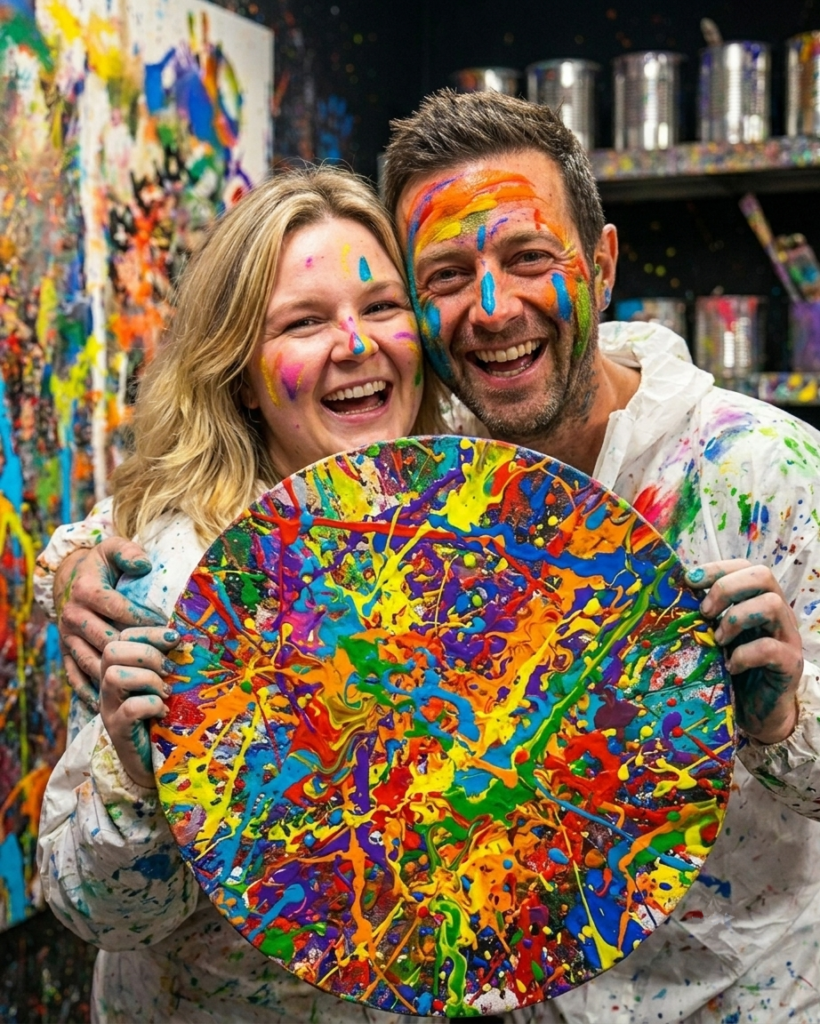
There’s no pressure to be “good” at it. This is a bigger deal than people think. So much of what we do, even our hobbies, is loaded with the expectation that we will get better, we will improve, we will accomplish something. Rage painting strips all that away. No one’s judging your technique. There is no ‘right’ way to splatter paint. For an hour you get to do something just because it feels good, not because it’s going to look impressive on your CV or your Instagram grid (although, let’s be honest, the photos do look great).
It’s a sensory reboot. The smell of paint, the sound of it hitting the canvas, the texture under your fingers if you go hands-on it pulls your brain out of “thinking mode” and into “doing mode.” It’s the same principle as that weirdly clearing your head when you’re doing the washing up or gardening. Repetitive physical sensory activity gives your overthinking brain a break, as for once it’s not in charge.
You get to put something out there. There is something quietly powerful about taking whatever’s been bouncing around your head, frustration, overwhelm, that argument you keep replaying and translating it into something physical. You stop thinking about your stress. You’re just throwing it against a wall. And then you get to walk away from it with a canvas that symbolizes… whatever you needed it to symbolize. Some people are surprisingly emotional about it. Others just think it’s hilarious. Both are correct.
Why This Is Truly Catching On Now
A few cultural shifts have converged to make rage painting feel like the right thing at the right time.
Take “rage rooms,” for example, those spots where you’re allowed to smash up all kinds of stuff with a baseball bat. They’ve been gaining popularity for years now, which suggests that people really do crave spaces where they can physically blow off steam in a controlled, safe environment. Rage painting is that energy but turned into something constructive. You’re not breaking things, you’re making things. It scratches the same itch, but you end up with more than a pile of broken plates and a dustpan.
There’s also a more general shift away from “productive” self-care. For a while, every wellness trend seemed to involve some homework: track your sleep, optimize your morning routine, journal your gratitude, meditate for exactly twelve minutes. Helpful, but also draining in its own way. People are tired of self-care being yet another task to tick off. Rage painting demands nothing of you. There is no other goal than to “try and see what happens.” That’s a rare thing and it’s refreshing.
And then there is the social aspect. Rage painting is fantastic as a solo reset, but it’s also become a genuinely popular group activity – birthdays, hen and stag parties, work team days out, date nights, even family outings. Studios across Bath, Bristol, Worcester and increasingly London have embraced this, offering group sessions as well as solo bookings. There’s something bonding about seeing your normally buttoned-up colleague lose it with a paint-filled water gun. It tears down the usual social barriers fast, because everyone is equally ridiculous and equally happy.
Who’s Really Making These Bookings?
Everybody, honestly. Which is part of what makes it interesting.
You’ve got people who are booking solo sessions after a tough week, treating it almost like a one-person therapy appointment (minus the therapy, plus the paint). Friend groups are booking it for birthdays because, let’s be real, another meal out is not it anymore. You’ve got couples doing it as a memorable date night rather than “dinner and a film, again.” Even workplaces have caught on, using it as a team bonding exercise — because nothing breaks the ice quite like watching your manager get hit with a splat of neon green paint.
There’s also a quieter group of people dealing with anxiety, burnout, or just general overwhelm, who’ve found that the physical, expressive nature of rage painting gives them something that talking therapies and apps haven’t quite managed to. Just to be clear, this isn’t a substitute for proper mental health support if you need it. But as a regular outlet, a means to physically work through a hard week before it becomes a hard month, it’s taking its place in people’s routines.
Families are getting involved too, usually with younger children who frankly have wanted to throw paint at things their whole lives and have finally been given official permission.
What to expect if you book your first session
If this sounds appealing (and frankly, why wouldn’t it) here’s a rough idea of what to expect when you book in.
Usually you’ll choose a time slot online, pick the type of experience you want: the classic splash session, a neon UV version, or one with live music or a sound bath and show up a few minutes early. Studios supply full protective gear so don’t worry about your clothes (though maybe don’t wear your favourite trainers, just in case a stray splat finds its way onto them).
Sessions usually last between 45 minutes to an hour. You’ll be given your own private space, a canvas and some paints. The rest is on you. Go quiet and methodical, or go full chaos mode – there’s no wrong way to do it. Many places also allow you to bring your own drinks, so a glass of something whilst you paint is very much on the table.
Some studios will post it after it’s dried if you don’t want to carry a wet painting on the train (fair enough), but your canvas is yours to take home at the end. Whichever way, you leave lighter than you came in and with a slightly ridiculous, slightly brilliant piece of art to show for it.
Whether you’re close to studios doing rage painting in Bath, rage painting in Bristol, rage painting in Worcester or you’re on the hunt for rage painting in London, it’s generally the same story: arrive stressed, leave covered in paint and laugh.
The Bottom Line:
We’ve gotten really good at managing stress in our heads overthinking it, analysing it, journaling about it and not nearly as good at letting our bodies actually release it. Rage painting closes that gap. It’s loud, it’s messy, it’s a little bit silly, and that’s why it works. There’s no pressure to be good at it, no goal but to feel better, and you leave with proof that you did something just for you.
If you’ve been feeling wound up, overstimulated or like you haven’t done anything purely fun in a while, don’t overthink it, book a session at your nearest studio, grab a friend (or go solo, that works too) and give yourself permission to make a glorious mess. Your future canvas and your nervous system will appreciate it.