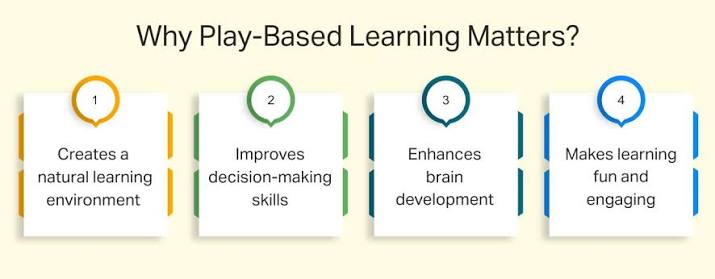
Children in their first five years learn best through play, not worksheets, and Pune parents can use that to choose a preschool wisely. A neighbour’s three-year-old is already writing the alphabet. A relative asks whether your child can count to a hundred. Somewhere between the school tours and the admission forms, it is easy to believe that earlier academics mean a better start.
The research on early childhood points the other way. The most important learning in these years happens through play: building, pretending, moving, talking and experimenting. This guide explains why play-based learning matters, what it looks like in practice, and how to choose the best preschool in Pune that provides you pure peace of mind.
What Play-Based Learning Actually Means
Play-based learning is a way of teaching in which children explore ideas through activities they choose and enjoy, guided by a trained teacher who plans the environment and asks the right questions.
It is not free-for-all time with toys. A child stacking blocks is learning balance, measurement and cause and effect. A group acting out a market scene is practising language, turn-taking and early maths. The teacher observes, extends the activity and gently introduces new vocabulary and concepts at the right moment.
The key difference from rote teaching is who is doing the thinking. In a worksheet, the child copies. In play, the child decides, tries, fails and tries again.
Why the First Five Years Matter So Much
The brain grows faster between birth and age five than at any other time in life, and play is how young children wire it.
By around age five, a child’s brain has reached roughly 90 percent of its adult size. Millions of new connections form every day, shaped by the experiences a child has. Repeated, rich, hands-on experiences strengthen the connections that support language, attention, memory and self-control.
Worksheets and drills engage a narrow slice of that growth. Play engages nearly all of it at once: the senses, the body, emotions, language and thinking. That is why early childhood experts across the world recommend play as the main vehicle for learning before primary school.
Five Skills Play Builds That Worksheets Cannot
Play builds the foundations that later make reading, writing and maths easy, and it builds character skills no worksheet touches.
• Language and communication: Pretend play, storytelling and songs give children new words and the confidence to use them, in English and in their home language.
• Social and emotional skills: Sharing a toy, waiting for a turn and resolving a disagreement teach empathy and self-regulation. These skills predict school success as strongly as early academics do.
• Fine and gross motor skills: Climbing, pouring, threading beads and clay work build the hand strength that later makes handwriting comfortable.
• Thinking and problem solving: Puzzles, construction and sorting games build early maths, logic and curiosity.
• Independence and confidence: When children choose activities and finish them, they learn that their ideas matter. That belief carries into every classroom they will ever sit in.
Three Myths Pune Parents Often Hear
Most worries about play-based learning come from a few common myths, and each one has a clear answer.
Myth 1: “Play means my child is not learning.” Learning in play is deliberate. Good teachers plan activities around specific goals such as counting, vocabulary or fine motor control, and track each child’s progress.
Myth 2: “My child will fall behind in Class 1.” Children from strong play-based programmes tend to arrive at primary school with better attention, stronger language and more willingness to try. Those are the habits that make formal learning easier.
Myth 3: “Early writing and memorising give a head start.” Pushing formal writing before the small muscles of the hand are ready often leads to poor grip, frustration and a dislike of school. A child who loves learning at five will catch up on letters quickly.
How Footprints Preschool Brings Play-Based Learning to Life
Footprints Preschool builds its programme on play, backed by a research-based curriculum and a strong focus on safety and wellbeing.
• HighScope curriculum: Footprints follows the HighScope approach, an internationally respected model built on active, hands-on learning. Children plan what they want to do, carry it out, and then reflect on it with their teacher. This plan-do-review rhythm builds decision-making, language and confidence from an early age.
• AI-integrated CCTV safety: Parents want to know their child is safe. Footprints classrooms use AI-integrated CCTV monitoring, so safety is supported by technology as well as by vigilant staff.
• All-female, police-verified staff: Every member of the teaching and care team is a woman and has undergone police verification, which gives families added peace of mind.
• Zero junk food policy: Healthy bodies support active minds. Footprints keeps junk food out of the preschool and encourages nutritious meals and snacks.
For families, this means play is not left to chance. It is planned, observed and connected to clear developmental goals, in an environment where children are safe and well cared for.
A Checklist for Choosing a Play-Based Preschool in Pune
A few simple observations during a school visit will tell you whether a preschool truly practises play-based learning.
• Look at the classroom. Are there different learning corners for blocks, pretend play, books, art and sensory activities? Is children’s own work displayed at their eye level?
• Watch the children. Are they busy, talking and making choices, or sitting in rows copying from the board?
• Listen to the teachers. Do they ask open questions such as “What do you think will happen?” instead of only giving instructions?
• Ask about the curriculum. Is it a recognised, research-based model, and can the school explain how it works in simple terms?
• Check outdoor time. Children need daily space to run, climb and explore.
• Ask about safety and staff. Look for CCTV monitoring, police-verified staff and clear pick-up procedures.
• Ask about food. Find out what is served, and whether the school supports healthy eating.
• Ask how progress is shared. Good schools report on skills and growth, not only on marks.
Simple Play Ideas You Can Try at Home
You do not need expensive toys to support play-based learning, because everyday household items work well.
• Kitchen play: Let your child pour, scoop and sort rice, dal or water. This builds early maths and hand control.
• Cardboard city: Turn old boxes into houses, buses or a toy shop, and ask your child to tell you the story.
• Park time: Visit a nearby garden or playground daily and let your child climb, run and jump freely.
• Story and song time: Read together every day, sing rhymes and ask what might happen next.
• Pretend play: Play doctor, shopkeeper or teacher, and let your child lead.
The best home practice is simple: follow your child’s interest, ask questions, and resist the urge to correct or hurry.
Give Your Child a Joyful Start
The first five years happen only once, and the foundation your child builds in them shapes everything that follows. Play-based learning protects what matters most at this age: curiosity, confidence, strong language, healthy relationships and a love of learning.
As you compare preschools across Pune, look beyond early writing and homework. Choose a place where children are safe, active, heard and encouraged to explore.
To see play-based learning in action, visit your nearest Footprints Preschool, meet the teachers and watch a classroom at work. Your child’s best learning may look a lot like play, and that is exactly how it should be.