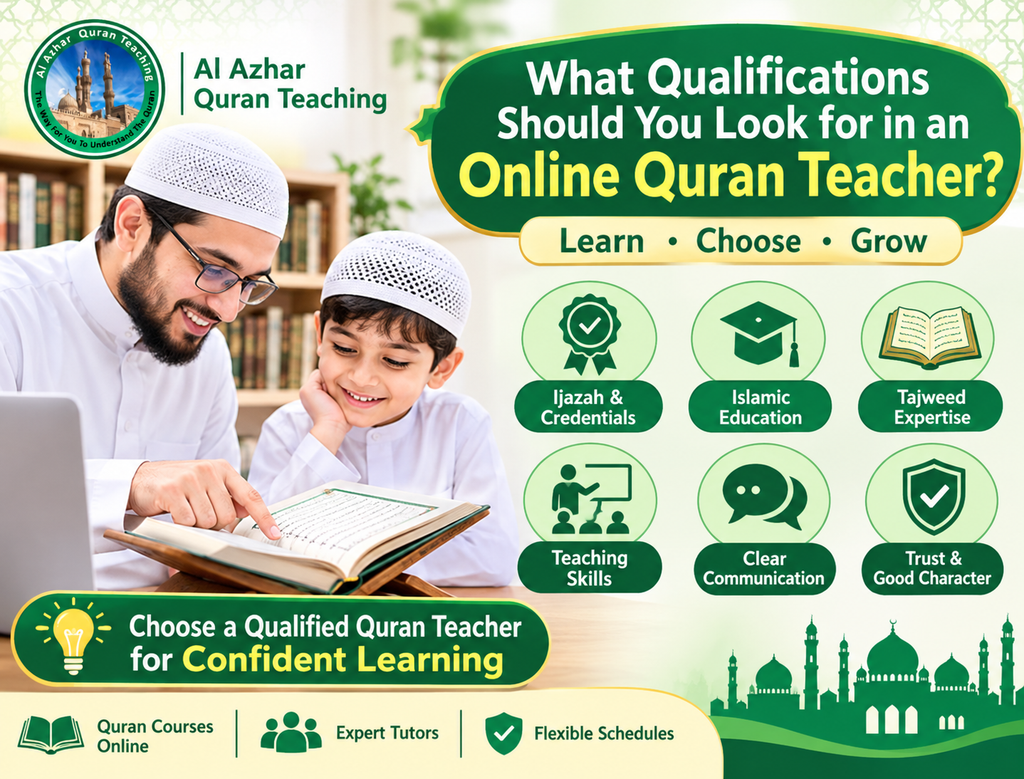
Choosing who guides your recitation is one of the most important decisions a Muslim learner can make. A strong teacher protects your pronunciation, builds your confidence, and keeps you motivated for years. That is why every student and parent should know how to find a qualified Quran teacher online before booking a first lesson.
The market has grown fast. Live video tools now connect learners in London, Toronto, and Sydney with instructors in Cairo within seconds. More choice is welcome, yet it makes quality harder to judge, because anyone can create a profile and call themselves a tutor. This guide explains the credentials, skills, and warning signs that matter, so you can decide with confidence.
Why Qualifications Matter More in Online Learning
Quran recitation is an oral tradition. Letters are shaped by the tongue, throat, and lips, and a small slip can change how a word sounds. Scholars have long stressed learning from a teacher who can hear you and correct you directly.
Nearly two billion Muslims live worldwide, and the large majority are not native Arabic speakers, according to Pew Research Center. Many learners therefore depend on a teacher to explain sounds that their mother tongue does not contain. Through a screen this job becomes harder, so the teacher’s training counts for even more.
Core Qualifications to Look For
1. A Verified Ijazah in Quran Recitation
An Ijazah is a certificate showing that a teacher recited the entire Quran to a qualified scholar and received permission to teach it. Many include a sanad, a chain of teachers that links back to the Prophet Muhammad ﷺ. Ask which narration the certificate covers, such as Hafs from Asim, and who issued it. A genuine teacher will answer these questions openly and with pride.
Did You Know? Scholars recognize ten canonical readings (qira’at) of the Quran, and Hafs from Asim is the most widely used around the world today.
2. Formal Islamic Education
A degree in Quranic sciences, Arabic, or Sharia adds depth beyond memorization. Institutions such as Al-Azhar in Cairo, whose mosque dates to 972 AD, remain widely respected for this training. Formal study helps a teacher explain why a rule exists, which makes lessons easier to remember.
3. Mastery of Tajweed
Tajweed is the science of giving every letter its proper right when reciting. A qualified teacher should be able to explain and demonstrate:
- Articulation points (makharij) of the letters
- Letter characteristics (sifat)
- Rules of noon sakinah and meem sakinah
- Lengths of elongation (madd)
- Correct stopping and starting (waqf and ibtida)
Beginners who start learning Quran with Tajweed under a trained instructor avoid repeating errors that become hard to unlearn later.
4. Real Teaching Skill
Knowing the Quran and teaching it are separate abilities. Look for:
- A clear lesson plan with short-term goals
- Patient, specific correction instead of general praise
- Regular progress feedback for students and parents
- Methods adjusted to age, level, and learning pace
Expert Insight: The most valuable skill a Quran teacher has is hearing the mistake that the student cannot hear yet, then guiding the tongue toward the right sound step by step.
5. Clear Communication
You learn faster when the explanation is in a language you understand. An instructor who can teach in Arabic, English, or Urdu helps beginners grasp rules quickly. Good audio quality and a stable connection matter just as much, because every sound must be audible.
6. Character and Trustworthiness
A teacher shapes your attitude toward the Quran, not only your recitation. Look for patience, punctuality, and respect. Parents should confirm that child safety practices exist, such as allowing a parent to sit in on lessons. Sisters who prefer to learn from women should be able to request a female tutor.
Matching the Teacher to the Learner
Different goals call for different strengths.
- Young children: need short activities, playful pacing, and gentle encouragement. Parents exploring kid-friendly Quran classes online should ask how the teacher keeps attention on a screen.
- Teenagers: need respectful, goal-based lessons that fit around school schedules.
- Adult beginners: need patience, privacy, and flexible hours, without embarrassment over basic mistakes.
- Memorization students: need a revision system and daily accountability. Many families find that live online Quran memorization classes provide structure that recorded lessons cannot.
- Large families: need coordinated schedules. Households with siblings at different levels should ask how lessons can be arranged for each child.
Trends Shaping Online Quran Learning
- One-to-one sessions remain the preferred format for recitation correction, since personal feedback is difficult to give in large groups.
- Flexible scheduling across time zones, including early morning and late evening slots, is now an expectation.
- Short, frequent sessions suit children better than one long lesson.
- Apps and recordings support daily practice, yet they work best alongside a live teacher.
- Families increasingly look for package options that cover several children.
Common Challenges
- Credentials that are difficult to verify from a distance
- Weak internet or poor microphones that distort recitation
- Time zone gaps between teacher and student
- Children losing focus during screen-based lessons
- Inconsistent attendance that slows progress
Most of these problems shrink when you choose a provider with a clear enrolment process, scheduled lessons, and transparent communication.
Practical Tips Before You Enrol
Credentials can be checked in several ways. Request a clear copy of the certificate, ask for the name of the issuing scholar, and listen to a sample recitation. Reputable academies also arrange a short demonstration lesson. Never rely on a polished profile photo or a long list of claims alone, because evidence you can see and hear is always stronger.
- Ask to see the Ijazah and the name of the issuing scholar.
- Book a free trial class and observe how mistakes are corrected.
- Listen to the teacher recite a short passage to judge clarity and fluency.
- Ask how progress is tracked and how often feedback is shared.
- Review the published fee details and confirm exactly what is included.
- Check that the available hours suit your time zone and family routine.
During the trial lesson, consider asking:
- How will you correct my pronunciation during recitation?
- What does a typical lesson look like?
- How will I know that I am improving?
Red Flags to Avoid
- Reluctance to share credentials or certificates
- Promises of complete mastery in an unrealistically short time
- Lessons that only listen without correcting
- No trial lesson and no lesson structure
- Pressure to pay for a long period upfront
If you notice two or more of these signs, keep searching. A good teacher welcomes questions.
Frequently Asked Questions (FAQs)
1. How can I tell if a Quran teacher online is qualified?
Ask for an Ijazah, the name of the scholar who issued it, and proof of Tajweed training. A qualified teacher should also give a clear lesson plan and correct your mistakes patiently. A demonstration lesson helps you judge fluency, and reading about high-quality online Quran lessons shows what good instruction looks like.
2. Is an Ijazah necessary for an online Quran teacher?
An Ijazah is the strongest sign that a teacher is authorized to teach recitation, because it shows they recited to a qualified scholar. It is not the only quality that matters, since teaching skill and character count too. Al Azhar Quran Teaching introduces the qualified teachers behind our academy so families can see who will guide them.
3. Can my child learn from a female Quran tutor online?
Yes. Many families, especially those with daughters, prefer a female tutor, and good academies offer this option. Ask about lesson length, parent supervision, and how progress is shared. You can sign up for a trial class and observe how the tutor works with your child before committing.
4. What should beginners study first with an online Quran teacher?
Beginners usually start with the Arabic letters, correct pronunciation, and basic Tajweed rules before reading full verses. A steady pace prevents bad habits from forming. Many students also keep Tajweed books nearby for revision between lessons.
5. Can adults with no Arabic background learn Quran recitation online?
Absolutely. Adult beginners can start from the alphabet and build up gradually, and a patient teacher makes this stress free. Learners who want stronger language foundations often add beginner Arabic courses online alongside recitation practice.
6. How long does it take to read the Quran correctly with Tajweed?
There is no fixed timeline, because progress depends on your starting level, lesson frequency, and daily practice. Short, regular sessions with consistent feedback tend to work better than irregular long ones. Reviewing the available course options helps you choose a path that matches your goals and schedule.
7. Can I study Islamic subjects as well as recitation?
Yes. Many learners combine recitation with lessons on belief, daily worship, and Islamic manners. Joining online Islamic classes gives this wider understanding while your Quran teacher online focuses on pronunciation and fluency.
Conclusion
A qualified instructor combines an authentic Ijazah, formal Islamic education, strong Tajweed knowledge, real teaching skill, and good character. Verify each point, use a trial class to test the fit, and stay consistent once you begin. Choosing a trusted Quran teacher online for your family is an investment in faith and character, and the right guidance turns daily practice into a lasting habit. At Al Azhar Quran Teaching, learners study with instructors inspired by the Al-Azhar tradition, through one-to-one lessons, male and female tutors, and flexible schedules. You can explore the Quran courses online and begin your journey today.