
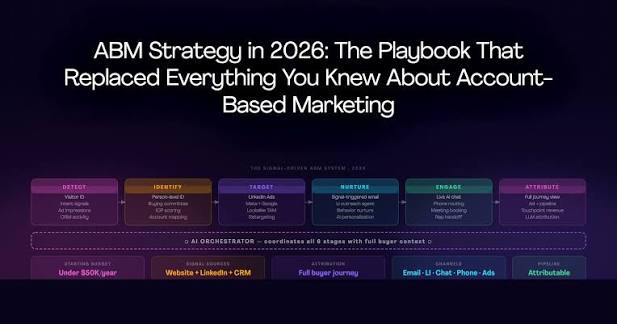
B2B buyers leave behind more signals than ever before.
They visit websites, download research, attend webinars, interact with social content, compare solutions, explore product pages, read industry publications, and engage with multiple stakeholders inside a vendor organization. Individually, these actions may appear insignificant. Together, they can reveal a much clearer picture of an account’s interests and potential buying stage.
The challenge for B2B marketing and sales teams is not a lack of data. It is knowing which signals matter, what they mean, and what to do next.
Artificial intelligence is changing that equation. By analyzing large volumes of account and engagement data, AI can help organizations identify meaningful patterns, prioritize accounts, personalize interactions, and coordinate campaigns across channels.
This is making account-based marketing more adaptive and measurable while helping teams move from simply collecting buyer signals to turning those signals into meaningful action.
The Shift From Static ABM to Adaptive Engagement
Traditional ABM campaigns often follow predetermined workflows.
A target account enters a campaign, receives an email, sees an advertisement, receives another email, and eventually gets a sales follow-up. While this structure can provide consistency, it does not necessarily reflect how buyers behave.
A prospect might demonstrate strong purchase intent after the second interaction, while another may remain in early research for months.
Treating both accounts identically can result in poor timing and irrelevant communication.
AI enables ABM programs to become more responsive.
Instead of following the same sequence regardless of behavior, intelligent systems can evaluate new signals and adjust the next interaction based on what the account appears to need.
What Counts as a Buyer Signal
Buyer signals can come from numerous sources.
Some are direct, such as requesting a product demonstration or visiting a pricing page. Others are indirect, including repeated visits to specific content, participation in webinars, engagement with industry research, or increased activity from multiple stakeholders within an organization.
Signals may include:
- Website engagement
- Content downloads
- Webinar attendance
- Email interactions
- Product research
- Account-level website activity
- Technology changes
- Hiring activity
- Executive movement
- Social engagement
- Research intent
- Interactions with sales representatives
The important consideration is context.
A single website visit rarely indicates that an account is ready to buy. Repeated engagement across multiple channels, combined with strong account fit, can be far more meaningful.
AI Helps Separate Noise From Intent
Modern B2B organizations can generate enormous amounts of behavioral data.
Manually reviewing every interaction is impractical.
AI can process these signals at scale and identify patterns that may otherwise remain hidden. For example, an account that previously engaged with introductory content may suddenly begin consuming technical resources, visiting product pages, and involving several stakeholders.
That change in behavior could indicate movement into a more active evaluation stage.
AI can surface these changes and help marketing and sales teams determine whether the account deserves additional attention.
The goal is not to let an algorithm make every decision. It is to give revenue teams better intelligence for making those decisions.
Building Smarter Multi-Touch ABM Sequences
Effective Multi-Touch ABM Sequences should feel like connected conversations rather than a collection of unrelated marketing activities.
Consider an account that downloads an industry report.
The next interaction might provide a related case study. If the account then attends a webinar on the same topic, the messaging can become more specific. If multiple stakeholders subsequently engage with technical content, sales may have a stronger reason to initiate a direct conversation.
Each interaction builds on the previous one.
AI can help determine which content, channel, and message should come next based on the account’s behavior.
This creates an adaptive journey rather than a rigid campaign.
Personalization Should Follow Buyer Intent
Personalization is most effective when it reflects something meaningful about the buyer.
Simply adding a company name to an email is not enough.
AI can help marketers personalize engagement based on industry, business challenges, account characteristics, previous interactions, stakeholder roles, and observed intent.
For example, a technology leader may receive technical implementation content, while a financial stakeholder within the same account receives information focused on business value and operational efficiency.
The account receives a consistent brand experience, but each stakeholder gets information that reflects their role.
Coordinating Multiple Channels
B2B buyers rarely stay within a single channel.
They may discover a brand through search, consume a report, interact with LinkedIn content, attend a webinar, visit the website, and eventually engage with sales.
A modern ABM strategy needs to connect these experiences.
AI can help coordinate email, digital advertising, content, social engagement, webinars, website experiences, and sales outreach based on account activity.
The objective is not to communicate everywhere simultaneously.
It is to ensure that each channel contributes something useful to the overall buyer journey.
AI-Powered Demand Generation Creates Better Prioritization
Traditional demand generation often focuses heavily on attracting and capturing leads.
Modern programs are increasingly focused on identifying accounts that demonstrate both strong fit and meaningful buying activity.
AI-Powered Demand Generation supports this shift by combining account intelligence, behavioral data, intent signals, predictive analytics, and campaign engagement.
Instead of treating every lead or account equally, AI can help prioritize organizations based on their likelihood of progressing toward an opportunity.
This allows marketing teams to allocate resources more intelligently while helping sales representatives focus their attention where it has the greatest potential impact.
Recognizing Buying Groups Instead of Individual Leads
One of the most important developments in modern ABM is the growing focus on buying groups.
Enterprise purchases rarely depend on a single person.
An account may have several stakeholders evaluating a solution from different perspectives. When multiple people from the same organization begin engaging with related content, that collective activity can provide a stronger signal than the behavior of one individual.
AI can help connect these interactions at the account level.
This enables teams to recognize when interest is spreading across a buying committee and adjust their engagement strategy accordingly.
Timing Is Critical
Even highly relevant messaging can fail when it arrives at the wrong time.
Contacting an account too early can create unnecessary pressure. Waiting too long can allow competitors to gain attention.
AI can evaluate engagement patterns and identify changes in account activity that suggest increased interest.
This can help teams determine when to move from educational content to deeper consideration-stage resources or direct sales engagement.
The result is a more contextual approach to outreach.
Human Judgment Still Matters
AI can identify patterns, recommend actions, and automate parts of campaign execution, but human expertise remains essential.
Sales professionals understand nuances that behavioral data cannot always capture. Marketing teams understand brand positioning and customer psychology. Account executives may know about organizational changes that are not visible in digital activity.
The strongest ABM programs combine AI-driven intelligence with human judgment.
AI should make teams smarter and faster—not remove the human element from B2B relationships.
Data Quality Determines AI Performance
AI-powered ABM depends heavily on the quality of the underlying data.
Outdated contact information, duplicate accounts, incorrect firmographic details, incomplete CRM records, and disconnected systems can weaken campaign intelligence.
Organizations should therefore maintain strong data hygiene practices and establish clear processes for validating and updating account information.
Better data creates better signals.
Better signals create better decisions.
And better decisions ultimately create better customer experiences.
Privacy and Responsible Personalization
The ability to analyze more buyer signals comes with greater responsibility.
Organizations should ensure that data is collected, processed, and used appropriately. Privacy requirements, consent preferences, security controls, and internal governance should be incorporated into the design of AI-driven marketing programs.
Personalization should make a buyer’s experience more relevant without becoming intrusive.
Trust remains one of the most valuable assets in B2B marketing.
Measuring the Impact of AI-Driven ABM
ABM performance should not be evaluated solely through clicks or email engagement.
Revenue-focused organizations should monitor metrics such as:
- Target account engagement
- Buying group engagement
- Qualified opportunities
- Pipeline generated
- Opportunity progression
- Sales cycle velocity
- Account conversion rates
- Revenue influenced by marketing
- Customer acquisition efficiency
These metrics provide a clearer picture of whether buyer signals are actually being converted into business outcomes.
The Future of Buyer Signal Activation
B2B marketing is moving toward a model where buyer signals are continuously analyzed and translated into intelligent actions.
Instead of waiting for a prospect to fill out a form, organizations can recognize patterns across multiple interactions. Instead of sending the same campaign to every target account, teams can adapt messaging according to behavior. Instead of treating channels independently, businesses can coordinate them around a unified account journey.
AI makes this level of orchestration increasingly practical.
But the technology itself is not the strategy.
The real advantage comes from combining reliable data, meaningful intent signals, thoughtful personalization, strong content, and human expertise into a coordinated engagement model.
The organizations that master this approach will be better positioned to engage high-value accounts at the moments that matter most.
If your organization wants to turn buyer intent into meaningful account engagement and stronger pipeline performance, reach out to Acceligize. With expertise in AI-powered demand generation, account-based marketing, intent intelligence, content syndication, and multi-channel B2B engagement, Acceligize helps businesses identify high-value opportunities, orchestrate relevant buyer journeys, and convert meaningful signals into measurable pipeline growth.
