
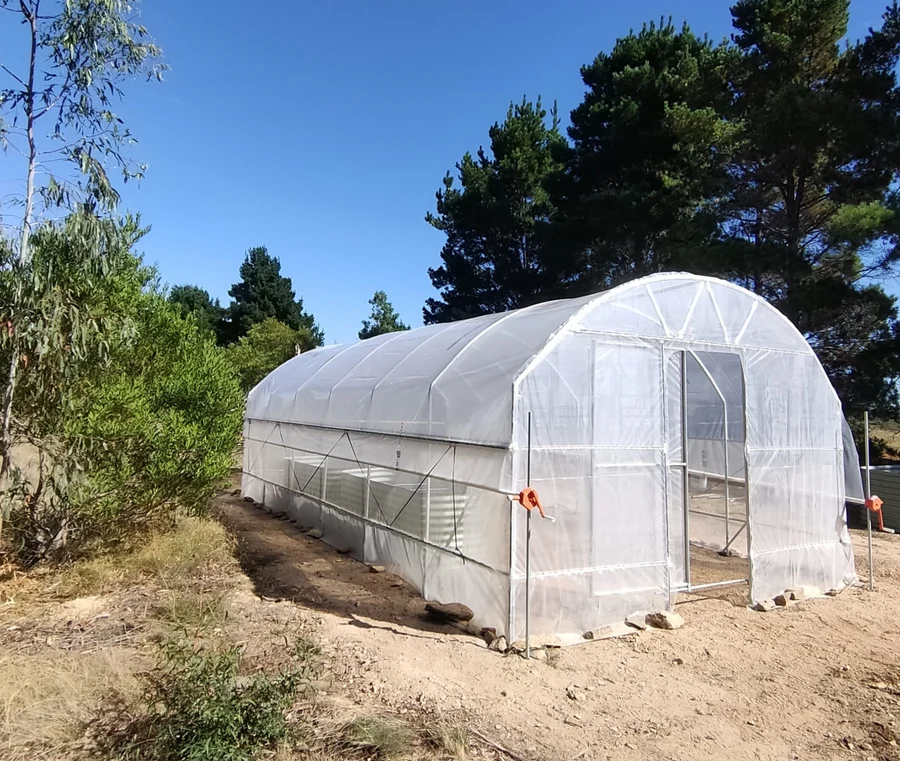
Canada gives growers a generous but narrow window of warmth, and even a good summer can be interrupted by a cold night, a hailstorm, or a stretch of wind that flattens tender seedlings. Covered growing has become the quiet answer, letting gardeners and market growers start earlier, finish later, and shield crops from the weather that a short season cannot afford to lose.
Among the covered options, a tunnel greenhouse stands out for doing a great deal with very little material, and the reasons trace back to a single curved shape.
The arch carries load the way a bridge does
The half-round profile is a structural decision before it is anything else. An arch takes a downward push at its crown and spreads it as compression running down both curved sides into the ground, rather than letting it bend a straight beam until it sags.
Wind behaves kindly around the same curve. Rather than slamming into a flat wall, moving air slides over the smooth dome and reattaches on the far side, so gusts are deflected instead of caught. That is why a well-anchored tunnel rides out a summer squall that would tear at a boxy structure, provided its feet are pinned firmly against the lift the wind tries to create.
Keeping the cover drum-tight is half the job
A loose plastic sheet is a liability. Slack film flaps in the wind, and every flutter works the material against the frame until it chafes, stretches, and finally splits along a crease.
A tight cover does the opposite. When the film is pulled drum-tight over the bows and locked down along the base, it can no longer move, so wind loads pass straight through the taut skin into the frame and down to the anchors. Tension also sheds rain, because water runs off a firm surface instead of pooling in a sagging pocket that would eventually pull the whole cover down.
Good tensioning rests on a few fundamentals worth naming:
•Even pull: stretch film equally across every bow
•Locked base: clamp the edges against uplift
•No wrinkles: creases become tear lines over time
•Firm anchors: tie the frame to solid ground
In summer, a tunnel lives or dies by airflow
Clear film traps solar energy, which is the entire point in spring but a hazard at the peak of a Canadian July. Sunlight passes through the cover, warms the soil and plants, and the heat given back off those surfaces cannot escape as easily as it entered, so the interior temperature climbs fast.
Left unchecked, that heat will stall growth or scorch a crop outright. Ventilation is therefore not an accessory but the core of hot-weather management. Roll-up sides open the long walls so a cross-breeze sweeps the length of the house, while open ends let the hottest air rise and flow out in a steady current.
The aim is to hold the inside close to the outside air on a hot day, using moving air to carry off excess heat and to lower humidity that would otherwise invite disease. A grower learns to read the sky and adjust the openings the way a sailor trims to the wind.
The clear film is a working material, not just a wrapper
The cover is doing optical and mechanical work at once. A six-millimeter clear plastic skin is thick enough to resist punctures and to carry tension without ballooning, yet it still passes the light a crop needs to grow.
Clear film also scatters incoming light as it passes through, spreading illumination so that lower leaves receive energy instead of sitting in the deep shade a single hard shadow would cast. The material has to hold up against constant ultraviolet exposure as well, since raw plastic left in the sun grows brittle and cloudy within a season or two.
A few properties decide how well the skin performs:
•Light transmission: feeds the whole canopy, not the top
•Diffusion: softens shadows across lower leaves
•Tear strength: holds tension without splitting
•Weather resistance: survives ultraviolet light and rain
A flexible tunnel is a different tool than a rigid glasshouse
It helps to place this design against its rigid cousins. A hard-walled greenhouse built from panels relies on stiff sheets and a heavy frame to stand, carrying load through rigid members that never move.
A tunnel greenhouse takes the opposite path. Its strength comes from a light bow frame combined with a membrane held in tension, so the cover itself becomes part of the structure. That makes the whole thing cheaper, faster to raise, and simple to re-skin when the film wears out, at the cost of the permanence and insulation a solid-panel house provides. For a grower who wants to expand covered ground quickly and cover a large footprint, that trade is often the right one.
The end walls and base close the enclosure
A tunnel greenhouse is only as good as the ends that cap it. The two end walls carry the doors and any fixed vents, and they take a real share of the wind that funnels straight down the length of the house, so they need their own framing rather than a loose flap of film.
The ground line matters just as much. Burying or clamping the film skirt along the base seals the tunnel against drafts and stops wind from getting underneath the cover to peel it off. A tidy edge also keeps pests and weeds from slipping in at soil level, where they would otherwise find an easy path into a warm, sheltered bed.
Warm soil is the quiet payoff
Much of what a tunnel greenhouse offers happens at the ground, not in the air. The cover traps heat that soaks into the soil during the day, and that warmed earth releases it slowly overnight, keeping roots several degrees above the chill outside.
This buffered root zone is what lets a grower set transplants out weeks before the open field is safe and keep harvesting well after the first frosts arrive. Warmer soil drives faster germination and steadier growth, turning a short northern season into something much closer to the long one that crops actually want. On a cool but sunny summer morning, the difference between the ground inside and the ground outside can already be felt underfoot.
None of these features stands alone. The arch, the tensioned cover, and the ventilation work as one system, each answering a specific demand of growing under plastic through an unpredictable season.
Approached as a piece of engineering rather than a plastic shed, a tunnel greenhouse becomes far easier to site, anchor, and manage across a full Canadian summer.
