
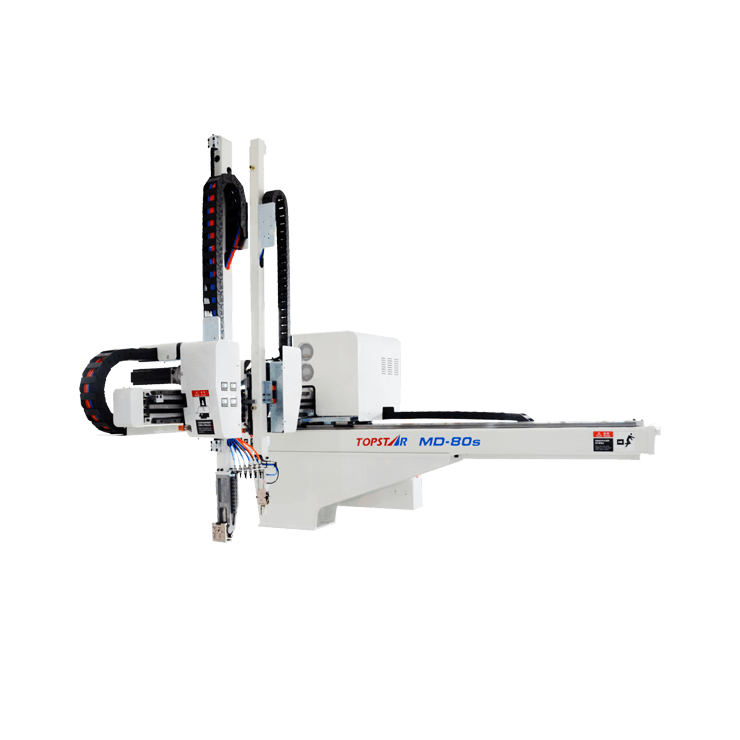
Choosing the right axis configuration, whether three-axis or five-axis, is not merely a matter of technical specifications but also a strategic decision that must align with part complexity, cycle-time requirements, and long-term production goals. Three-axis injection molding robot typically move linearly along the X, Y, and Z axes, reliably performing standard pick-and-place operations, part removal, and simple assembly tasks. In contrast, five-axis injection molding robots add rotational degrees of freedom, enabling them to perform more complex operations, such as part orientation, multi-angle insertion, and secondary assembly. This additional flexibility is particularly important for high-precision applications requiring delicate part handling or multi-cavity molds.
Injection Molding Robot Axis Capabilities: Three-Axis Performance
Due to their simple structure, high reliability, and cost-effectiveness, three-axis injection molding robot remain the industry’s mainstay equipment. These robots operate along three linear axes—typically denoted X, Y, and Z—making them ideal for simple pick-and-place operations.
The advantages of three-axis injection robots include high repeatability, with linear axes providing stable, precise motion, which is crucial for consistent part removal. Short cycle-time integration and minimal mechanical complexity ensure rapid operation, thereby reducing overall molding cycle time, lower cost and maintenance, fewer mechanical parts, and reduced initial investment and long-term maintenance needs.
While three-axis systems offer these advantages, they still have limitations in applications requiring rotation or complex directional adjustments. For example, parts that require flipping, rotation, or insertion at multiple angles often exceed the capabilities of a purely linear injection robot. Engineers must carefully evaluate part geometry, mold configuration, and production targets to determine if a three-axis solution is sufficient.
Injection Molding Robot Axis Capabilities: Fully Leveraging Five-Axis Flexibility
In addition to the three linear movements of X, Y, and Z, five-axis injection molding robots include rotary axes—typically designated A and B. This configuration allows the robot to manipulate parts with greater degrees of freedom, making it suitable for complex molds, multi-cavity operations, and assembly tasks within the injection molding unit.
Key advantages include handling complex parts, the additional axes enabling flipping, rotation, and precise angular positioning without human intervention, improved cycle efficiency, and integration with auxiliary equipment for automated post-processing. Five-axis systems are particularly suitable for high-variety, low-volume production where flexibility is paramount. However, they have higher initial costs and require more complex programming and maintenance.
Injection Molding Robot Axis Selection Criteria: Part Geometry Considerations
When selecting a three-axis or five-axis injection robot, part geometry is a key determining factor. Simple rectangular or cylindrical parts with a uniform top surface typically do not require rotational axes. Conversely, asymmetrical or multi-feature parts require additional degrees of freedom for orientation, insertion, and positioning.
Factors to consider include:
Part size and weight: Heavier or larger parts may require specific axis configurations to maintain stability and repeatability.
Surface complexity: Irregular shapes benefit rotational motion to ensure proper handling without damage.
Cavity layout: Multi-cavity molds often require angular orientation for efficient part removal.
By matching axis performance to part geometry, manufacturers can minimize operational errors, reduce scrap rates, and improve overall production efficiency. This geometric alignment ensures the injection molding robot operates within its optimal range of motion, balancing speed and accuracy.
Cycle Time and Efficiency
Cycle time optimization is another key factor in selecting an axis. Three-axis injection molding robots, due to their relatively simple mechanical structure, typically achieve faster linear motion, making them well-suited for simple, high-speed operations. While five-axis robots offer greater flexibility, they may require longer strokes or rotational adjustments, potentially increasing single-cycle time.
To balance flexibility and efficiency, consider the following factors:
Average Molding Cycle Time: The robot should complete pick-and-place or part handling within the injection molding machine’s cycle time.
Motion Optimization: Efficiently planning multi-axis paths can reduce longer travel distances.
Parallel Operation: A 5-axis robot can perform orientation and transfer tasks simultaneously, reducing net cycle time despite increased complexity.
Topstar engineers typically recommend simulating the robot path during the injection molding cycle to ensure the selected axis configuration doesn’t become a bottleneck. A suitable axis configuration should balance speed, accuracy, and flexibility.
Injection Molding Robot Integration: System Compatibility and Programming
Integration with existing injection molding equipment and automation systems is crucial for both three-axis and five-axis injection molding robot. System compatibility affects programming complexity, safety protocols, and overall operational efficiency.
Key considerations include:
Controller Interface: Ensuring seamless communication between the robot controller and the injection molding machine.
Safety Systems: Interlocking devices, light curtains, and emergency stop devices must be synchronized with axis movement.
Programming Flexibility: Multi-axis programming requires advanced software for path optimization, collision avoidance, and repeatable motion loops.
Five-axis robots, with their additional rotary axes, typically require more complex programming. However, modern control software can automate complex paths, making even complex operations intuitive. Proper integration ensures the injection robot operates reliably and safely, maximizing productivity while minimizing human error.
Choosing the Right Axes for Maximum Efficiency and Precision
Choosing the right axis configuration for the Topstar injection molding robot is more than a technical decision; it determines the robot’s operational capabilities, efficiency, and impact on overall production quality. As this guide states, three-axis robots offer reliable, cost-effective linear motion, ideal for high-volume production of uniformly shaped parts. In contrast, five-axis robots offer the flexibility and precision required for complex, multi-angle part-handling and assembly tasks.
