A prop firm challenge gives traders an opportunity to prove their skills before receiving access to a funded trading account. Instead of depositing large amounts of personal capital, traders complete a structured trading evaluation that measures consistency, discipline, and risk management. When they meet the firm’s requirements, they can qualify to trade with company capital while following the firm’s trading rules.
Many new traders focus only on reaching the profit target. Experienced traders know that passing a prop firm challenge depends on much more than making profitable trades. Successful evaluations require disciplined execution, controlled drawdowns, proper position sizing, and a well-tested trading plan. Traders who protect capital often achieve better long-term results than those who chase large profits.
This guide explains how prop firm challenges work, what evaluation rules typically include, how risk management affects performance, and what practical steps can improve your chances of earning a funded trading account.
What Is a Prop Firm Challenge?
A prop firm challenge is an evaluation process created by a proprietary trading firm to assess whether a trader can manage risk while generating consistent returns. Rather than funding every applicant immediately, the firm asks traders to complete a simulated trading evaluation under predefined rules.
The challenge usually takes place on a demo trading account that mirrors real market conditions. The firm’s objective is not simply to identify traders who earn the highest returns. Instead, it looks for traders who can follow rules consistently while preserving capital.
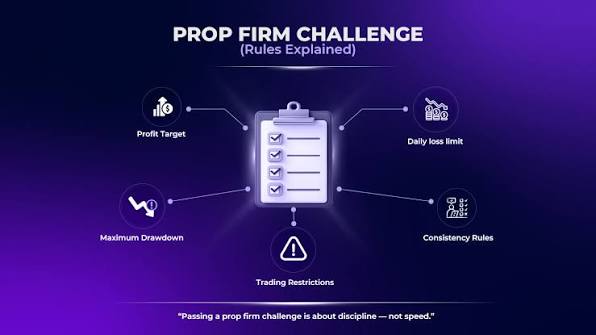
Each proprietary trading firm designs its own evaluation criteria, but most challenges include:
- Profit target requirements
- Maximum daily drawdown rules
- Maximum overall drawdown limits
- Minimum trading day requirements
- Trading performance consistency
- Risk management compliance
Passing the evaluation demonstrates that a trader can operate responsibly before managing a funded trading account.
How a Proprietary Trading Firm Uses Trading Evaluations
A proprietary trading firm provides capital to qualified traders in exchange for a share of the profits they generate. Since the firm carries financial risk, it needs a structured method to evaluate applicants.
The trading evaluation measures several important qualities:
Risk Management
The evaluation examines how well traders protect capital during changing market conditions. Traders who avoid unnecessary losses generally perform better over time than those who pursue aggressive gains.
Trading Performance
Consistent performance matters more than occasional large winning trades. Firms prefer traders who demonstrate repeatable decision-making instead of relying on luck.
Trading Discipline
Successful traders follow their trading plan regardless of emotions. They avoid revenge trading, overtrading, and impulsive decisions after winning or losing trades.
Rule Compliance
Evaluation rules exist to simulate professional trading standards. Firms expect traders to respect drawdown limits, trading hours, and position management requirements throughout the challenge.
How a Funded Trading Account Works
After successfully completing the evaluation, eligible traders may receive access to a funded trading account.
Unlike a personal brokerage account, the trading capital belongs to the proprietary trading firm. The trader manages the account according to the firm’s policies and receives an agreed percentage of the profits.
Most funded accounts continue to include risk controls such as:
- Maximum drawdown limits
- Position size restrictions
- Daily loss limits
- Trading consistency expectations
- Account scaling opportunities
Maintaining discipline remains essential even after receiving funding. Many firms monitor ongoing trading performance to ensure traders continue following professional risk management practices.
Understanding Profit Targets
The profit target represents one of the main objectives during a prop firm challenge. It specifies the amount of profit a trader must achieve while remaining within all evaluation rules.
For example, if an evaluation requires an 8% profit target, traders must increase the account balance by that percentage without violating maximum drawdown limits or other trading conditions.
Many traders make the mistake of focusing exclusively on reaching the target quickly. This often leads to excessive risk and unnecessary losses.
A better approach combines steady account growth with disciplined execution. Smaller, consistent gains frequently outperform aggressive trading strategies over the full evaluation period.
Why Drawdown Rules Matter
Drawdown rules protect both the proprietary trading firm and the trader.
A drawdown measures how much an account declines from its previous balance or equity level. Most evaluations include both daily and overall drawdown limits.
Daily Drawdown
The daily drawdown limits how much a trader may lose during a single trading day.
If the limit is exceeded, the evaluation may end immediately regardless of previous profits.
Maximum Overall Drawdown
The maximum drawdown measures the largest decline allowed throughout the entire evaluation.
This rule encourages traders to preserve capital rather than recover from large losses through increasingly risky trades.
Professional traders often focus on protecting drawdown before pursuing additional profits because capital preservation supports long-term consistency.
Risk Management Is the Foundation of Every Successful Challenge
Risk management separates consistently profitable traders from those who repeatedly fail evaluations.
Effective risk management includes:
Position Sizing
Position sizing determines how much capital is exposed on each trade.
Using smaller position sizes allows traders to withstand losing streaks without approaching drawdown limits too quickly.
Stop-Loss Discipline
Every trade should include a predefined exit point based on the trading plan.
Accepting controlled losses helps preserve capital for future opportunities.
Risk-to-Reward Planning
Professional traders evaluate whether potential reward justifies the risk before entering a position.
Maintaining favorable risk-to-reward ratios helps improve long-term trading performance even when not every trade succeeds.
Consistency Over Excitement
Large winning trades may feel rewarding, but consistent execution produces better evaluation results over time.
Successful traders prioritize repeatable decision-making rather than attempting to double their accounts in a few trades.
Demo Trading Account vs Live Trading Conditions
Most prop firm challenges use a demo trading account during the evaluation phase.
Although simulated, these accounts generally reflect real market prices, spreads, and execution conditions. The purpose is to evaluate trading ability without exposing the proprietary trading firm to immediate financial risk.
Traders should approach demo evaluations with the same seriousness they would use when managing real capital. Developing professional habits during the evaluation often leads to stronger performance after funding.