
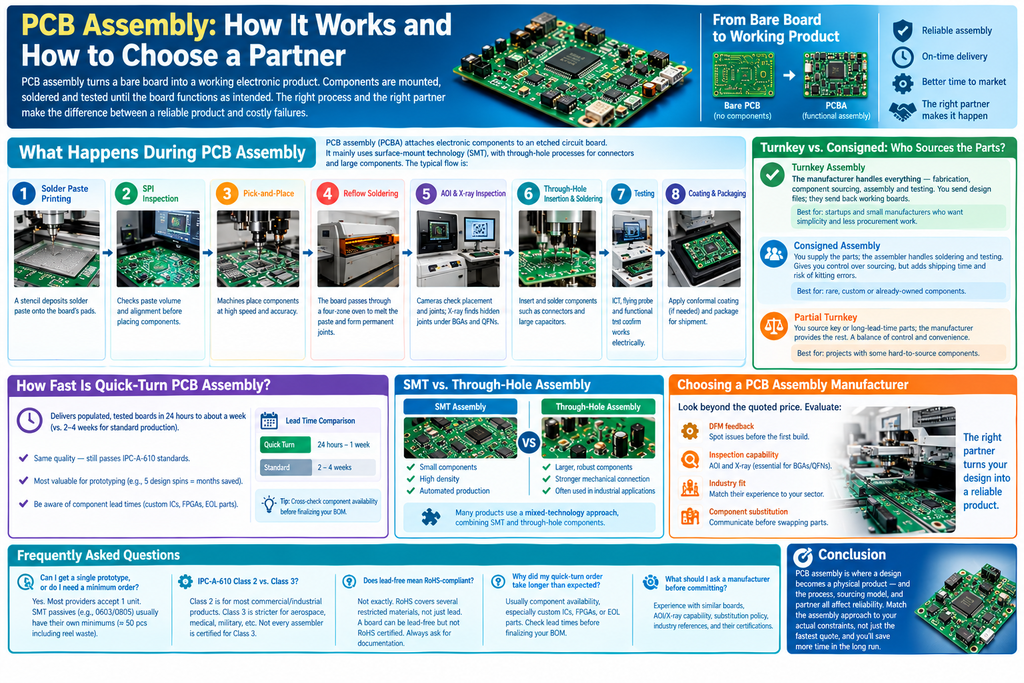
All electronic products-even the tiny garage-door sensor that only operates one button and nothing more-emerge from their birthplace as nothing more than bare boards. PCB assembly is what turns a naked board into something useful: the process of assembling, soldering, and testing components until you can be sure the board works as intended. The process can fail at many points, leading to field failures or prototypes that fail to boot.
Good assembly means a working board every time.
Here, the team describes what happens in reality, where other engineers typically run into trouble, and how to ensure the manufacturing partner doesn’t become the weak link in your project delivery.
What Happens During PCB Assembly
PCB assembly (often abbreviated PCBA) is the soldering process that attaches electronic components to an etched printed circuit board so it can function as an electrical device. This stage comes immediately after bare-board fabrication and immediately before final product integration.
Most boards today are surface-mount-processed, but additional through-hole processes are carried out for items such as connectors and large capacitors to add mechanical robustness. Typically the order is as follows:
- Solder paste printing – A stencil deposits solder paste onto the board’s pads.
- Solder paste inspection (SPI) – Paste volume and alignment are checked before placing anything, since paste defects cause most downstream soldering problems.
- Pick-and-place – Machines place components onto the pasted pads at speeds of tens of thousands of parts per hour.
- Reflow soldering – The board passes through an oven with a controlled four-zone thermal profile that melts the paste and forms permanent joints.
- Automated optical inspection (AOI) – Cameras check placement and joint quality; X-ray inspection follows for hidden joints under BGAs and QFNs.
- Through-hole insertion and wave or hand soldering, where applicable.
- Testing – In-circuit test (ICT), flying probe, and functional test confirm the board actually works electrically, not just visually.
- Conformal coating and final packaging, for boards facing moisture, dust, or vibration.
Skip or rush any of these steps, and defects—solder bridges, tombstoning, cold joints, misaligned components—tend to show up later, usually at the worst possible time in a product’s life.
Turnkey vs. Consigned: Who Sources the Parts?
This is one of the first decisions any team makes, and it affects cost, lead time, and risk.
Turnkey PCB assembly means the manufacturer handles everything: fabricating the bare board, procuring every component on the bill of materials, and assembling and testing the finished product. You send design files; they send back working boards. It’s the most common route for startups and small manufacturers who don’t want to carry component inventory or manage a dozen vendor relationships.
Consigned assembly flips that: you supply the parts, and the assembler handles only soldering and testing. This gives you control over sourcing — useful for rare, custom, or already-owned components — but adds shipping time and the risk of kitting errors on your end.
Most projects land somewhere in between, using partial turnkey, where the customer sources hard-to-find or long-lead-time parts and the manufacturer fills in the rest from stock. There’s no universally “better” option here — it’s a genuine trade-off between convenience and control, and the right call depends on how unusual your BOM is.
How Fast Is Quick-Turn PCB Assembly?
A direct answer: quick-turn PCB assembly delivers populated, tested boards in 24 hours to about a week, compared to two to four weeks for standard production runs. The board itself isn’t lower quality—it still has to pass the same IPC-A-610 artistry checks; only the scheduling priority changes.
Quick turn matters most during prototyping, where five design revisions at standard lead times can eat four months of calendar time. Multiply that by a couple of days per spin and a team can verify a design and proceed to production in a few weeks instead of a quarter. The catch is availability: custom ICs, FPGAs, and end-of-life parts are the typical culprits that delay a “quick turn” order, so it’s wise to verify component lead times before finalizing a BOM.
Choosing a PCB Assembly Manufacturer
A few things separate a manufacturer worth building a relationship with from one that will cause headaches down the line:
- DFM feedback. A good partner flags design-for-manufacturing issues before your first build, not after a failed batch.
- Inspection capability. AOI is table stakes; X-ray is non-negotiable if your board has BGAs or QFNs.
- Industry fit. A house that’s excellent at consumer electronics volume runs may not have the process controls an aerospace or medical board requires — ask for references from your specific sector.
- Communication on component substitutions. Supply chain gaps happen. What matters is whether they tell you before swapping a part, not after.
Frequently Asked Questions
Can I get PCB assembly done for a single prototype, or do I need a minimum order?
Yes. Most modern assembly providers accept orders as small as one unit, largely because online quoting platforms have made low-volume runs profitable. That said, individual passive components (resistors, capacitors, diodes…) in (0603 or 0805 or other) packages typically have their own per-line minimums as well, usually (around) 50 pcs including reel waste, regardless of whether the board quantity is one.
What’s the difference between IPC-A-610 Class 2 and Class 3?
Class 2 is the default standard for most commercial and industrial electronics, covering reliable performance under normal service conditions. Class 3 is a stricter workmanship standard reserved for high-reliability products — aerospace, medical implants, military hardware — where a field failure isn’t an acceptable risk. Not every assembler is certified for Class 3 work, so confirm this before sending a board that needs it.
Does lead-free assembly mean the same thing as RoHS-compliant?
Not exactly — the two overlap but aren’t identical. RoHS certification relates to the levels of several prohibited materials that can appear on a board, not lead alone. A board might be lead-free but not yet RoHS certified because it uses other prohibited materials elsewhere in the assembly. Always inquire from a supplier specifically about documentation regarding RoHS or lead-free; don’t presume one or the other:
Why did my quick-turn order still take longer than expected? Almost always component availability, not the assembly process itself. Lead times on specialty ICs, FPGAs, and end-of-life parts are measured in months, no matter how quickly the assembly line runs. The best way to secure a quick-turn schedule is to cross-reference available components with your BOM before placing your order.
What should I ask a PCB assembly manufacturer before committing? Ask about their experience with boards similar to yours, their inspection capabilities (AOI and X-ray at minimum), how they handle component substitutions when parts go out of stock, and whether they can provide references from your specific industry. A manufacturer that’s excellent at high-volume consumer electronics won’t necessarily have the process controls a medical or aerospace board requires.
Conclusion
PCB assembly is where a design on paper becomes a physical product that either works or doesn’t — and the process, the sourcing model, and the manufacturing partner all shape how reliably that happens. Whether you’re running a single prototype or scaling to volume production, matching the assembly approach to your actual constraints, rather than defaulting to whatever’s fastest to quote, tends to save far more time than it costs upfront.
