
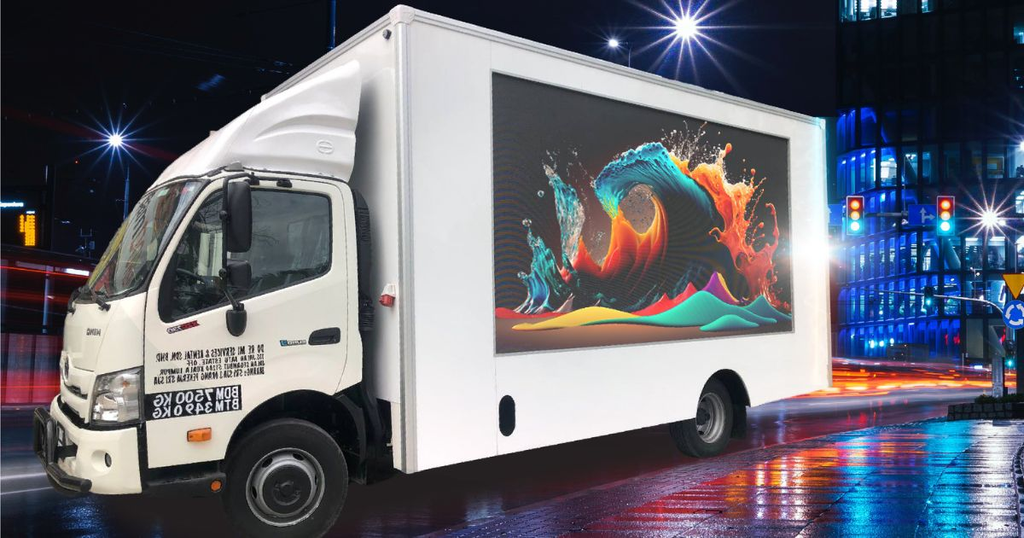
From high-energy music festivals and stadium tailgates to dynamic guerilla marketing campaigns, high-brightness visual media has become the foundation of modern outdoor engagement. Traditional printed billboards and standard indoor displays simply cannot compete with direct-view LED technology under ambient sunlight.
The visual display industry relies on two primary deployment models for outdoor messaging: stationary outdoor LED screens and mobile event trucks. Understanding how these technologies withstand harsh environments, how pixel pitch dictates visual performance, and how mobile trucks open new revenue channels will ensure you select the optimal visual hardware for your venue or campaign.
What is an Outdoor LED Screen?
An outdoor LED display is a weatherized, high-luminance video wall engineered specifically for high-ambient-light environments. Built using heavy-duty structural frames and light-emitting diodes (LEDs) arranged on modular panels, outdoor screens emit powerful direct illumination capable of overcoming harsh direct sunlight.
Unlike delicate indoor LED displays, outdoor systems are built with structural protection against rain, wind, dust, temperature extremes, and physical impact.
Core Architecture of Outdoor LED Displays
- DIP vs. SMD Diodes: Older outdoor screens often utilized Dual In-line Package (DIP) diodes due to their massive light output. Modern systems predominantly feature Surface-Mounted Device (SMD) packaging, which blends red, green, and blue dies into a single diode, offering wider viewing angles (140+) and superior color consistency.
- Conformal Coating: Internal printed circuit boards (PCBs) are treated with silicon, acrylic, or polyurethane conformal coatings to protect sensitive electronic driver ICs from humidity, condensation, and corrosion.
- Heat Dissipation & Cooling: Outdoor cabinets feature cast-aluminum or magnesium alloy housings that act as heat sinks. Fanless ventilation paths or forced air-cooling loops prevent thermal throttles without allowing dust or water ingress.
Crucial Technical Engineering Metrics for Outdoor Displays
Evaluating outdoor LED hardware requires looking at specific performance thresholds that directly influence durability, daytime readability, and camera recording quality.
Ingress Protection (IP Ratings)
An outdoor LED display’s durability is certified through its Ingress Protection (IP) code, expressed as two numbers:
- First Digit (Solid Ingress): A rating of 6 means complete protection against dust and micro-particulates.
- Second Digit (Liquid Ingress): A rating of 5 protects against water jets from any direction, while 6 protects against high-pressure water streams.
Standard outdoor screens feature an IP65 front-face rating and an IP54/IP65 rear-casing rating, ensuring rain and dust cannot enter the internal circuitry.
Brightness Levels (Nits)
Standard household TVs sit around 300to500nits, and indoor LED walls produce 600to1,200nits. In contrast, outdoor LED screens must produce 5,000to10,000+nits to maintain full image contrast during mid-day sunlight. High-end screens feature ambient light sensors that automatically adjust output, conserving power at night and blasting max luminance under clear skies.
Pixel Pitch (P) and Distance Calculations
Pixel pitch dictates the physical spacing between individual LED pixels in millimeters. Outdoor deployments typically balance visual resolution against build cost and viewing distance:
- P2.9mm-P3.9mm: Used for close-range mobile screens, outdoor stage backdrops, and interactive event spaces where viewers stand 10 to 15 feet away.
- P4.8mm-P6.2mm: The sweet spot for mobile LED trucks, sports stadium perimeters, and large festival walls viewed from 20 to 40 feet.
- P8.0mm-P10.0mm: Ideal for massive highway billboards and building facades placed 50+ feet away from passing vehicular traffic.
OptimalViewingDistance(Meters)PixelPitch(mm)2.5
What is a Mobile LED Truck?
A mobile LED truck (or mobile display vehicle) is a commercial truck chassis equipped with an integrated high-brightness outdoor LED video wall, onboard generator, hydraulic lifting system, and full audio-visual control booth.
Instead of erecting static scaffolding or hanging modular truss arrays over several hours, a mobile LED truck provides a complete, self-contained, high-impact video setup that can arrive on-site, elevate, and broadcast within 15 minutes.
Key Mechanical Components of LED Trucks
- Hydraulic Masts & Swivel Rotators: Most commercial LED trucks feature hydraulic lifting poles that raise the screen 10 to 20 feet above the truck bed. Many units include 360 motorized rotators to pivot the display toward the largest crowd concentrations.
- Onboard Power Generation: Integrated quiet diesel or lithium-battery power plants supply steady AC current to the LED wall and audio systems, eliminating the need for external venue hookups.
- Commercial AV Rack Equipment: The interior control cabin houses video scalers, video switcher boards, wireless microphones, sound system amplifiers, media players, and 4G/5G cellular routers for direct live streaming.
- Hydraulic Outriggers: Extending stabilizer legs absorb sway and prevent mechanical tipping caused by wind loads on the elevated video surface.
Primary Applications for Outdoor Displays and Mobile LED Trucks
The combination of mobility, extreme daytime visibility, and versatile media playback makes these displays essential across various commercial and civic industries.
1. Experiential Marketing and Mobile Billboards
Brands utilize mobile LED trucks to target dense foot traffic zones, entertainment districts, product drops, and trade show entrances. Unlike static print billboards that remain fixed on a highway, mobile trucks drive dynamic video campaigns, interactive QR codes, social media walls, and real-time product teasers straight to target demographics.
2. Live Sports Broadcasting and Fan Tailgates
At marathons, golf tournaments, motorsports, and stadium watch parties, viewing areas span across huge open grounds. Mobile LED trailers and trucks act as instant live-feed scoreboards, replay screens, fan engagement hubs, and sponsor visibility engines.
3. Community Events and Outdoor Cinemas
Municipalities, parks departments, and universities use mobile displays for outdoor movie nights, graduation ceremonies, civic rallies, and holiday parades. The rapid setup times eliminate multi-day event staging permits and labor overhead.
4. Emergency Management and Public Information
During natural disasters, heavy traffic detours, or public health emergencies, city officials deploy mobile LED vehicles to communicate real-time evacuation orders, wayfinding maps, and safety alerts.
Comparing Deployment Strategies: Fixed, Modular Rental, & Mobile Truck
To select the right hardware setup, evaluate how these three common outdoor display configurations differ in operational overhead, setup time, and structural needs:
| Operational Feature | Fixed Outdoor Billboard | Modular Truss Rental | Mobile LED Truck |
| Setup Time | Days to weeks | 4 to 8 hours | 10 to 20 minutes |
| Mobility | None (Permanent location) | Requires freight transport | Fully road-mobile |
| Power Source | Grid tie-in | Venue shore power / Genset | Integrated Onboard Generator |
| Labor Requirement | Construction crew | Rigging & AV technicians | 1 Driver / Operator |
| Wind Resistance | Permanent concrete base | Ballast water tanks/weights | Hydraulic Outriggers |
| Best For | Highway advertising | Long-term multi-day festivals | Pop-up events & mobile marketing |
Essential Purchasing and Rental Planning Checklist
Before investing in an outdoor LED project or booking a mobile truck service, ensure you clear these fundamental technical hurdles:
1. Verify Environmental Weatherproofing Ratings
Always confirm that the display features an IP65 rating on the front module face. In coastal or humid environments, ask suppliers for marine-grade stainless steel hardware, anti-UV polymer module masks, and heavy copper-clad PCB traces to prevent salt-air degradation.
2. Confirm Wind Load and Rigging Safety
Outdoor screens act as giant sail walls against wind gusts. Verify that mobile trucks feature certified hydraulic outriggers rated for local wind safety standards (e.g., 45to60mph stability limits). For hanging truss displays, ensure structural engineering sign-offs are secured in advance.
3. Review Camera Broadcast Performance
If your event involves camera recording or live broadcasts, select an LED driver IC with a refresh rate of 3,840Hz or higher. Lower refresh rates (1,920Hz) cause black horizontal scan lines and severe flickering when captured by high-speed video camera shutters.
4. Local Permit and Zoning Compliance
Mobile LED advertising trucks and fixed roadside billboards are governed by local municipal signage bylaws. Confirm permit rules regarding screen animation, brightness limits during nighttime hours, and vehicle route restrictions before launching commercial ad runs.
Conclusion
Direct-view LED technology has revolutionized outdoor messaging. Whether permanently mounted to a highway facade or driven directly to an audience aboard a mobile LED truck, high-brightness outdoor displays deliver unmatched visibility, high-resolution visuals, and weather-resistant durability. By evaluating pixel pitch, IP ratings, power logistics, and setup speeds, organizations can leverage outdoor screens to maximize brand reach and deliver unforgettable live experiences.
