
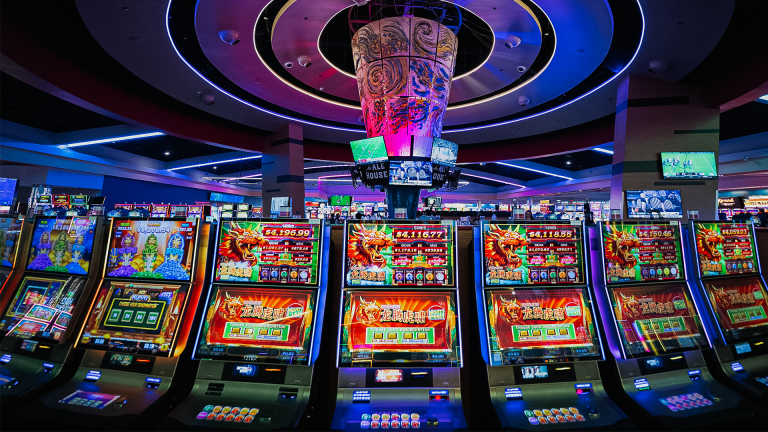
Slot games are among the most recognizable forms of casino entertainment. Their spinning reels, colorful symbols, sound effects, and simple controls make them easy to identify, but modern titles contain far more than a basic spin button.
A Slot Casino can provide hundreds or even thousands of games with different themes, layouts, wagering systems, and bonus mechanics. Behind every title is a mathematical structure that determines how results are generated and how payouts are calculated. Eligible adults who choose to play should understand these systems before risking real money.
From Mechanical Machines to Digital Reels
Traditional slot machines used physical reels containing a fixed collection of symbols. Pulling a lever caused the reels to rotate before stopping on a particular arrangement. A payout was awarded when the final symbols formed an eligible combination.
Electronic machines later introduced buttons, digital displays, and more advanced visual effects. As slot games moved online, developers were no longer restricted by physical reels or cabinet dimensions.
Modern digital slots can use expanding grids, animated characters, changing symbols, cascading combinations, interactive bonus rounds, and detailed storylines. Although the presentation has changed significantly หวยรัฐบาล, the central idea remains familiar. A wager begins the round, a result is produced, and the game checks whether that result qualifies for a payout.
How a Slot Casino Generates Results
Most regulated digital slot games use a random number generator, commonly known as an RNG. This software continuously creates numerical values that can be converted into possible game outcomes.
When the player starts a paid round, the system selects a relevant value and translates it into the symbols shown on the screen. The spinning animation presents the result but does not normally determine it.
Each round is designed to operate independently. Previous wins, losses, bonus features, or near misses do not force the next round to produce a particular outcome.
This means a long losing sequence does not guarantee an approaching win. In the same way, a recent large payout does not make another winning result impossible. Attempts to predict future outcomes from previous spins are unreliable because the results are generated separately.
Understanding Reels, Rows, and Paylines
The playing area of a traditional slot contains vertical reels and horizontal rows. A common format uses five reels with three rows, although modern games can have much larger or more flexible layouts.
A payline is a route connecting selected positions across the reels. Some slots use only a few paylines, while others include dozens or hundreds of fixed patterns.
To receive a payout, matching symbols usually need to appear in the required order on an active payline. Many games evaluate combinations from the leftmost reel, but this is not a universal rule.
Certain titles pay in both directions or allow combinations to begin from different positions. Players should read the game instructions rather than assuming that every slot follows the same structure.
Alternative Ways to Create Winning Combinations
Not every slot uses traditional paylines. Ways-to-win games often award payouts when matching symbols appear on consecutive reels, regardless of their exact row positions.
Cluster games use another system. Instead of forming a line, identical symbols must connect horizontally, vertically, or through another pattern defined by the rules.
Some titles use symbols that pay when they land anywhere on the grid. Others increase the number of possible combinations when additional rows or reels become active.
These alternative formats can make a game appear more dynamic, but a larger number of possible combinations does not guarantee frequent profits. Symbol values, probability, and the complete mathematical model remain important.
Regular Symbols and Their Values
Regular symbols form the standard paying combinations in a slot game. Lower-value icons may appear more frequently and produce smaller payouts, while premium symbols usually provide higher values.
The number of matching symbols also affects the payment. A combination containing five matching symbols is generally worth more than a combination containing three, although the exact amount depends on the paytable.
Payouts can be displayed in cash, coins, credits, or multiples of the wager. Players should understand the displayed units before starting a round.
A paytable lists the available symbols, qualifying combinations, and corresponding values. Reviewing this information is one of the simplest ways to understand how a particular game works.
Wild Symbols and Substitution Features
A wild symbol usually substitutes for selected regular symbols to help complete a paying combination. Its function is similar to a flexible card that can represent several different icons.
Some wilds remain in a single position, while others expand across an entire reel. Sticky wilds may stay active for several rounds, and moving wilds can change position during a feature.
Multiplier wilds increase the value of combinations in which they participate. A game may also combine several wild mechanics during free rounds or bonus features.
Wilds do not necessarily replace every symbol. Scatters, jackpots, bonus icons, and other special symbols may be excluded. The paytable should explain all limitations.
Scatter Symbols and Bonus Activation
Scatter symbols commonly activate free spins, bonus rounds, or direct payouts. Unlike regular combinations, scatters may not need to appear on an active payline.
A specific number of scatters is normally required to begin a feature. Additional scatters may award more free rounds, increase a multiplier, or unlock an enhanced version of the bonus.
Some games allow bonus features to be triggered again while they are already active. Others place a strict limit on the number of free rounds that can be awarded.
The presence of a scatter symbol does not always mean a bonus will begin. The complete qualifying requirement must be satisfied.
Cascading Reels and Continuing Sequences
Cascading games remove the symbols involved in a winning combination. New symbols then fall or appear in the empty positions, and the grid is evaluated again.
This process can create several consecutive payouts from one paid round. In some games, a multiplier increases after every successful cascade.
The sequence ends when no new eligible combination appears. A long cascade can be visually exciting, but it does not guarantee that the total payout will exceed the original wager.
Players should also confirm whether all displayed payouts are combined before being added to the account balance.
Return to Player and House Advantage
Return to Player, usually shortened to RTP, is a theoretical percentage calculated across a very large number of rounds. It describes how much of the total qualifying wagered amount a game is designed to return over time.
If a slot has a theoretical RTP of 96 percent, the remaining percentage represents the mathematical advantage of the operator. It does not mean that a person who wagers a certain amount will automatically receive 96 percent of it back.
Individual results can be substantially higher or lower. A player may receive a large payout, recover only a small part of the money wagered, or lose the entire amount allocated to play.
RTP provides information about the long-term mathematical model, but it cannot predict a short playing session.
Volatility and Payout Distribution
Volatility describes the general pattern through which a slot distributes its payouts. A lower-volatility title may be designed to produce smaller payouts more regularly, while a higher-volatility game may provide less frequent but potentially larger rewards.
Neither category guarantees a better result. Lower volatility does not remove the possibility of losing, and higher volatility does not promise that a large payout will occur.
Volatility can help players understand the intended style of a game. However, it should not be used as a reason to increase a wager or continue after reaching a spending limit.
Every slot remains unpredictable during an individual session.
Wager Settings and the Cost of Play
The cost of a round may be controlled through a total bet selector. Other games divide the wager into coin value, bet level, and number of active paylines.
Players should focus on the final amount displayed before pressing the spin button. Changing one setting can sometimes increase the complete wager more than expected.
Speed also affects the financial cost of playing. A small wager may appear harmless when considered individually, but repeated rounds can quickly create a much larger total amount wagered.
Automatic play and fast-spin settings can accelerate this process. These features do not improve the probability of winning. They simply allow more rounds to occur within a shorter period.
Bonus Purchases and Increased Risk
Some digital slots allow players to pay for immediate entry into a bonus feature. The purchase price may be many times larger than the cost of a regular round.
Buying a bonus does not guarantee a profit. The feature can still return less than its purchase price, and the complete cost is usually deducted from the balance immediately.
Players should review the price, potential restrictions, and maximum exposure before using this option. A bonus feature should never be considered a reliable method for recovering previous losses.
In locations where bonus purchases are restricted, the feature may be unavailable even when the standard version of the game can be accessed.
Mobile Slot Casino Experiences
Many slot games are designed to work on smartphones and tablets. Responsive technology allows the reels, menus, and controls to adjust to different screen sizes.
A reliable mobile interface should clearly display the balance, total wager, paytable, and account settings. Important information should remain accessible without requiring the player to search through multiple menus.
Mobile access offers convenience, but it can also make impulsive play easier. Notifications, quick deposits, and constant availability may encourage longer or more frequent sessions.
Setting financial and time limits before opening a game can help prevent convenience from turning into excessive activity.
Licensing, Fairness, and Account Security
Before using a platform, players should check whether it is licensed to operate in their location. Licensing information should identify the operator and relevant regulatory authority.
Some regulated games are independently tested to confirm that their software and published mathematical information meet applicable requirements. Users should verify claims through reliable sources when possible.
Account security also deserves attention. Players should create a strong password, avoid sharing login details, and activate additional verification when available.
Payment rules, withdrawal limits, identity checks, privacy policies, and customer support information should be reviewed before any deposit is made.
Responsible Slot Casino Play
Slot games should be treated as paid entertainment, not as a dependable source of income. There is no strategy that can consistently overcome independently generated results.
A sensible budget should include only money that can be lost without affecting essential needs. Rent, food, healthcare, bills, savings, and borrowed funds should never be used for gambling.
Players should avoid chasing losses, increasing wagers in response to frustration, or continuing simply because they believe a win is due. When a limit has been reached, the session should end regardless of previous results.
Deposit limits, session reminders, cooling-off periods, and self-exclusion tools can provide additional control. Anyone finding it difficult to stop should seek support from a qualified gambling assistance service.
Final Thoughts
Modern slot games combine visual design, mathematics, animation, sound, and digital technology within a fast-moving form of entertainment. Understanding reels, paylines, symbols, RTP, volatility, wager settings, and bonus mechanics allows eligible adults to approach these games with more realistic expectations.
Every result remains uncertain, and every paid round carries the possibility of losing money. A Slot Casino should therefore be used only where legally permitted, with firm limits and a clear focus on entertainment rather than financial gain.
