
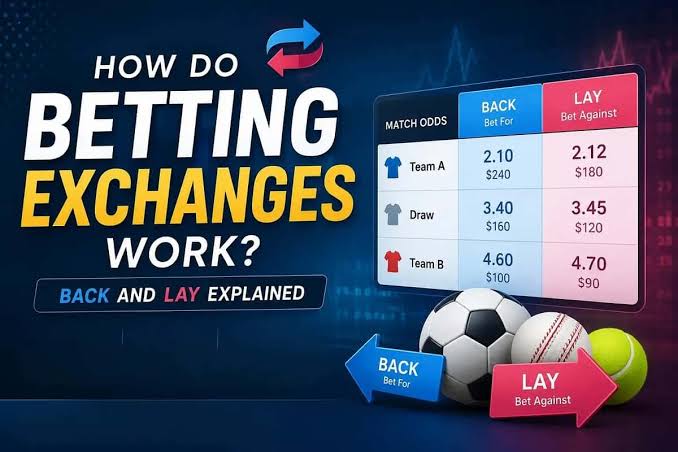
An online betting exchange operates differently from a traditional sportsbook. You are playing against the house at a traditional sportsbook, while on an online betting exchange, you play against another player. Here, your bet is matched against another user who wants the opposite result, and the platform serves as the marketplace, taking a small cut of your winnings. You just need to learn how the back and lay betting system works, and everything else will make sense then.
How Do Back and Lay Bets Work In a Betting Exchange?
You are familiar with the Backing. You put ₹1,000 on India at 2.00, and you’re saying India wins. And Laying is a bit tricky if you are new to betting exchanges. Because a Lay bet means you bet for the things that won’t happen, accepting someone else’s bet. Lay India at 2.00 for ₹1,000, and you keep their ₹1,000 if India loses, and you owe ₹1,000 if they win. That exposure is called liability, and the sum behind it is stake times (odds minus one).
Bigger odds, bigger liability. Lay a 9.00 outsider for ₹500, and you’ve got ₹4,000 on the line. Worth reading the slip twice before you confirm.
How Do Betting Exchanges Work When Nobody Takes Your Price?
Absolutely nothing is going to happen. Your bet sits unmatched in the queue until someone accepts it or you cancel it. Ask for 2.20 on a side, the market prices at 2.00, and you may wait all afternoon for a taker.
So when you bet in a betting exchange, the liquidity matters. In popular leagues like the IPL and top football leagues, these bets are filled within seconds, as many people are betting there. At the same time, a regional fixture at 3 a.m. can be thin enough that only half your bets get matched.
Betting Exchanges Commissions
Exchanges charge a percentage of your net winnings in a market, usually a few percent. Lose the bet, and you pay nothing at all.
Sounds like the worst deal? Compare the actual prices. Exchange odds come from users competing with each other, so there’s no bookmaker overround shaving value off the top, and the post-commission price frequently beats what a traditional book offers on the same selection.
Trading a position Mid-match
Prices shift ball by ball, and you don’t have to sit on a bet until the result. Back a team at 3.00 before the toss, watch the price shorten to 1.80 after a strong powerplay, then lay it back at that number. You’ve now got a profit locked in whichever way the game finishes. Cash out buttons do this same calculation for you, just faster and without the mental maths.
How Do Betting Exchanges Work in India?
Betting rules and regulations in India vary from one state to another. Simply put, the rules that apply when you are in Goa do not apply when you play in Telangana. Most exchanges operating in India hold foreign licenses but still accept rupee deposits via UPI and local bank transfers.
The most important part is choosing a good betting exchange; you should check for legal betting exchanges in India and verify the state’s position on betting. Also, check liquidity, commission rate, and withdrawal speed before signing up anywhere.
Wrapping Up
So, when it comes to the question of how do betting exchanges work? The answer in one line is you bet against other people rather than a bookmaker, and the house takes a commission instead of a margin. If you are new, you can always start by backing only with a smaller bet amount and slowly move into lay bets once you get familiarized with the system.
