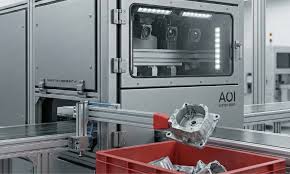
As production lines move faster and manufacturing tolerances become tighter, traditional manual inspection is becoming harder to scale. A human inspector can only review so many products before fatigue affects consistency, and some micro-defects are simply too small for the human eye to catch reliably.
That’s why many manufacturers are turning to automated visual inspection (AVI). Using machine vision systems, industrial cameras, and AI-powered defect detection software, manufacturers can identify quality issues in real time and improve consistency across production lines.
This article explains what automated visual inspection solves, how the technology works, and how manufacturers can successfully deploy it without common implementation mistakes.
What Automated Visual Inspection Solves in Manufacturing
One of the clearest examples of automated visual inspection at scale comes from the BMW Group. Since 2019, BMW has integrated AI-based visual inspection into its manufacturing operations to improve production quality and reduce inspection inefficiencies. BMW’s systems handle the type of production variation that often causes traditional rule-based inspection systems to fail. The AI checks whether the correct door sill model has been installed and inspects leather components for missing or incorrectly colored stitching before the vehicle moves further down the production line.
More importantly, BMW encountered one of the biggest challenges most manufacturers face when implementing AI visual inspection: data quality and availability.
According to BMW, thousands of production images had to be categorized manually to account for different production variations and defect types. To accelerate deployment, the company began generating synthetic training images, allowing new inspection tasks to be trained using only a small number of reference images.
BMW reported that this reduced the time needed to deploy AI-based quality inspection tasks by more than two-thirds. That pattern, strong ROI combined with significant data preparation challenges, is common across many manufacturing environments.
How Automated Visual Inspection Works
Several technologies work together inside a modern automated visual inspection system.
1- Cameras and Lighting
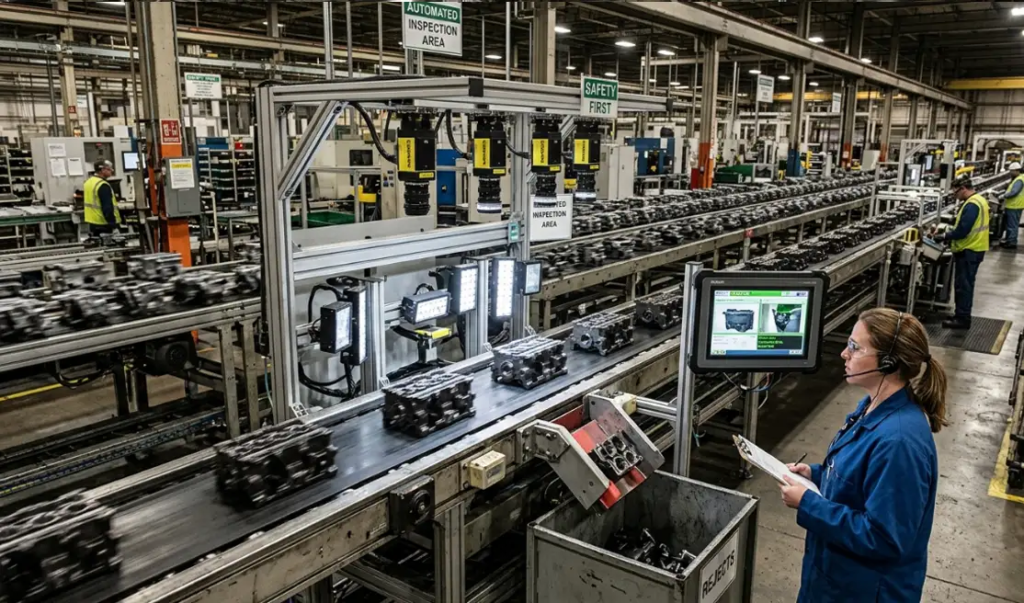
The foundation is machine vision: high-resolution industrial cameras combined with controlled lighting systems designed to highlight specific defect types. In practice, lighting is often more important than the camera itself. Directional, diffuse, and structured lighting each reveal different surface conditions, textures, and dimensional defects. Poor lighting can produce inconsistent images that reduce inspection accuracy, regardless of how advanced the AI software may be.
Manufacturers with successful deployments often spend more time optimizing lighting conditions than selecting camera hardware.
2- AI and Machine Vision Software
Traditional inspection systems relied on rule-based software that compared images against predefined templates. While effective in controlled environments, these systems struggled when lighting conditions changed or when products had natural variations. Modern AI-powered visual inspection systems use deep learning models instead. These models learn from production images and identify patterns associated with acceptable and defective products.
As a result, AI defect detection systems can:
- adapt to manufacturing variation,
- reduce false positives,
- inspect high-mix production lines,
- and identify subtle defects more consistently than traditional rule-based systems.
This shift has made automated quality inspection more practical for complex manufacturing operations.
How to Implement Automated Visual Inspection in Manufacturing
Successful deployment is usually more operational than technical. The most effective strategy is to start with a focused pilot project, validate results, and expand gradually.
A typical rollout includes five stages:
- Identify a high-value inspection problem, such as a defect causing excessive scrap, rework, or warranty claims.
- Collect and label representative production images for that specific defect type.
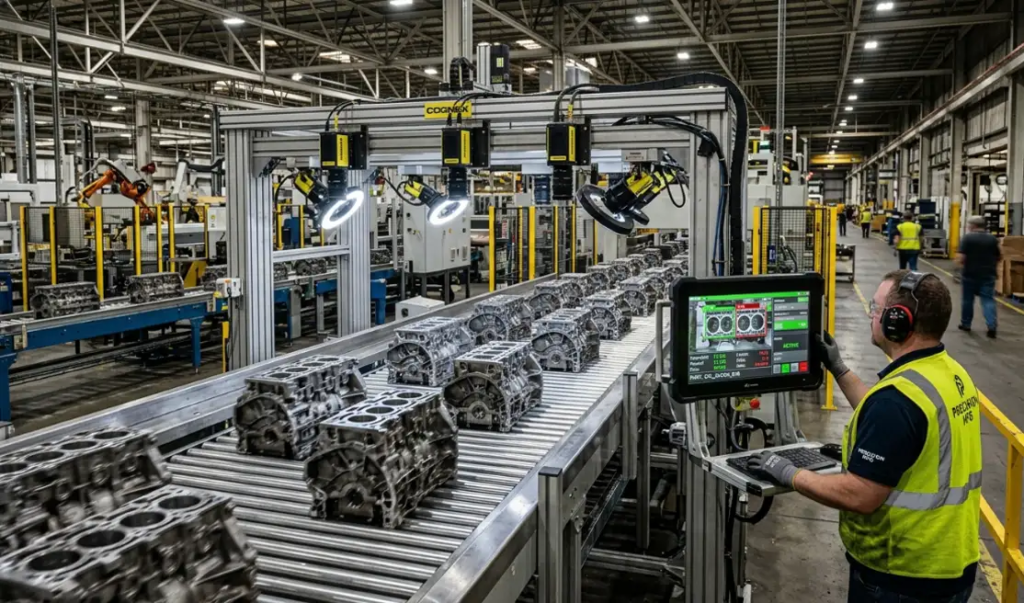
- Install and integrate cameras, lighting systems, and sensors into the existing production environment.
- Train and validate the AI model using known good and defective samples until inspection accuracy becomes reliable.
- Deploy the system inline, monitor performance, and gradually expand to additional defect categories or production lines.
Common Implementation Challenges
Most automated visual inspection deployments face similar challenges.
Data Availability
AI inspection systems require high-quality labeled production images for training. Many manufacturers lack sufficient defect datasets, especially for rare failure conditions.
System Integration: Integrating cameras, lighting, and sensors into an existing manufacturing line is often more difficult than designing a new line around the inspection system.
False Positives: Over-sensitive inspection models may incorrectly flag acceptable products as defective, creating unnecessary operator interventions and production slowdowns.
Skills and Maintenance: Maintaining AI inspection systems requires expertise in machine vision, machine learning, and data management that many traditional manufacturing teams are still developing.
How Manufacturers Overcome These Challenges
Fortunately, these problems are now well understood across the industry.
Modern few-shot learning systems can train from relatively small image datasets, while synthetic data generation helps manufacturers simulate rare defects without waiting for them to occur naturally. Many manufacturers also reduce deployment risk by starting with phased pilot projects rather than attempting full plant-wide rollouts immediately.
False positives typically improve over time through operator feedback loops, where inspection results are reviewed and corrections are fed back into the AI model for continuous improvement. To address skills gaps, manufacturers often partner with AI inspection vendors during early deployment stages while building internal expertise in parallel.
Conclusion
Automated visual inspection has evolved from a specialized technology into a core part of modern manufacturing quality control. By combining machine vision systems, industrial imaging, and AI-powered defect detection, manufacturers can improve inspection consistency, reduce defects, and identify quality issues earlier in the production process.
While challenges around data, integration, and technical expertise still exist, the technology has matured significantly in recent years. For manufacturers investing in smart manufacturing and Industry 4.0 initiatives, automated visual inspection is increasingly becoming one of the most practical and proven quality improvement investments available.