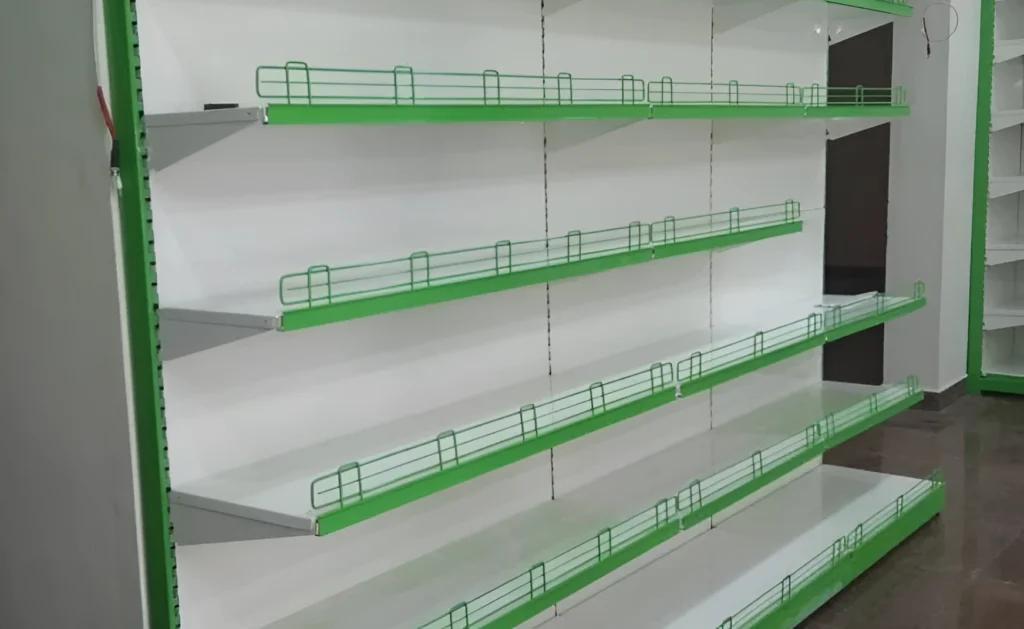
When a retail store runs out of usable shelf space, the problem rarely starts at the shelf. It starts months earlier, with a purchasing decision that prioritized price over build quality, or selected a supplier without understanding the difference between display furniture and storage infrastructure. In a supermarket environment, racks are not passive fixtures. They define traffic flow, influence product visibility, determine how safely staff can restock shelves, and ultimately affect whether the store can operate without interruption.
Chennai has grown into one of South India’s most active commercial centers for retail infrastructure. The city hosts a wide range of manufacturers, from large-scale industrial fabricators to mid-tier regional suppliers who serve grocery chains, hypermarkets, convenience stores, and wholesale outlets. For a store owner or procurement manager evaluating options, the sheer number of vendors makes comparison difficult without a clear framework for assessment.
This article identifies ten manufacturers worth knowing in 2025, along with the criteria that actually matter when making this kind of procurement decision.
Why Manufacturer Selection Matters More Than Product Selection
Buyers searching for supermarket racks Chennai often start with a product specification in mind — a particular height, load capacity, or finish. That instinct is understandable, but it places the emphasis in the wrong place. The product matters less than the manufacturer’s ability to deliver consistently, support installation, and stand behind the product after it has been in use for a year or two.
Industry resources on retail fixture standards, including those maintained by bodies like the International Organization for Standardization, reflect a consistent principle: structural performance in storage and display systems depends on manufacturing process controls, not just raw material specifications. A rack made from adequate steel but assembled with inconsistent welds will fail earlier and less predictably than one made from slightly thinner steel with rigorous quality checks throughout production.
For buyers evaluating vendors, the question is not just “what do they make” but “how do they make it, and what happens when something goes wrong.” Established manufacturers who have supplied larger retail chains or institutional clients are generally better positioned to deliver on both counts. Their production workflows are more standardized, their installation teams more experienced, and their after-sales processes more clearly defined.
Sourcing from a supplier with a documented track record in supermarket racks Chennai also reduces procurement risk significantly — particularly for first-time store fitouts or large-scale expansions where delays have real commercial consequences.
The Ten Manufacturers Worth Considering in Chennai
The following list reflects a cross-section of manufacturers who serve the supermarket and grocery retail segment in Chennai. They vary in scale, specialization, and target market, but each has an established presence in the region and a product range suited to retail environments.
1. Expanda Stands
Expanda Stands has built a consistent reputation in the Chennai retail fixture market with a product range that spans gondola shelving, checkout counters, display racks, and warehouse-grade shelving for back-of-store storage. Their product catalog reflects the needs of both small format stores and larger retail environments, and their manufacturing approach emphasizes structural consistency across batches rather than one-off customization.
2. Mahalakshmi Display Systems
Operating from the broader Chennai manufacturing belt, Mahalakshmi Display Systems specializes in mid-range gondola systems and wall-mounted shelving. They serve primarily independent grocery stores and regional retail chains, with a focus on keeping lead times predictable and installation support available within the city.
3. Sri Lakshmi Rack Industries
This manufacturer has a longer presence in the Tamil Nadu market and has historically served institutional buyers including cooperative retail outlets and government-run distribution centers. Their products tend toward heavier-duty construction, which suits environments where shelves are loaded and unloaded frequently throughout the day.
4. Chennai Shelving Solutions
Positioned more toward retail interior design integration, Chennai Shelving Solutions works with store designers and architects as well as direct buyers. Their product line includes modular systems that can be reconfigured without specialist tools, which appeals to stores that adjust their floor plan seasonally or in response to product category changes.
5. Prime Steel Fabricators
Prime Steel is a fabrication-first business rather than a retail fixture specialist, but their output includes heavy-duty pallet racking and multi-tier shelving systems that serve supermarket back-end operations well. Buyers who need both front-of-store display racks and back-store storage infrastructure sometimes find it practical to work with a single fabricator like Prime Steel to maintain consistency in build standards.
6. Royal Display Works
Royal Display Works serves the branded retail segment and has supplied fixtures to organized retail formats operating in the Chennai metro area. Their manufacturing standards lean toward the requirements of national retail brands, which typically involve tighter tolerances on finish quality and dimensional accuracy.
7. Sakthi Rack Systems
Sakthi Rack Systems operates at a mid-volume scale and supplies both supermarket racks and specialized display units for pharmacy and personal care retail. Their dual-market experience means their design team has reasonable familiarity with regulatory and safety requirements across product categories.
8. Raj Metal Industries
One of the longer-standing names in Chennai’s industrial fabrication sector, Raj Metal Industries has expanded into retail fixture manufacturing over the past decade. Their strength lies in high-volume production for chains that need consistent output across multiple store fitouts simultaneously.
9. Apex Display & Racking
Apex is known primarily for its gondola shelving range and has supplied to several franchise-format convenience stores operating within Tamil Nadu. Their product documentation and warranty terms are generally more clearly defined than smaller regional competitors, which can simplify procurement processes for buyers working within larger organizations.
10. Southern Shelf Systems
Southern Shelf Systems focuses on lightweight and medium-duty shelving for smaller supermarkets, convenience stores, and urban grocery formats where floor space is limited and shelving needs to work efficiently in tighter configurations. Their product line tends to be more accessible in price while still meeting the structural demands of daily retail operations.
What Distinguishes a Reliable Manufacturer from a Capable One
In any manufacturing market, capability and reliability are different things. A manufacturer may be technically capable of producing a product that meets your specifications but lack the operational consistency to deliver that product on time, at the agreed quality, and in the quantities you need. This distinction becomes especially important for supermarket fitouts, where shelving installation is often tied to a store opening timeline that cannot move without cascading consequences.
Post-Installation Support as a Reliability Indicator
The manufacturers who are most reliable over time are generally those who maintain structured after-sales support. This includes the ability to supply replacement components — brackets, shelf panels, end caps — without requiring a new custom order each time. For a store that has been operating for two or three years, a rack system that can no longer be serviced or expanded becomes a practical liability.
Buyers should ask any prospective manufacturer directly about their component availability and replacement lead times before committing to a purchase. Manufacturers who have difficulty answering this question clearly are likely organized around initial sales rather than long-term client relationships.
Manufacturing Scale and Batch Consistency
For buyers outfitting a single store, production scale may seem irrelevant. In practice, it is not. A manufacturer who primarily serves large-volume clients has typically invested more in process controls that prevent variation between production batches. For a store with long runs of shelving across multiple aisles, visible inconsistencies in finish, height, or panel alignment create a poor impression and sometimes indicate structural variation as well.
Understanding where a particular manufacturer sits in terms of their typical order size and client profile gives buyers a reasonable proxy for the level of quality control embedded in their production process.
Regional Sourcing Considerations for Chennai-Based Buyers
Chennai’s position as a manufacturing and logistics hub in South India provides buyers with a practical advantage: many manufacturers in the region can offer shorter lead times and lower freight costs compared to suppliers based in other parts of the country. For buyers in Tamil Nadu and neighboring states, this logistical proximity often outweighs marginal differences in product pricing.
At the same time, regional sourcing should not become a reason to overlook the basic evaluation criteria that apply to any procurement decision. A local manufacturer with inconsistent quality controls does not become a better choice simply because they are geographically closer. The value of regional sourcing is realized only when the manufacturer also meets the standards of reliability and consistency that the buyer’s operation requires.
Conclusion
Selecting a supermarket rack manufacturer in Chennai is not a decision that resolves itself through a product comparison. It resolves through a clear understanding of what a specific retail operation actually needs — not just in terms of product specifications, but in terms of delivery timelines, installation capability, post-purchase support, and long-term component availability.
The manufacturers listed here represent a range of options suited to different store formats, budget ranges, and procurement contexts. Some are better suited to large-scale organized retail. Others serve independent grocery stores or smaller urban formats more effectively. None of them is the right choice for every buyer, and none is the wrong choice by default.
The most productive starting point for any buyer is to approach two or three manufacturers with a clear brief — store dimensions, expected product load, installation timeline — and assess not just what they offer, but how they respond. The quality of that initial conversation usually reflects the quality of the relationship that follows.
In a market as active as Chennai’s retail infrastructure sector, buyers who take the time to evaluate manufacturers on operational terms, rather than product terms alone, tend to make decisions they do not need to revisit within a year or two of store opening.