
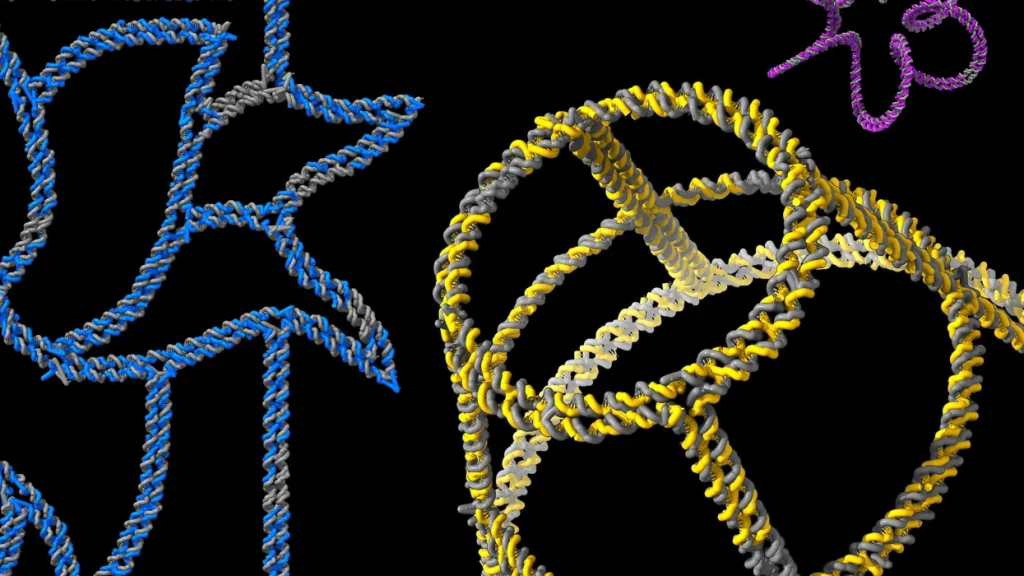
Scientists are giving one of nanotechnology’s most unusual building materials a powerful new design tool: artificial intelligence.
DNA is best known as the molecule that stores genetic information. But researchers have spent decades demonstrating that DNA can also be used as a programmable construction material. Through a technique known as DNA origami, long DNA strands can be folded with shorter strands into precisely engineered structures at the nanoscale.
Now, generative AI is expanding what researchers can design.
A 2026 study published in Nature Communications introduced a diffusion-based generative framework called Generative SNUPI, which can create DNA origami structures from user-defined target geometries. The researchers generated more than 100 designs and experimentally validated selected structures, including reconfigurable architectures and modular assemblies.
The development represents a shift from designing DNA nanostructures primarily through predefined rules toward using generative models, physical simulation, and automated DNA routing to explore much larger design spaces.
That could eventually make it easier to create molecular machines, programmable materials, nanoscale devices, and biomedical structures that would be difficult or time-consuming to design manually.
Table of Contents
- What Is DNA Origami?
- How Scientists Use DNA as a Building Material
- How AI Is Changing DNA Origami Design
- What Is Generative SNUPI?
- How the AI DNA Design Process Works
- What Scientists Successfully Created
- Why De Novo DNA Design Matters
- AI, Simulation, and Physical Validation
- Potential Applications of AI-Designed DNA
- Current Limitations and Challenges
- The Future of Generative DNA Nanotechnology
- Frequently Asked Questions
- Conclusion
What Is DNA Origami?
DNA origami is a nanotechnology technique that uses DNA strands as construction materials.
The basic idea is surprisingly intuitive.
A long DNA strand, often called a scaffold, is folded into a desired shape using many shorter DNA strands known as staples. The complementary base-pairing properties of DNA allow these strands to bind together in predictable ways.
By designing the sequences and connections carefully, researchers can create structures with dimensions measured in nanometers.
DNA as a Programmable Material
DNA is particularly useful for nanotechnology because its molecular interactions are highly predictable.
The four DNA bases—adenine, thymine, cytosine, and guanine—form specific base pairs.
That predictable chemistry gives researchers a programmable molecular system.
Instead of manufacturing a structure from conventional materials such as silicon or metal, scientists can encode instructions into DNA sequences that cause molecules to assemble into a predetermined architecture.
DNA origami has already been used to create:
- 2D patterns
- 3D cages
- Nanomachines
- Molecular containers
- Reconfigurable structures
- Drug-delivery platforms
- Nanoscale sensors
The challenge has been designing increasingly complicated structures efficiently.
How AI Is Changing DNA Origami Design
Traditional DNA-origami design can involve substantial human expertise.
Researchers must consider geometry, DNA routing, structural stability, mechanical properties, strand interactions, and whether the final design can actually fold as intended.
As structures become more complex, manually navigating all of those constraints becomes increasingly difficult.
Generative AI offers another approach.
Instead of telling a computer exactly how every component should be arranged, researchers can provide a target geometry and allow a generative model to explore possible molecular structures that satisfy that target.
This is similar in concept to generative AI systems that produce images from descriptions.
But there is an important difference.
A DNA structure cannot simply look correct.
It also needs to obey physical and molecular constraints.
That is why the researchers combined generative modeling with simulation and DNA-routing algorithms.
What Is Generative SNUPI?
Generative SNUPI is a diffusion-based framework designed to generate complex DNA-origami structures.
The research team used a multiscale computational model called SNUPI to generate simulated equilibrium configurations that could serve as training data.
This helped address one of the major challenges facing AI-based DNA design: there are not enough large, standardized experimental datasets of DNA-origami structures to train a generative model directly.
The researchers created a training set containing 450 wireframe DNA-origami structures, including two-dimensional and three-dimensional designs.
The generative model then learned structural patterns from those simulated configurations.
Why Simulation Matters
This is an important part of the research.
The AI was not simply trained on photographs of DNA structures.
Instead, the researchers used computationally simulated equilibrium structures to provide information about physically plausible DNA architectures.
That gives the model a stronger connection to the underlying mechanics of the material.
How the AI DNA Design Process Works
The system combines several computational steps.
Step 1: Define a Target Shape
Researchers begin with a target geometry.
The input can be a line-based representation created manually, with computer-aided design software, or with AI-assisted design tools.
Step 2: Generate a Molecular Structure
The diffusion model starts from a noisy representation and progressively generates a structured arrangement of DNA base pairs.
This is conceptually similar to how image-generation diffusion models transform noise into an organized image.
Step 3: Apply DNA Routing
The generated structure is converted into a design that includes a scaffold route and staple sequences.
This step translates the geometric concept into a nucleotide-level DNA construction plan.
Step 4: Predict Structural Properties
The framework evaluates the generated structure computationally.
Researchers can examine properties such as structural stability and stiffness before moving to laboratory experiments.
Step 5: Experimentally Validate the Design
Selected designs are synthesized and analyzed experimentally.
This final step is essential because computationally plausible structures are not automatically guaranteed to fold correctly in the laboratory.
The researchers experimentally validated selected designs and found that they could produce structures with the intended geometries and functions.
What Scientists Successfully Created
The researchers used Generative SNUPI to explore a broad range of DNA-origami architectures.
The generated designs included:
- Free-form shapes
- Artwork-inspired structures
- 3D wireframe architectures
- Curved and tilted structures
- Knot-like geometries
- Kirigami-inspired structures
- Reconfigurable architectures
- Modular assemblies
More than 100 candidate structures were generated, with selected examples experimentally tested.
Reconfigurable DNA Structures
One particularly interesting capability was the creation of structures that could change configuration.
The researchers demonstrated auxetic metastructures with open and closed states.
These structures were designed to undergo controlled mechanical transformations.
That matters because future DNA nanotechnology may require structures that do more than simply exist in one fixed shape.
They could potentially open, close, move, assemble, disassemble, or respond to environmental signals.
Modular DNA Nanostructures
The researchers also demonstrated modular assembly.
Instead of creating one large fixed structure, DNA components can be designed with compatible interfaces so that different pieces connect together.
The study demonstrated modular structures in which different components could be combined using shared geometric interfaces.
This concept could become important for building increasingly complex nanoscale systems from reusable components.
Why De Novo DNA Design Matters
The term de novo design means creating something new rather than simply modifying an existing structure.
This is significant because conventional DNA-origami design methods can be constrained by predefined structural motifs and established design rules.
Generative models can explore combinations that human designers may not immediately consider.
The goal is not to replace scientists.
Instead, generative design can expand the number of possibilities scientists can investigate.
From Rule-Based Design to Generative Design
The transition can be summarized like this:
| Traditional DNA Design | Generative DNA Design |
|---|---|
| Relies heavily on predefined motifs | Explores broader structural spaces |
| Manual design can be time-consuming | Generates candidates computationally |
| Human specifies many structural details | Human can specify target geometry |
| Limited by established design patterns | Can explore noncanonical architectures |
| Testing may require many design iterations | Computational screening can happen earlier |
This does not mean AI eliminates the need for expert knowledge.
The research demonstrates that physical modeling, routing algorithms, structural prediction, and laboratory validation remain important.
AI, Simulation, and Physical Validation
One of the most important lessons from the research is that generative AI alone is not enough.
DNA nanotechnology is governed by physics and chemistry.
A visually attractive computer-generated structure may fail to fold correctly, become unstable, or behave differently from what a computational model predicts.
The Generative SNUPI approach therefore combines:
- Generative diffusion modeling
- Molecular simulation
- Structural prediction
- DNA strand routing
- Computational evaluation
- Experimental validation
This combination creates a more practical design-build-test workflow.
Instead of moving directly from an idea to laboratory synthesis, researchers can use computation to explore and filter designs before investing in physical experiments.
Potential Applications of AI-Designed DNA
The technology is still at the research stage, but the broader field of DNA nanotechnology has potential applications across several areas.
Molecular Robotics
DNA structures can act as components of nanoscale machines.
Generative design could help researchers explore more complicated mechanical architectures.
Drug Delivery
DNA origami structures have been investigated as nanoscale carriers capable of organizing or presenting molecules in controlled configurations.
Future designs could potentially improve targeting and molecular organization.
Biosensors
DNA nanostructures could serve as programmable platforms for detecting biological signals.
Smart Materials
Reconfigurable DNA architectures could contribute to nanoscale materials that change their physical configuration in response to specific conditions.
Molecular Computing
DNA can also be used to encode and process information through molecular interactions.
Recent work has demonstrated increasingly sophisticated DNA-based computing systems, illustrating how programmable DNA can function as more than a passive structural material.
Current Limitations and Challenges
Despite the excitement surrounding AI-generated DNA structures, several challenges remain.
Limited Training Data
DNA-origami datasets are much smaller and less standardized than datasets available in fields such as computer vision.
The 2026 research addressed this partly by generating simulated equilibrium configurations for training.
Experimental Validation
A computational design still needs to be synthesized and tested.
Laboratory validation can be slower and more expensive than generating digital candidates.
Structural Stability
DNA structures must remain stable under the conditions in which they are intended to operate.
This becomes especially important for biomedical applications.
Manufacturing
Creating a design is one challenge.
Producing large quantities of the structure consistently and economically is another.
Biological Compatibility
Potential medical applications introduce additional requirements involving stability, toxicity, immune response, delivery, and biological behavior.
AI-generated geometry does not automatically solve those problems.
The Future of Generative DNA Nanotechnology
The most important development may not be a single DNA structure.
It may be the emergence of a new design methodology.
Generative AI can allow researchers to describe what they want a nanoscale structure to accomplish and then computationally explore possible architectures.
Over time, this could turn DNA nanotechnology into a more automated engineering discipline.
Researchers could potentially move through a workflow such as:
Target function → Geometry → AI generation → Physical simulation → DNA routing → Experimental fabrication → Testing → Optimization
That feedback loop could significantly accelerate research.
The approach may also become more sophisticated as models learn to optimize several properties simultaneously.
Instead of asking an AI system to create a particular shape, researchers could eventually specify requirements such as:
- Target dimensions
- Mechanical stiffness
- Flexibility
- Stability
- Assembly behavior
- Reconfiguration
- Molecular binding
- Environmental response
The system could then search for structures satisfying multiple constraints.
Frequently Asked Questions
What is DNA origami?
DNA origami is a nanotechnology technique that uses DNA strands as programmable building materials. A long scaffold strand is folded into a desired shape using many shorter staple strands.
How is AI being used in DNA origami?
AI can generate candidate DNA-origami structures from target geometries. In the 2026 Generative SNUPI study, a diffusion model generated physically plausible structures that were then routed into nucleotide-level designs and evaluated computationally.
What is Generative SNUPI?
Generative SNUPI is a diffusion-based framework for de novo DNA-origami design. It combines generative modeling, structural simulation, DNA routing, and computational evaluation.
Can AI create DNA structures from scratch?
AI can generate new candidate DNA-origami architectures from user-defined target geometries. However, the resulting structures still require computational evaluation and, for practical use, experimental validation.
How small are DNA origami structures?
DNA-origami structures typically operate at the nanoscale, with many designs measuring tens to hundreds of nanometers.
Why is AI useful for DNA nanotechnology?
AI can explore a much larger design space than researchers could reasonably investigate manually. Generative models can rapidly produce candidate structures that can then be screened computationally and experimentally.
Could AI-designed DNA be used in medicine?
Potential applications include drug delivery, biosensing, molecular robotics, and other biomedical technologies. However, many of these applications remain under research and require extensive testing for stability, safety, manufacturing, and biological compatibility.
Conclusion
DNA origami has already demonstrated that one of biology’s most familiar molecules can become a sophisticated nanoscale construction material.
Generative AI is now expanding what researchers can do with it.
The 2026 Generative SNUPI research shows that diffusion-based generative modeling can produce diverse DNA-origami architectures from target geometries, translate them into nucleotide-level designs, and help researchers explore structures that would be difficult to create using conventional rule-based approaches. Selected designs were also experimentally validated.
The significance extends beyond making unusual shapes.
AI-assisted DNA design could eventually help researchers create programmable molecular machines, reconfigurable nanomaterials, biosensors, drug-delivery systems, and other nanoscale technologies.
There is still a substantial gap between generating a promising structure on a computer and deploying a reliable nanoscale device in the real world.
But the direction is clear.
DNA is no longer being treated solely as biological information storage. Increasingly, it is being engineered as a programmable material—and generative AI is giving scientists a new way to explore what that material can become.
