
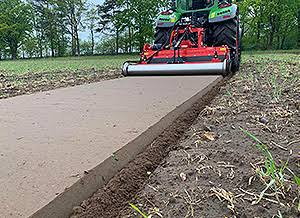
The stones are still there, just lower down
Spring is when many Australian properties get rough, stony ground ready for a new lawn or a small paddock sowing, while the soil still holds moisture from winter rain. Picking rocks by hand is slow, and a standard cultivator tends to leave them sitting on top. A stone burier takes a different approach: it does not remove the stones at all. It sorts the soil as it works, so the stones end up underneath and a fine layer ends up on the surface. That one point explains both the smooth finish and where the limits lie.
A sieve that works upside down
Think of sifting flour. Lumps stay in the sieve and fine powder falls through. A stone burier does something similar, except it drops the lumps first and the fine material second. Its rotor spins in the opposite direction to the wheels of a moving tractor. Instead of pushing soil forward and down, the blades cut upward and throw soil backward into the hood. Behind the rotor sits a grid of evenly spaced bars. Stones, clods and old roots are too large to pass between those bars, so they hit the grid and fall straight down into the trench the rotor has just opened. Fine soil passes through the gaps and lands on top of them a moment later.
The result is layered ground: coarse material at the bottom of the worked depth, crumbly soil at the surface. Nothing has been taken away, only rearranged, which is why the ground can look stone-free straight after a single pass.
How is this different from a rotary tiller?
A conventional rotary tiller spins its tines in the same direction as the wheels. It chops and mixes the soil thoroughly, which is useful for blending in compost or breaking up turf, but it has no grid and no sorting action. Stones get stirred through the soil and plenty finish on or near the surface, where they catch mower blades and make seeding uneven.
The reverse rotation also changes how the machine behaves behind a tractor. Because the blades cut upward rather than bite forward, there is no tendency for the implement to push the tractor along. The trade-off is that throwing soil up against a grid takes more power than simply chopping it, so a burier generally needs a stronger tractor than a tiller of similar width.
Where a power harrow fits in
A power harrow uses tines that spin on vertical shafts, stirring the soil sideways without turning it over. That makes it good at breaking clods and levelling ground that is already reasonably clean, and it leaves soil structure less disturbed than a rotor does.
On stony ground, though, a harrow largely leaves stones where they are. Where rocks are the main problem, burying them in a single pass usually suits the job better. Where the soil is already clean and only needs refining, a harrow may be all that is required.
The trade-off: buried is not gone
Because stones are placed below the fine layer rather than removed, a few things follow. First, the worked layer is shallow. This 1350 mm model has a tilling depth of up to 120 mm, so stones are buried within that band. Rocks too large to fit through the rotor, or boulders fixed in the subsoil, cannot be handled this way and need to be removed first.
Deeper work later can undo the result. Digging garden beds, trenching for irrigation or ploughing below the buried layer will bring stones back up. Ground that is headed for a lawn or pasture that will not be disturbed again suits burying well. Ground earmarked for vegetable beds or repeated deep cultivation may be better served by removing stones.
Fine soil on top can crust. A very fine surface is ideal for small seed, but heavy rain on bare, fine soil can seal it. Sowing soon after working and keeping the surface covered where possible reduces that risk.
Soil moisture decides the finish
The sorting action of a stone burier relies on soil breaking apart cleanly. When ground is too wet, soil smears, sticks to the blades and packs between the grid bars, so stones and fine soil come out together. When it is bone dry, clods resist breaking and the tractor works harder for a dustier result.
The right time is usually when a handful of soil crumbles after being squeezed. In much of southern Australia, the weeks after winter rain in early spring often provide exactly that, before the ground bakes hard in summer.
One pass instead of several
Most burier designs also run a heavy roller behind the grid. It firms and levels the fresh surface so seed or turf can go down soon after. For many small jobs that replaces a string of separate passes:
- Picking up surface rocks by hand
- Breaking clods with a separate harrow
- Levelling with a drag or rake
- Rolling before sowing
That saving matters most on hobby farms and house blocks, where a single tractor does every job, time on the seat is limited, and seed or turf needs to go down while spring moisture lasts.
Matching the implement to the tractor
A tractor stone burier is judged first by whether the tractor can drive it comfortably. This model is rated for tractors from 28 to 40 HP on a Category I three-point hitch. Working at the lower end of that range generally calls for slower ground speed, especially in heavy or stony soil.
Width matters as well. At 1350 mm, the machine should cover the tractor’s wheel tracks where possible, so tyre marks from the previous pass are worked out rather than left as ridges. PTO speed, shear bolts or slip clutch settings and gearbox oil levels should follow the operator’s manual. When comparing any stone burier for sale, those same checks apply: hitch category, horsepower range, working width relative to the tractor, and whether the grid and roller suit the soil being worked.
Keeping people clear
The rotor throws soil and small stones with real force inside the hood, and damaged guards can let debris escape. Bystanders, children and pets belong well away from the working area. A blocked grid should only ever be cleared with the PTO disengaged, the engine off and the key removed, since stones wedged between the bars can release suddenly.
Choosing the right ground for it
Burying stones makes the most sense where the surface needs to be smooth and will stay undisturbed for years. For a small tractor in the 28 to 40 HP class, the 1350 mm model from TMG Industrial gives a 120 mm working depth on a Category I hitch, suited to lawns, horse arenas and small paddocks rather than ground that will be dug deeply again.
