
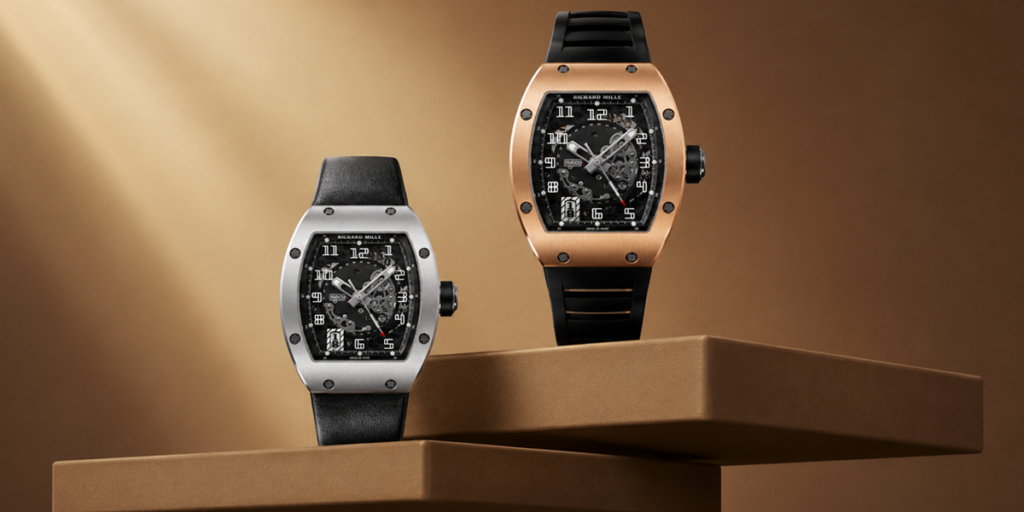
No brand in watchmaking attracts more confident opinions from people who have never handled one. The case looks like a component from something else, the movement is visible through most of the dial, and the price is unlike anything else on the wrist. From a photograph it is easy to conclude the whole thing is theatre.
It is not, and understanding why requires setting aside the marketing language on both sides and looking at what the manufacturing actually involves. The engineering decisions are unusual, expensive, and mostly invisible in an image, which is precisely why the brand is so poorly understood by people evaluating it from a distance.
The Founding Premise
The brand was established in 1999 and introduced its first watch, a tourbillon, at Basel in 2001. The premise was that a wristwatch could be engineered the way a racing car or an aerospace component is engineered, with material selection driven by performance requirements rather than by tradition.
That inverted the usual order. Traditional fine watchmaking begins with materials the craft has used for a century and applies extraordinary finishing to them. This approach begins with a performance question, such as how to make a movement survive forces that would destroy a conventional one, and then selects or develops whatever material answers it.
Whether that is a better philosophy is a matter of taste. That it is a genuinely different one is not.
Carbon TPT and Why It Looks Like That
The distinctive striped material on many cases is a composite built from extremely thin layers of carbon filament, laid down with each layer rotated relative to the one beneath it before being cured under heat and pressure.
The rotation is the functional point. Composites are strongest along the direction of their fibres, so alternating the orientation of each layer distributes strength across all directions rather than concentrating it along one. The result resists impact and flexing in a way a single-orientation layup does not.
The visual signature is a side effect. Because the block is built from layers and the case is then machined out of it, the cutting path intersects those layers at varying angles and exposes them as the flowing striped pattern on the finished surface. No two cases are identical, because no two cuts pass through the layers in exactly the same way.
A related material substitutes silica-based filaments for carbon, which allows colour to be introduced into the layers. That is where the coloured striped cases come from.
Titanium, and Why the Grade Matters
Movement baseplates and bridges in most of the catalogue are grade 5 titanium, an alloy rather than pure titanium, chosen for a combination of properties that brass, the traditional baseplate material, does not offer.
It is substantially lighter, which matters when the design goal is a watch that is barely noticeable on the wrist. It is more rigid, which allows a baseplate to be skeletonized aggressively while still holding the gear train in alignment under load. It is corrosion resistant and biocompatible. And it is considerably harder to machine than brass, which is a direct cost.
That last point deserves emphasis, because it recurs throughout the catalogue. Nearly every material choice here trades manufacturing difficulty for performance, and manufacturing difficulty is expensive in a way that shows up in the final figure.
Sapphire Cases Are an Absurd Undertaking
Some references use cases machined from sapphire, and these represent the extreme end of what the approach produces.
Sapphire in this context is a synthetically grown crystal, extremely hard, extremely scratch resistant, and extremely difficult to shape. It cannot be cut conventionally; it has to be ground away with diamond tooling, slowly, with the constant risk that a piece cracks late in the process and the accumulated work is lost.
The machining time for a full set of case components runs to an extraordinary number of hours, and the yield is poor. Production runs on these references are correspondingly tiny, sometimes single figures.
The result is a watch whose movement appears to float without visible support. Whether that justifies the cost is a personal judgement, but the cost is not arbitrary.
The Movement as Structure
The more interesting engineering is not in the materials themselves but in how the movement is mounted.
In a conventional watch the movement sits inside the case, held by a ring, and the case takes the impact. Here the baseplate is frequently designed as a structural element, sometimes mounted on shock-absorbing components and connected to the case in a way that isolates it from forces transmitted through the exterior.
This is what makes the athlete collaborations more than a marketing exercise. A watch worn during professional tennis experiences repeated acceleration and deceleration that would damage a conventional movement quickly, and the references developed for that use are engineered around the problem. The brand publishes shock resistance figures for certain references that are far beyond ordinary watchmaking specifications.
Assembly reflects this too. Fasteners are specified and torqued to defined values rather than tightened by feel, and components are traceable. That is an aerospace approach to assembly applied to an object worn on a wrist.
Skeletonization Is Structural, Not Decorative
Open-worked movements are not new, and traditionally they are a decorative exercise where material is removed from an existing design and the remaining surfaces are hand finished.
Here the logic runs the other way. The baseplate is designed from the outset with material only where it is structurally necessary, which produces the skeletal appearance as an outcome of the engineering rather than as a treatment applied afterward. Removing material reduces weight, which is one of the design goals, and the shapes that remain are determined by where load actually travels.
This is also why these movements photograph the way they do. There is no dial concealing the architecture, because the architecture is the design.
Scarcity Is Real Rather Than Manufactured
Production is reported to run to a few thousand watches a year across the entire catalogue, which is a small figure for a brand with global recognition. Individual references, particularly collaborations and material experiments, are made in far smaller numbers.
That constraint is not primarily a marketing decision. The manufacturing processes involved, particularly on the exotic case materials, do not scale easily, and yields on the most difficult pieces are low.
The consequence for a buyer is straightforward. Retail allocation for most references is effectively closed, and the secondary market is where availability exists. Pricing there reflects actual scarcity rather than a retail figure that few buyers can transact at. Richard mille luxury watches are stocked by Wrist Aficionado across references including the RM 11, RM 35, RM 67-02, RM 72-01, and athlete collaborations, each authenticated, with pieces viewable at boutiques in New York, Miami Beach, and Beverly Hills or shipped worldwide. Wherever a buyer sources from, the material specification and reference variant should be confirmed precisely, since visually similar pieces can differ substantially in construction and value.
The Honest Criticisms
A fair assessment includes the objections, because they are not unreasonable.
- The designs are conspicuous by intent, and for buyers who want a watch nobody notices, this is the wrong brand entirely.
- The aesthetic is polarising, and a case shape and open architecture that some find compelling read as excessive to others.
- Service is restricted and involved, which is a genuine ownership consideration rather than a footnote.
- The brand lacks the long institutional history that some collectors weight heavily.
- Market pricing on the most requested references reflects demand as much as construction, and a buyer should be clear about which portion of the figure they are paying.
None of these are engineering criticisms, which is the point. The manufacturing is not in dispute. Whether it is what a given buyer wants is an entirely separate question.
Key Takeaways
- Material selection is driven by performance requirements rather than by watchmaking tradition, which inverts the usual order.
- Carbon TPT gets its strength from alternating layer orientation; the striped appearance is a by-product of machining through those layers.
- Grade 5 titanium baseplates allow aggressive skeletonization while staying rigid, at the cost of much harder machining.
- Sapphire cases require diamond grinding, enormous machining time, and produce low yields, hence tiny production runs.
- Movements are often mounted as structural elements isolated from case impact, which is what makes the athlete references function.
- Skeletonization here is a structural outcome rather than a decorative treatment.
- Scarcity follows from manufacturing constraints, not only from positioning.
Frequently Asked Questions
Are these watches actually durable, or is that marketing?
The durability claims relate to specific engineering: shock-isolated movement mounting, composite and titanium construction, and assembly to defined torque specifications. The brand publishes shock resistance figures for certain references that considerably exceed ordinary watch specifications. As with any watch, the sensible approach is to treat published figures as laboratory conditions rather than a guarantee against every real-world event.
Why does a carbon case cost more than a gold one?
Because the cost sits in process rather than in raw material value. Building a layered composite block, curing it, and then machining a complex case from it involves more steps and more difficult machining than working gold, which is comparatively straightforward to shape. The material is cheaper and the manufacturing is not.
Is the tonneau case comfortable to wear?
Generally yes, and it surprises people. The case is curved to follow the wrist, and the low weight of titanium and composite construction means the watch sits lighter than its visual size suggests. It is nonetheless a large watch, so trying one on remains the only reliable test.
What does skeletonized mean here?
It means the movement’s baseplate and bridges carry material only where structurally required, so the mechanism is visible through the front of the watch. Unlike traditional skeletonization, which removes material from an existing design for decorative effect, the openness here is a consequence of designing for minimum weight.
How is servicing handled?
Service is carried out through the brand’s own network rather than by independent watchmakers, given the specialised construction and materials. Turnaround is longer than for conventional watches and cost is significant, which is a real ownership consideration and worth understanding before purchase rather than after.
Do these hold their value?
Certain references have performed very strongly on the secondary market, driven by limited production and sustained demand, while others have been more variable. Reference, material, production volume, condition, and completeness all bear on the outcome. As with any watch, buying primarily on projected appreciation is a bet rather than a plan.
Conclusion
The brand is easy to dismiss from a photograph and difficult to dismiss from a workshop. The material science is genuine, the machining is unusually demanding, and the movement architecture solves problems conventional watchmaking has not needed to solve. What remains legitimately debatable is whether a buyer wants a watch built on those terms, and that is a question about taste rather than about engineering.
