
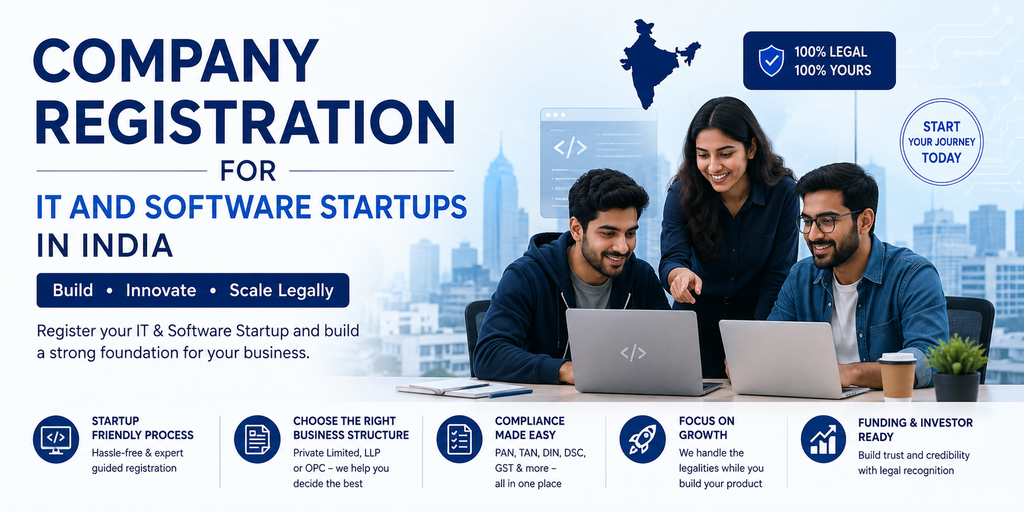
India’s IT and software startup ecosystem is one of the largest in the world, and founders are building everything from SaaS products to AI tools and freelance dev studios at record pace. But before writing the first line of production code or pitching your first investor, there’s a legal step that shapes everything downstream: company registration. The structure you choose determines how easily you can raise funding, issue ESOPs to early employees, protect your intellectual property, and bill international clients.
Most serious tech founders opt for private limited company registration because investors, accelerators, and enterprise clients typically require a formally registered entity, not a freelancer or unregistered team, before signing term sheets or contracts. Operating without proper registration can mean lost funding rounds, IP disputes, and personal liability for business obligations.
Why Is Company Registration Important for IT and Software Startups?
Company registration gives an IT or software startup legal identity, limited liability protection, and the credibility needed to raise funding, sign enterprise contracts, and protect intellectual property. Without formal registration, founders remain personally liable for business obligations and cannot access institutional funding, ESOP structures, or many B2B and export opportunities.
Key reasons tech founders formally register their startup:
- Investor readiness: VCs and angel investors require a registered company structure (typically Private Limited) before investing
- IP ownership clarity: Registering the company ensures code, products, and trademarks are owned by the entity, not individual founders
- ESOP issuance: Only a company can legally issue Employee Stock Option Plans to attract and retain tech talent
- Enterprise and export contracts: Corporate clients and overseas customers typically require a registered legal entity before signing service agreements
- Limited liability protection: Personal assets remain protected from business debts, contractual disputes, or IP litigation
Did You Know? Under Indian company law, a Private Limited Company can issue Employee Stock Option Plans (ESOPs) directly to employees, but a Limited Liability Partnership (LLP) legally cannot, a key reason most VC-backed tech startups choose the private limited structure.
Which Business Structure Is Best for IT and Software Startups?
While IT and software startups can be registered as sole proprietorships, partnerships, LLPs, or companies, Private Limited Company registration is generally preferred for startups planning to raise funding, issue ESOPs, or scale internationally, because it offers limited liability, structured equity ownership, and easier investor onboarding.
| Feature | LLP | Private Limited Company | One Person Company (OPC) |
| Legal liability | Limited | Limited | Limited |
| Can raise VC/angel funding | Difficult | Yes, easily | No |
| Can issue ESOPs | No | Yes | No |
| Ideal for | Small dev/consulting teams | Scalable, funded tech startups | Solo tech founders, early stage |
| Compliance burden | Moderate | Higher, but manageable | Moderate |
| Foreign investment (FDI) | Restricted in some sectors | Generally permitted under automatic route | Not permitted |
For founders planning to raise institutional funding, build a product company, or hire a growing engineering team, private limited company registration is almost always the recommended structure.
Step-by-Step Process for Company Registration for IT and Software Startups
- Obtain Digital Signature Certificate (DSC) for all proposed directors
- Apply for Director Identification Number (DIN) through the SPICe+ form
- Reserve a unique company name via the RUN or SPICe+ Part A service on the MCA portal, ideally aligned with your product/brand name
- Draft Memorandum of Association (MOA) and Articles of Association (AOA), clearly defining software development, IT services, or product objectives
- File SPICe+ Part B with incorporation details, registered office proof, and subscriber details
- Submit PAN and TAN application simultaneously through the SPICe+ form
- Receive Certificate of Incorporation (COI) from the Registrar of Companies (RoC)
- Open a current bank account in the company’s name using the COI, PAN, and board resolution
- Apply for GST registration, particularly important for startups billing clients across states or exporting services
Documents Required for IT/Software Company Registration
| Document | Purpose |
| PAN card of directors/shareholders | Identity proof |
| Aadhaar card / passport / voter ID | Address proof |
| Passport-size photographs | KYC requirement |
| Proof of registered office (rent agreement/utility bill/NOC) | Business address verification, can be a co-working space or home office |
| Digital Signature Certificate (DSC) | For filing incorporation forms |
| Director Identification Number (DIN) | Mandatory for all directors |
| MOA and AOA | Defines business objectives, should clearly cover software/IT services scope |
| Founders’ agreement (recommended, not mandatory) | Clarifies equity split and IP assignment among co-founders |
Additional Registrations IT and Software Startups Typically Need
Company registration lays the foundation, but most tech startups also need these registrations depending on their business model:
- GST Registration: Mandatory once turnover crosses the threshold, or immediately if billing clients across state lines or providing OIDAR services
- Import Export Code (IEC): Required for startups exporting software services or billing overseas clients directly
- Startup India Recognition (DPIIT): Enables tax exemptions, easier compliance, and access to government startup schemes
- Trademark Registration: Recommended to protect the product/brand name, especially before public launch
- Copyright Registration: For proprietary source code, ensuring stronger legal protection in case of IP disputes
- Professional Tax Registration: Applicable in certain states based on employee headcount
- Shops and Establishment Registration: Required in most states for the registered business premises
Checklist: Is Your Tech Startup Fully Compliant?
- Company registered with MCA (COI obtained)
- PAN, TAN, and current bank account set up
- GST registration obtained (if applicable)
- DPIIT Startup India recognition applied for
- Trademark applied for product/brand name
- IP assignment clauses signed with all founders and employees
- IEC obtained (if exporting services)
Cost and Timeline for IT/Software Company Registration
| Particular | Approximate Timeline |
| DSC issuance | 1–2 working days |
| Name reservation (RUN/SPICe+ Part A) | 1–2 working days |
| SPICe+ Part B filing and approval | 5–7 working days |
| Certificate of Incorporation | Issued on approval |
| Total estimated timeline | 7–10 working days |
Common Mistakes IT and Software Founders Make
- Choosing an LLP structure early on, then struggling to raise VC funding or issue ESOPs later
- Not signing IP assignment agreements with co-founders and early employees, leading to ownership disputes over source code
- Registering the company without securing the matching trademark or domain name, risking brand conflicts later
- Delaying GST registration despite billing clients in multiple states or overseas
- Skipping DPIIT Startup India recognition and missing out on available tax benefits and compliance relaxations
- Drafting vague MOA objects that don’t clearly cover software development or IT services, causing complications later
Case Study: Two engineers building a SaaS analytics tool initially operated as an unregistered partnership while developing their MVP. When they approached angel investors for a seed round, the investors declined to proceed without a formally registered Private Limited Company and clear IP assignment from both founders. After completing private limited company registration, drafting a founders’ agreement, and registering their trademark, they closed their seed round within two months.
Conclusion
For IT and software founders, company registration is far more than a formality, it’s the legal backbone that determines whether you can raise funding, protect your intellectual property, issue ESOPs, and confidently sign enterprise or export contracts. Private limited company registration remains the structure of choice for most scalable tech startups in India, thanks to its investor-friendly framework and limited liability protection. Getting the structure, documentation, and IP ownership right from the outset saves founders significant legal and financial risk as the company grows. For accurate, end-to-end guidance tailored to your tech startup, it’s best to consult Zolvit’s legal experts.
Why Choose Zolvit?
- Expert lawyers and Chartered Accountants guiding you through the right structure for your tech startup
- Company Secretaries managing MCA filings and post-incorporation compliance
- Fast, hassle-free processing for company registration, GST, and DPIIT recognition
- Affordable, transparent pricing with no hidden charges
- End-to-end compliance support, from incorporation to trademark, IP, and investor-ready documentation
- Dedicated support team to guide you through every stage of your startup journey
Ready to build your tech startup on a solid legal foundation? Get expert consultation and end-to-end company registration support from Zolvit today.
FAQs
1. Is a Private Limited Company the best structure for a software startup in India?
YES, for most startups planning to raise funding or scale. A Private Limited Company allows equity fundraising and ESOP issuance, which LLPs and sole proprietorships cannot offer, making it the preferred structure for tech founders.
2. Can an LLP raise venture capital funding like a private limited company?
Generally, NO. Most VCs and angel investors prefer investing in Private Limited Companies due to standardised equity structures and easier share transfer mechanisms, making LLPs less attractive for VC-backed software startups.
3. Is GST registration mandatory for software startups exporting services?
GST registration becomes mandatory once turnover crosses the applicable threshold, though many exporting startups register early to claim input tax credit and meet documentation requirements for zero-rated export supplies.
4. Do I need DPIIT Startup India recognition along with company registration?
DPIIT recognition is not mandatory but is highly recommended, as it offers tax exemptions, self-certification benefits, and easier access to government schemes for eligible IT and software startups.
5. Should co-founders sign an IP assignment agreement after company registration? YES. Co-founders and employees should sign IP assignment agreements ensuring all source code, products, and inventions are legally owned by the company, preventing ownership disputes during fundraising or exit.
