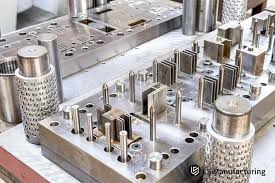
A stamping die is only as good as the engineering decisions made before a single line of steel is cut. Poor stamping die design is responsible for an estimated $2.3 billion in annual rework and downtime costs across North American metal stamping operations, according to the Precision Metalforming Association’s 2023 industry benchmarks. The difference between a die that runs reliably for 3 million strokes and one that fails at 80,000 comes down to a focused set of critical design decisions.
Factor 1: Material and Thickness Specification
Every stamping die design begins with the workpiece material. The die’s clearances, punch geometry, and steel selection all flow from this single input. Critical parameters:
• Tensile strength: HSLA steels (80,000–120,000 PSI) require 25–35% tighter punch-to-die clearances than mild steel (30,000–50,000 PSI)
• Material thickness variation: Always design for the maximum specified thickness, not the nominal — coil stock commonly varies ±10% from nominal
• Work hardening rate: Stainless steel work hardens rapidly; die geometry must account for springback angles 15–25% larger than mild steel equivalents
Factor 2: Punch-to-Die Clearance
Clearance is the single most influential variable in cut quality and tool life. Industry standard clearance is 6–12% of material thickness per side for general blanking. Specifics:
• Soft materials (copper, aluminum): 5–8% per side
• Mild steel: 8–12% per side
• High-strength steel: 10–15% per side
• Stainless steel: 12–18% per side
Too little clearance increases cutting force and accelerates punch wear. Too much clearance creates excessive burr and rollover, requiring secondary deburring at additional cost.
Factor 3: Strip Layout and Material Utilization
Material is typically 50–70% of total part cost in metal stamping. Strip layout optimization directly controls profitability.
| Layout Type | Typical Material Utilization | Best Application |
| Single-pass straight | 65–75% | Simple rectangular blanks |
| Angled layout (15°–45°) | 72–84% | Circular or oval blanks |
| Two-out progressive | 78–88% | Small, high-volume parts |
| Interlocking/nested | 82–92% | Complex contour blanks |
| Scrap bridge minimized | 85–93% | High-value materials (titanium, Inconel) |
A strip layout revision from single-pass to nested geometry on a stainless steel medical bracket reduced material cost by $0.018 per part — translating to $18,000 annual savings at 1 million parts/year.
Factor 4: Die Block Strength and Steel Selection
The die block must withstand peak cutting forces without deflection or cracking. Key custom tool and die design rules:
• Minimum die block thickness = 3× material thickness for cutting dies
• Carbide inserts extend die life 5–10× over tool steel for abrasive materials
• D2 tool steel handles general stamping well; H13 is preferred for heat-generated forming operations
• Die blocks should be heat treated to 58–62 HRC for standard applications
Factor 5: Stripper Design and Pressure
The stripper plate controls material flow and prevents the workpiece from lifting with the punch on the return stroke. Undersized stripper springs cause sheet distortion and pilot misregistration:
• Stripper force should equal 10–20% of cutting force for light materials
• For high-strength materials, increase to 25–35% of cutting force
• Spring-loaded strippers outperform fixed strippers in progressive dies — they provide pre-pressure that holds material flat during the cutting stroke, reducing burr height by 30–50%
Factor 6: Piloting and Registration
In progressive dies, pilots register the strip at every station. Pilot diameter should be 0.0005″–0.001″ smaller than the pilot hole for light-gauge materials, tightening to 0.0002″–0.0005″ for precision parts.
Pilot timing is equally critical: pilots must fully engage the strip before any cutting or forming station activates. Early activation by even 0.010″ can shear the pilot hole, destroying strip registration and producing scrap at 400+ parts per minute.
Factor 7: Die Life Planning and Maintenance Intervals
| Die Component | Expected Life (Strokes) | Maintenance Trigger |
| Carbide punches (mild steel) | 2M–8M | 0.003″ wear land on cutting edge |
| D2 tool steel punches | 500K–2M | 0.005″ wear land |
| Die blocks (carbide) | 5M–15M+ | Burr height exceeds 10% of material thickness |
| Guide pins and bushings | 1M–3M | 0.001″ play detected |
| Spring packs | 500K–1M | Pre-load drops below 80% of specification |
Planning die maintenance intervals into the production schedule — rather than reacting to failures — reduces unplanned downtime by 65–75% and extends overall die life by up to 40%, according to tool room data from a Tier 1 automotive stamping supplier.
Integrating All 7 Factors: The Design Review Protocol
Successful metal stamping die construction relies on a structured design review before steel is cut:
• Confirm workpiece material certification and thickness tolerance band
• Run strip layout simulation to validate material utilization target
• Calculate cutting forces and verify press tonnage with 20–30% safety margin
• Specify steel grades and heat treatment for every active component
• Define pilot timing sequence in die design drawings
• Document maintenance intervals and wear limits in the tooling specification package
• Establish first-article inspection criteria tied to tolerance stack in the die design
Following this protocol, SS Precision’s die engineering team consistently delivers tools that meet or exceed specified stroke life targets — ensuring customers’ metal stamping tooling cost remains predictable across high-volume production runs.
SSPrecision Is a Trusted Partner for Die Manufacturing Cost Optimization
SSP Precision is an ISO 9001 & IATF 16949 certified manufacturer delivering end-to-end precision solutions, from design and prototyping to high‑volume production, for the automotive, medical, electronics, aerospace, and industrial sectors. We handle every stage in‑house – DFM engineering, rapid prototyping, CNC machining, EDM, grinding, and global logistics – to manufacture the tooling that makes your parts and the parts themselves.
What we build and supply: visit our sites: https://ssprecision.com.cn/
- Stamping dies manufacturing and stamping die parts – high‑precision transfer stamping dies and progressive/compound dies for volume metal stamping.
- Injection molding and injection mold – custom injection molds for plastic components, including single‑, multi‑cavity, and over‑molding & insert‑molding tools that combine metal and plastic in one part.
- Specialty molded components – eco‑friendly green mold parts and microscopic medical micro‑molded parts.
- Precision metal and plastic end‑use parts – high‑volume serial production of precision products (metal stampings, plastic moldings) with full PPAP traceability.
Tooling spare parts manufacturing & – tooling spare parts (punches, inserts, ejector pins) and precision robotics spare parts to keep your production running.