
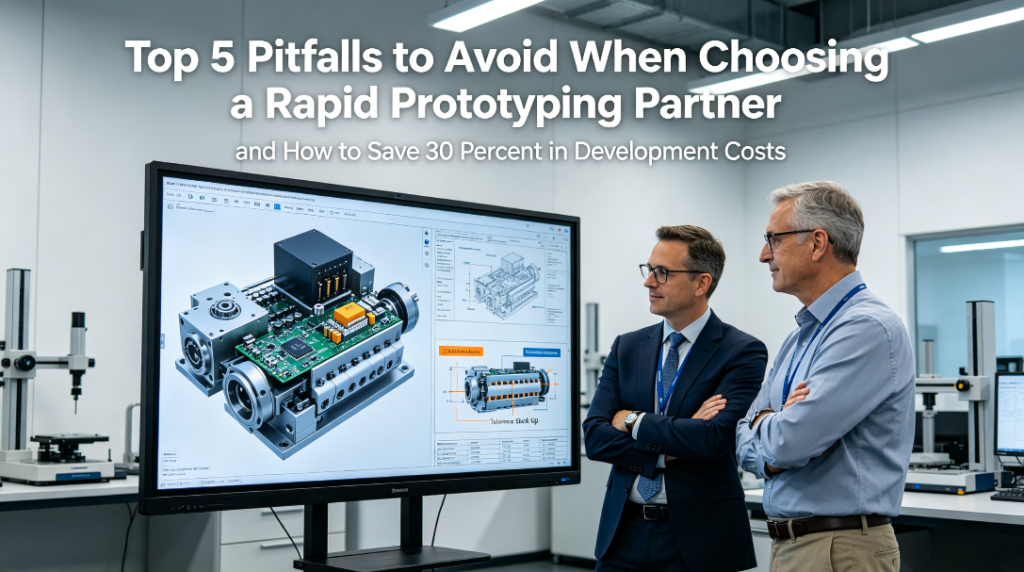
In the race to market, rapid prototyping is the critical bridge between concept and reality. Yet, for many teams, a partner chosen for speed and low cost becomes the source of major setbacks: prototypes that fail validation, materials that don’t perform, and a catastrophic breakdown during the transition to mass production. These issues lead to blown budgets and missed deadlines, eroding the very advantage prototyping is meant to provide.
The root cause is a selection process focused on superficial metrics. Choosing based on quoted price and lead time alone ignores the foundational pillars of a successful partnership: process stability, materials expertise, and actionable Design for Manufacturability (DFM) feedback. This article provides a framework to look beyond simple comparisons, helping you identify partners with the engineering depth to ensure first-pass success and a seamless path to production, potentially saving 30% or more in total development costs.
Is Low Price Really the Biggest Cost Saver for Complex Prototypes?
The allure of a low upfront quote is powerful, but for complex prototypes, it is often a dangerous illusion. The true cost of a prototype is not its purchase price, but its total impact on the product development lifecycle. A superficially cheap prototype that fails to reveal a design flaw, uses non-representative materials, or is built with an unscalable process can incur massive hidden costs in late-stage tooling changes, production delays, or warranty failures. The most significant savings are found not in the unit cost, but in risk mitigation and right-first-time execution.
1. The High Stakes of “Cheap” in Critical Applications
For prototypes in regulated or high-performance sectors like aerospace or medical devices, a failure can be catastrophic. A part that passes a fit check but lacks the proper material certification or traceability can invalidate months of testing, forcing a complete restart. The cost of requalification, lost time, and potential compliance issues dwarfs any initial savings from a discount vendor. Investing in a partner who understands and implements industry-specific quality protocols from the first prototype is a non-negotiable cost-avoidance strategy.
DFM Analysis: The Ultimate Cost-Saving Tool
A deep, engineer-to-engineer DFM analysis is where real value is created. A partner that invests time in reviewing your design for manufacturability, assembly, and function can identify issues that would cost 10x or 100x more to fix in production. This proactive collaboration transforms the prototype from a simple physical model into a validation milestone for the entire production process. The minor additional cost of this service is insurance against the exorbitant expense of late-stage design changes.
3. Quantifying the Total Cost of Ownership (TCO)
A sophisticated evaluation shifts focus from piece-part price to Total Cost of Ownership. This includes the cost of delays, re-spins, quality escapes, and production ramp-up struggles. A partner whose process ensures a seamless prototype to production transition delivers vastly lower TCO, even with a higher initial quote. When selecting a partner, the ability to provide actionable, production-oriented custom rapid prototyping services is a direct indicator of their impact on your project’s overall financial and timeline health.
How Can You Verify a Supplier’s Claim of “High Precision” Beyond Machine Specifications?
A website filled with images of advanced machinery is not a guarantee of precision. True capability is demonstrated not by the tools owned, but by the systemic controls that govern their use. To verify claims of high precision, you must audit the quality management system and demand objective evidence of consistent output. This means looking beyond the machine brochure and into the supplier’s documentation, measurement data, and operational discipline.
1. The Evidence: First Article Inspection and Statistical Proof
Any credible supplier should provide a comprehensive First Article Inspection (FAI) Report for initial samples. This report should show actual measured values against every dimension on the drawing, not just a pass/fail stamp. For ongoing production, Statistical Process Control (SPC) charts for critical dimensions are the gold standard. These charts prove the process is capable and in control, demonstrating that precision is a repeatable outcome, not a one-off achievement. This level of documentation is standard for aerospace prototype and medical device prototyping work.
2. The System: Certifications and a Culture of Quality
While equipment is important, the system that manages it is paramount. Certifications like ISO 9001:2015 and AS9100D are not just plaques on the wall; they represent an audited, systemic commitment to process control, corrective action, and continuous improvement. As emphasized by organizations like the Society of Manufacturing Engineers (SME), manufacturing excellence is built on robust systems and skilled people. A supplier operating within such a framework has the procedures to ensure that every operator, on every shift, produces parts to the same exacting standard.
3. The Technology: Measurement Over Machinery
Precision is meaningless if it cannot be verified. A partner’s investment in metrology equipment like Coordinate Measuring Machines (CMMs) and optical scanners is as important as their CNC machines. The ability to generate a 3D color deviation map comparing the scanned part to the original CAD model provides undeniable, objective proof of conformity. This data-driven approach eliminates subjectivity and provides a clear, shared fact base for engineering discussions, ensuring that “high precision” is a verified result, not a marketing claim.
Why Does Material Choice and Traceability Matter More Than You Think?
For prototypes, the material is not just a shape-holder; it is a functional requirement. Using an incorrect or substandard alloy can lead to misleading test results, causing teams to pursue flawed designs or, worse, approve a non-conforming product. The stakes are highest with high-performance alloys like titanium, PEEK, or Invar, where subtle variations in composition or heat treatment can drastically alter mechanical properties. Material traceability — the unbroken chain from mill to finished part — is the only guarantee of authenticity and performance.
- The Risk of Unverified Materials: Sourcing materials from non-authorized distributors or using “equivalents” without proper testing is a common pitfall. A prototype may look correct but fail under stress or in a specific environment due to material inconsistencies. For functional prototypes, especially in low-volume production runs that serve as bridge tooling, this can be disastrous. A professional partner sources directly from certified mills and can provide full Material Test Certificates (MTCs) that validate chemical composition and mechanical properties, ensuring your tests are valid.
- Traceability as a Foundational Requirement: In industries like medical and aerospace, full traceability is a regulatory and safety imperative. It allows for the investigation of any field issue back to the specific batch of raw material. Partners serving these sectors, often certified to IATF 16949 or AS9100D, have systems to maintain this chain of custody. This discipline, applied to prototyping, means every part can be linked to its source material, heat treat lot, and inspection records, building a bulletproof pedigree for your design validation.
- Specialized Knowledge for Specialized Applications: Material science is a specialization. A partner experienced in precision die casting prototyping understands the flow characteristics and shrinkage of aluminum or magnesium alloys. A partner machining PEEK for medical devices knows the specific speeds, feeds, and cooling required to prevent stress cracking or degradation. This application-specific knowledge is critical. It ensures the prototype is not just geometrically accurate, but also materially representative, providing confidence that test results will translate to the production intent component.
What Separates a Simple Prototype Vendor from a True Development Partner?
The market is split between automated platform vendors and engineering-led service providers. Platforms excel at speed and cost for standard geometries. However, for complex, mission-critical prototypes with challenging geometries, tight tolerances, or integrated functions, you need a true development partner. This partner provides not just a machining service, but collaborative engineering to solve problems, often suggesting creative alterations to the design or process that ensure both prototype success and future manufacturability.
1. From Order Taker to Problem Solver
A true partner engages in a technical dialogue before a purchase order is issued. They ask probing questions about the part’s function, load cases, and assembly. Their engineers provide constructive DFM feedback that goes beyond automated warnings, suggesting specific fillet radii, wall thickness adjustments, or alternative feature designs that enhance strength, simplify machining, or reduce cost. This early-stage collaboration is where the greatest risks are mitigated and value is created.
2. Creative Solutions for “Unmachinable” Designs
Platform vendors may reject overly complex designs. A development partner sees them as a challenge. They leverage advanced manufacturing techniques — such as multi-axis simultaneous machining, custom soft jaws for unique fixturing, or non-standard tooling — to produce what seems impossible. They think in terms of process innovation, not just following a standard workflow. This capability is essential for aerospace prototype components, medical instruments, and other highly engineered parts.
3. The Bridge to Production
The most significant differentiator is a long-term vision. A vendor delivers a part; a partner delivers a pathway to production. They design the prototype process as a pilot for the rapid prototype manufacturing services that will follow. They consider scalability, selecting processes and designing fixtures that can be adapted for higher volumes. This ensures that the knowledge gained and the process proven during prototyping is directly transferable, eliminating the notorious “production ramp-up valley of death” where designs fail when moved to a high-volume shop.
How to Ensure a Smooth Handoff from Prototype to Mass Production?
The prototype-to-production gap is where many projects falter. A beautiful, functional prototype proves a design, only for the production version to suffer from poor yield, high cost, or failed performance. The solution is the “production-intent prototype.” From the very first unit, the prototyping process should mirror the intended mass production process as closely as possible, using the same materials, manufacturing techniques, and quality benchmarks.
1. The Philosophy of Production-Intent Prototyping
This approach means moving beyond simply making a part that looks right. It involves using the same or similar tooling strategies, fixturing principles, and even the same machine platform if possible. For example, if the production part will be machined from a forging, the prototype should be machined from a forging blank, not a piece of bar stock. This validates the entire manufacturing workflow, not just the geometry, uncovering potential issues with material grain structure, residual stress, or accessibility for production-scale tooling.
2. Knowledge Transfer and Process Documentation
A smooth handoff requires the seamless transfer of tacit knowledge. The best partners document everything during the prototyping phase: the specific CNC program used, tooling offsets, inspection setups, and any quirks discovered. This information is packaged into a comprehensive process dossier that becomes the master guide for the production team. This eliminates the costly and time-consuming “re-learning” that typically occurs when switching suppliers or moving to an internal production line.
3. The Role of Integrated Quality Systems
A certified quality management system, such as ISO 9001:2015, provides the framework for this consistent handoff. It mandates control of documents, management of changes, and clear definition of processes. When a partner operates within such a system, the prototype to production transition is not an ad-hoc project but a managed phase of the product lifecycle. The procedures for First Article Inspection, process validation, and non-conformance management that were used for the prototype are the same ones that will govern production, ensuring continuity and reliability at every stage.
Conclusion
Selecting a rapid prototyping partner is one of the most consequential decisions in the product development cycle. It is a choice that extends far beyond unit cost and lead time, fundamentally impacting technical risk, schedule integrity, and total cost. By looking past the initial quote and rigorously evaluating a partner’s engineering collaboration, quality systems, material mastery, and production vision, you transform your prototype from a simple proof-of-concept into a powerful de-risking tool. The right partner acts as a true extension of your team, ensuring that the path from prototype to successful product is direct, predictable, and efficient.
FAQs
Q: What’s the most overlooked factor when startups choose a rapid prototyping service?
A: It’s the depth of DFM feedback. The best partners provide actionable, engineer-led analysis on manufacturability, assembly, and function, suggesting modifications that prevent costly late-stage changes. This early collaboration is a critical investment that de-risks the entire project and ensures a scalable design from the start.
Q: For a medical device prototype, what certifications should I prioritize in a supplier?
A: ISO 13485 is essential for medical device manufacturing, ensuring rigorous quality systems for design and production. ISO 9001 shows a foundational quality commitment. Prioritize suppliers with these and full material traceability, as this is mandatory for regulatory submissions and patient safety.
Q: How can I accurately compare quotes from different rapid prototyping companies?
A: Look beyond price. Compare the scope of services included (like full DFM and detailed inspection reports), the guaranteed specifications for tolerance and finish, and the engineering engagement evident in the proposal. A higher quote that includes risk-mitigating strategies often provides a lower total cost of ownership.
Q: We need both prototypes and eventual low-volume production. Should we use different suppliers?
A: Using a single, capable supplier for both is strongly advised. This ensures process continuity and a seamless knowledge transfer. The prototyping phase becomes a pilot run for production, eliminating re-qualification risk and guaranteeing that the performance you validate scales directly to your low-volume production batches.
Q: What’s the realistic lead time for a complex, tight-tolerance metal prototype?
A: For a complex 5-axis CNC metal part, expect 5-10 business days from a quality supplier. This includes engineering review, programming, machining, and thorough measurement. Special materials, very tight tolerances (<±0.025mm), or required post-processing will extend this. Beware of promises of 1-2 days, as they often compromise on critical engineering and inspection steps.
Author Bio
The insights in this article are drawn from precision manufacturing specialists with extensive experience in guiding complex projects from concept to volume production. The expert team at LS Manufacturing applies a rigorous, engineering-first approach — underpinned by certifications like IATF 16949 and AS9100D — to help innovators navigate the pitfalls of rapid prototyping. They focus on delivering production-intent prototypes that validate both design and manufacturability. For a detailed analysis of your next project, contact their engineering team for a comprehensive DFM review and quote.
